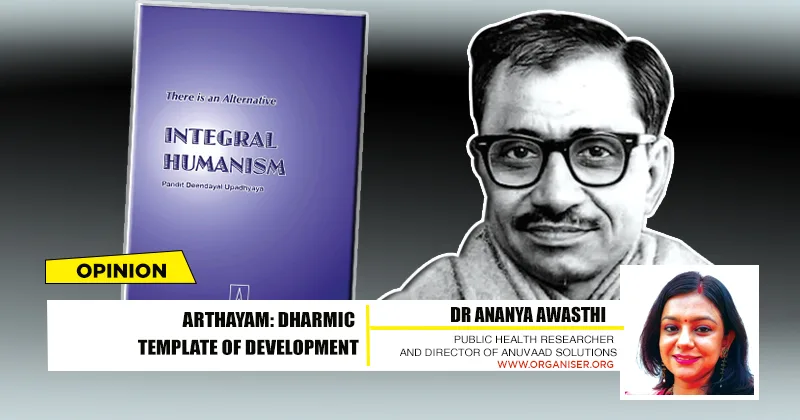
When first articulated Integral Humanism in 1965, he envisioned a uniquely Indian framework of development. Rejecting the binaries of Western thought—capitalism versus socialism, nationalism versus internationalism—he argued for a philosophy that placed the individual at the centre of policy while harmonising it with society, nature, and culture. Integral Humanism stressed that development must nurture the body, mind, intellect, and soul together, balancing material prosperity with social justice, moral responsibility, and ecological harmony.
Relevance of Deendayal’s Philosophy
In the past decade, this philosophy has found renewed relevance in India’s development journey. Flagship schemes across health, livelihoods, technology, rural development, ecology, and social empowerment illustrate how Integral Humanism can be a living template for inclusive, sustainable development.
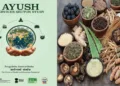
The first principle of Integral Humanism is that true progress cannot be limited to material well-being alone, but must nurture the human being in totality—integrating body, mind, intellect, and soul in harmonious growth. Yoga and promotion of Holistic Health has been central to this vision. In 2014, India proposed at the UN General Assembly that June 21 be observed as the International Day of Yoga (IDY)—a resolution passed with unprecedented global support. The Ministry of AYUSH has institutionalised this movement through the National AYUSH Mission, AYURSWASTHYA Yojana, and the Yoga Certification Board, while annual IDY themes—such as 2025’s “Yoga for One Earth, One Health”—have tied personal health with planetary well-being.
Beyond Yoga, the Government’s focus on preventive and promotive health resonates deeply with Integral Humanism’s holistic outlook. Under Ayushman Bharat, over 1.77 lakh Health and Wellness Centres (Ayushman Arogya Mandirs) have been established, offering screening, early detection, NCD management, and maternal-child health services. Recent initiatives like the Swasth Nari, Sashakt Parivar Abhiyaan (2025) integrate cancer, TB, and anaemia screening with nutrition and family health awareness—emphasising that individual well-being is inseparable from family and social health.
Organic Unity of Individual and Society
Integral Humanism highlights that personal behaviour must align with collective well being. Upadhyaya argued that while the individual must be empowered with dignity, freedom, and opportunity, this empowerment finds its highest purpose when exercised in service of the larger community. This philosophy finds a powerful expression in the Swachh Bharat Mission (SBM). The campaign did not stop at providing toilets or waste infrastructure; it sought to awaken a national consciousness of hygiene as a shared civic duty. When the Prime Minister picked up the broom at Rajghat in 2014, he transformed sanitation into a Jan Andolan, changing India’s “Chitti” or national temperament by showing that cleanliness was not just the Government’s task, but a citizen’s responsibility.
Individual at Centre of Developmental Paradigm
From a developmental perspective, Deendayal Upadhyaya emphasised that every model of progress must begin with the dignity of the individual, placing the citizen at the very heart of policy. Unlike Western frameworks that either glorify the individual in isolation, as in capitalism, or dissolve the individual within the collective, as in socialism, Integral Humanism calls for a balance where each person’s growth is valued within society. Progress, therefore, cannot be measured by aggregate output alone, but by how far it enables every individual—especially the weakest—to live with self-respect, exercise choice, and contribute meaningfully to the collective well-being.
This vision finds concrete expression in the JAM trinity (Jan Dhan–Aadhaar–Mobile) and Direct Benefit Transfers (DBT), which have transformed welfare delivery into a truly citizen-centric system. Over the past decade, more than 56 crore Jan Dhan accounts— 56 per cent held by women, with deposits of Rs 2.1 lakh crore—have brought millions into the formal financial system. Aadhaar provides each person a secure digital identity, while mobile connectivity ensures last-mile access.
Together, these instruments have enabled the transfer of over Rs 34 lakh crore directly into citizens’ accounts across 300+ schemes, ensuring transparency and efficiency.
Antyodaya: Uplifting the Last Person
The heart of Integral Humanism is Antyodaya—the principle that the true measure of national progress lies in how the poorest and most marginalised are uplifted. Deendayal Upadhyaya believed that society is an organic whole, and just as the body cannot be healthy if any limb is weak, a nation cannot prosper if even one section of its people is left behind. Antyodaya therefore demands that policies and programmes do not merely serve the already empowered, but consciously reach the “last man in the queue.” The Deen Dayal Antyodaya Yojana (DAY), launched in 2014, exemplifies this principle. Under DAY-NRLM, over 9.5 crore rural women have been mobilised into 87 lakh Self Help Groups, fostering financial independence, entrepreneurship, and leadership. Initiatives like Lakhpati Didi and Namo Didi are direct outcomes of this community mobilisation. The Pradhan Mantri Garib Kalyan Anna Yojana (PMGKAY) ensures food security for 81.35 crore people, providing 5 kg of free foodgrain per person each month. The Jal Jeevan Mission has expanded rural tap-water connections from 3.23 crore households in 2019 to 15.6 crore by July 2025—81 per cent coverage. The Ujjwala Yojana has provided over 10.33 crore LPG connections, reducing indoor pollution and improving women’s health.
Integral Humanism extends non-dualism to nature, recognising that humans, animals, and plants form one organic whole. A standout citizen-led initiative is Ek Ped Maa Ke Naam (Plant4Mother Campaign). By 2024, it had planted over 102 crore trees, with a target of 140 crore by March 2025. This campaign ties ecological responsibility to cultural values of reverence for the mother. Alongside this, the Government’s SDG
National Indicator Framework Progress Report 2025 maps schemes to global sustainable development goals, demonstrating accountability to both citizens and the planet.
India’s progress in welfare and inclusion has been significant, yet further strengthening is needed to fully realise the vision of Integral Humanism. The Make in India initiative must now deepen local value chains, worker skilling, and innovation ecosystems to build true self-reliance. In agriculture, the sector has made impressive gains, yet it remains over-reliant on a narrow band of crops, which can expose farmers to risks and constrain income growth.