
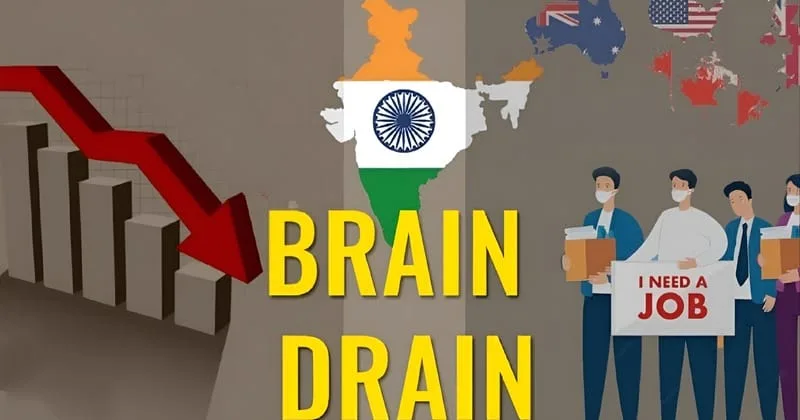
The vision for the future is called “Viksit Bharat” or “Developed India.” It serves to make India a prosperous, independent and globally competitive economy. Among the biggest hurdles to overcome is brain drain. Brain drain has become a major worry in India as talented individuals leave in search of better chances elsewhere. This outflow benefits host countries while posing various issues for India, including talent loss and economic repercussions. Post-independence, particularly since the 1960s, India has lost a large proportion of its talented youth to research positions and occupations overseas, harming the country’s progress and prosperity while contributing significantly to western economies. Lack of opportunity in education, research, and other areas due to insufficient infrastructure, as well as a lack of financing for research and development, occurred prior to 2014. A lack of governmental will to improve their spirits, as well as unwanted meddling in their sphere of employment, compelled them to relocate. And, being endowed with immense potential and equally industrious, they took advantage of every opportunity that presented itself and thus excelled. However, the situation has altered significantly as India has increased its investment in scientific research and development, as evidenced by ISRO’s recent accomplishments, and the government’s efforts to enthuse DRDO, among other things, will aid in stemming the ongoing brain drain from India.
India’s brain drain will undoubtedly be a thing of the past with a few more extra efforts, starting with skill development, encouraging and inducing a scientific temperament through the new National Education Policy, building cities according to global standards, etc., even though people cannot be stopped from taking advantage of opportunities and moving in today’s globalised world.
What figures reveal about brain drain?
According to the “International Migration 2020 Highlights” study, India experienced the greatest growth in international migration, with approximately 10 million individuals migrating between 2000 and 2020. According to a government assessment, Indians account for up to 12 per cent of scientists and 38 per cent of doctors in the United States, and 36 per cent, or four out of every ten scientists, at NASA. In the corporate world, 34 per cent of employees at Microsoft, 28 per cent at IBM, 17 per cent at Intel, 13 per cent at XEROX, and more than 12 per cent at Google are Indian. The Indian Diaspora, estimated to be 32 million and present in 189 countries, generates over $400 billion in annual economic income, accounting for nearly 13 per cent of India’s GDP (MEA).
The 1 million Indians in the US earn almost 10 per cent of India’s national revenue, but accounting for only 0.1 per cent of the population. The expected volume of remittances in 2022 is $89.1 billion. Remittances represent about 3 per cent of India’s GDP. Approximately 200,000 students travel abroad each year for higher education programs. As a result, almost Rs 50,000 crore is spent on higher education programs outside of India each year.
Brain drain has far-reaching societal and cultural repercussions in addition to economic ones. Professional migration has an effect on the social fabric, altering neighbourhood developments and fostering an environment non-conducive to intellectual discourse. The community’s capacity to produce the next generation of leaders and innovators is impacted by the loss of mentorship and knowledge transfer caused by the decline in the number of qualified individuals remaining in India. As a result, there are few chances for aspiring professionals in the nation, which leads to a cycle of dependency. Consequently, many pursue their careers abroad. Additionally, a lot of migrants might accept positions that are not a good fit for their skills, which would result in “brain waste.” This results in a misallocation of employment and skills, which costs India and the host nations because they lose out on a chance to properly utilize their talents.
Over the past decade, India has been a popular place to invest. The availability of a competent workforce at affordable costs is one of the main factors influencing this preference. This places India in a position of steady growth, notwithstanding the global economic crisis. However, the Indian External Affairs Ministry reports that 2.5 million Indians leave the country each year, making them the largest diaspora in the world. Government statistics show that since 2011, more than 1.6 million Indian nationals have renounced their citizenship, costing India billions of dollars in lost tax revenue. The Great Indian Brain Drain is the term used to describe this occurrence.
Many Indians have friends or relatives who reside abroad, and they tell their relatives back home about the positive changes in their lives. The quality of life, social welfare, healthcare, infrastructure, fair compensation, and so forth. Many young Indians have undoubtedly been influenced by these stories and have made moving abroad their greatest life goal. It’s not that there aren’t any scary tales. Numerous accounts exist of workplace microaggressions and racial discrimination. However, a number of Indians still wish to work abroad.
How did Indians develop such a mindset?
While colonisation damaged India’s old systems, it also provided some cosmetic improvements that fundamentally altered Indian culture, such as the concepts of Liberty, Equality, Freedom, Human Rights, and so on. When the English language was adopted, Indian civilisation became exposed to Western literature and art, which prompted new ways of thinking and being. Industrialisation made it impossible for the indigenous agricultural industry to survive. The policies and changes forced workers into a vicious cycle of debt, poverty, and unemployment. The concept of modernisation, new job prospects, and the need of English education were now embedded in the Indian worldview.
Indian culture has become increasingly Westernised; the introduction of sophisticated cuisine, attire, and social behaviour is just the tip of the iceberg. Deeply ingrained traditional values have also changed, including planned marriages, joint families, hospitality, tolerance, and the idea that success is defined as leading a happy life.
Native Indians view the impact of the West as a bad thing. But the western style of life gave the wealthy and middle class a fresh perspective on the world. They started to envision a life that would surpass their current one in size and quality. In India, materialism and consumerism increased as a result. The gap between the rich and the poor is growing, and social inequality is present. Many people now choose Western customs over traditional ones. The traditional Indian wisdom, art, and customs were naturally neglected as a result of enjoying foreign cuisines, admiring pop culture, and following worldwide fashion labels, among other things.
Westerners gained acceptance in India as they embraced numerous Indian customs, such as yoga and plant-based diets. We seem to need the “stamp of approval” from the West. This is the outcome of colonialism, which promoted a loss of self-cultural identity and a sense of cultural superiority. It must be better if it’s Western. For most Indians, working abroad is also considered a “feather in the cap” that signifies a significant achievement.
What are the existing actions, and how can the government, industries, and institutions help to transform brain drain into brain gain?
Addressing brain drain requires a multifaceted approach. Critical steps include upgrading the educational system, increasing R&D spending, creating an entrepreneurial culture, and reducing skill gaps. Government programs, such as research parks and university networks, aim to cultivate talent domestically. However, more needs to be done to offer job opportunities and a desirable environment for qualified individuals. Significant changes have occurred in India as the transition from brain drain to a “two-way street” has occurred. Economic improvement, as well as changes in legislation and education systems, have resulted in more opportunities in India, enticing many Indians to stay, while others return for work.
The Ramanujan Fellowship attracts bright Indian scientists and engineers from all over the world to take up research positions in India, offering them an unparalleled opportunity to showcase their expertise. Similarly, the Visiting Advanced Joint Research (VAJRA) Faculty Scheme encourages non-resident Indian academics to perform joint research at Indian universities. These generously financed projects aim to reintroduce the brightest brains to India’s scientific community. The INSPIRE Scheme is crucial for motivating students to pursue science and creating a valuable resource pool for the country’s R&D foundation. Similarly, the MK Bhan-Young Researcher Fellowship Program encourages young researchers to stay in the country after earning their PhD. The Prime Minister’s Research Fellows (PMRF) scheme attempts to counteract brain outflow while increasing brain gain. The plan is the most current attempt to target research and academia, and it was unveiled in 2018. This innovative program finds and supports young STEM research enthusiasts pursuing PhDs at certain Indian universities. The program gives them an unprecedented opportunity to collaborate on issues of national significance.
To guarantee that people with high-value skills are kept, an innovation ecosystem must be established. India has to concentrate on initiatives that support R&D in each of those fields. This would be accomplished by creating a culture of innovation by gaining public support for research institutions and organisations. The corporate sector and the government can work together to establish research collaborations that can improve R&D efforts and provide professionals with opportunities to work on innovative projects in the nation.
Technology parks or innovation centres, which bring together investors, researchers, and entrepreneurs to foster creativity and cooperation, are another way to upgrade the infrastructure. Thus, conferences, workshops, and networking events turn into chances to create a feeling of community while maintaining the ability to exchange information. It is also necessary to promote international cooperation, mainly through exchange programs that allow Indian professionals to gain international experience without permanently leaving the country.
Donald Trump’s remarks and threats directed toward the Indian diaspora should be taken seriously by everyone. Nothing compares to pride in one’s nation. Having a “nation first” approach is crucial because, after you return with knowledge and experience, you should utilise it to further our nation. However, there is nothing wrong with working or studying abroad. India has to take advantage of the unrealised potential that exists within its boundaries by creating programs and policies that will not only support its talented populace but also turn the country into a global hub for development and opportunity. By accomplishing this, India will solidify its status as a major intellectual and economic force in the world while simultaneously halting the brain outflow and establishing a new narrative of brain gain.