Sustainability: A new term for ancient Indian wisdom
The introduction of the concept of Sustainable Development by the Brundtland Report in 1987 was widely regarded as a revolutionary milestone in contemporary global affairs. The further introduction of the 17 Sustainable Development Goals, by the United Nations General Assembly in the year 2015, amplified the notion of creating a global framework for tackling inequalities, preserving the environment, and fostering international partnerships as an inevitable part of economic development. The world celebrated the idea as a fresh perspective on global dynamics. To India, it was no relic of the past – what the world now calls ‘environmental protection,’ ‘climate action,’ and ‘gender equality’ had been woven into its culture for centuries.
The question that arises here is not whether India can align with these goals. The question is whether the world is ready to acknowledge the ancient wisdom that has been embodied in the rich culture of India for ages.
India on the SDG scoreboard: More than what meets the metric
According to the latest ranking in the United Nations’ Sustainable Development Goals Index, released in June 2025, India is ranked at the 99th position among 167 countries. The ranking has significantly improved from 109th in the year 2024. This marks a remarkable improvement in the sustainability matrix as defined in the contemporary world.
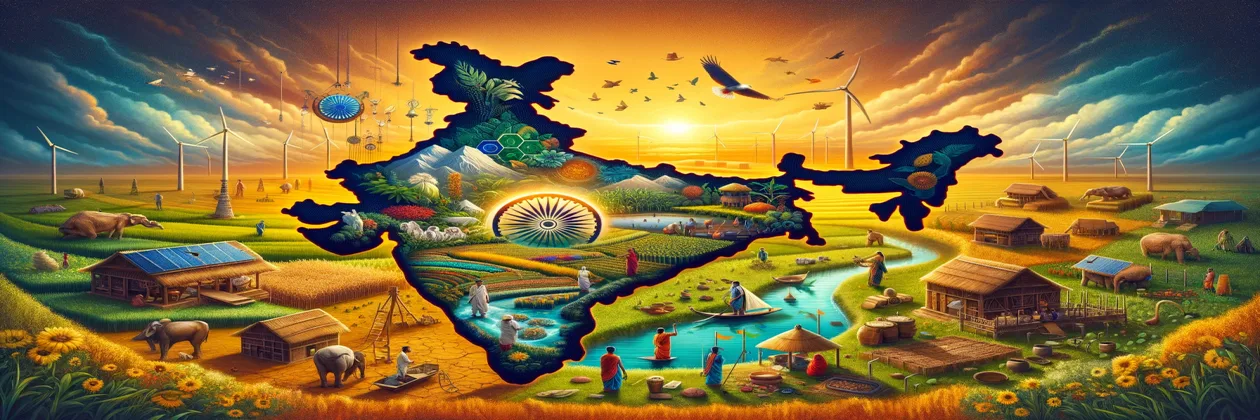
However, the index somehow falls short of recording the culture-specific models of sustainability that are interwoven within the Indian society, especially in the rural and tribal communities. The “undefined” indicators of these models fail to align with the “pre-defined” measurable indicators, for instance, the traditional rainwater harvesting techniques, organic farming techniques followed for centuries, worshipping the feminine energy as “Devi”, a non-consumerist lifestyle, and the ideology that “The World is One Family” (Vasudhaiva Kutumbakam). These practices often go unrecognised in the formal SDGs assessments.
Sustainability v/s Dharma: A clash of ideologies
The emergence of the concept of sustainability as a part of contemporary vocabulary can be traced back to the post-industrialization era, when the resources were overly utilized, the female workforce was discriminated against in terms of physical capabilities, and environmental degradation was exaggerated in the name of development.
On the other hand, “Dharma” as defined by various religions like Hinduism and Buddhism, has never separated human development from planetary care. Indian civilization has always inculcated the concept of “evolving” without damaging nature. Sustainability was never a policy goal, but “a way of living” in India.
The roots run deep: Historical evidence of “Sustainability” even before “Sustainability” was a Thing
The present-day SDGs provide a comprehensive outlook of economic development, keeping in view reduced inequalities, poverty, and hunger, gender equality, access to education, nature preservation, and global partnerships. The Indian culture, scriptures, texts, and heritage present clear evidence of a society rich in values.
According to one of the shlokas in the oldest Veda in India, Rig Veda, “Mata Bhumih Putro Aham Prithivya” (The Earth is my mother; I am her son.). The idea formulated by the shloka aligns with the present-day concept of “Sustainability”, as a whole.
Kabirdas, one of the renowned Indian saints, mentioned in one of the dohas, “Sai itna deejiye, ja mein kutumb samaye. Main bhi bhookha na rahun, sadhu na bhookha jaye” (Lord, Give me as much, that my family is taken care of, I do not sleep hungry, nor does a Sadhu on my door return hungry.) This presents a picture of how Indian culture, since time immemorial, has focused on reducing inequalities and ensuring that everyone has access to basic human requirements (SDG 1: No Poverty, SDG 2: Zero Hunger and SDG 10: Reduced Inequalities).
There is abundant evidence that Indian culture has never distinguished individuals based on gender, ensuring a strong society with empowered women (SDG-5, Gender Equality). A verse from Manusmriti, a foundational text of Hindu Law, suggests that “Yatra naryastu pujyante ramante tatra devata”, meaning – Where women are respected, divinity blossoms there. The culture of denoting the male deities and heroes by the names of their mothers or wives has cultural significance across India, for example, Anjani-putra Hanuman (Son of Anjani, Lord Hanuman), Siya-var-Ram (Maa Siya’s Husband Shri Ram), Radha-Krishna, Kunti-putra Arjun (Son of Queen Kunti, Arjuna), among many others. Women not only excelled in warfare skills (like Kaikeyi – Mother of Bharat in Ramayana, Rani Lakshmi Bai, Rani Velu Nachiyar), but also in the academic field (like Gargi, Maitreyi, and others).
The remains of a few of the oldest existing universities in the World, ensuring affordable and quality education (SDG 4 – Quality Education), are even recognized by UNESCO, like Nalanda University (established in 427 CE), Takshashila University (6th century), the Gurukuls (Ramayana and Mahabharata era till now), etc.
Traditional use of cow dung as biofuel, energy-efficient architecture in hot and cold regions (e.g., mud houses in Rajasthan, stone houses in Ladakh), use of earthen stoves (chulhas) and oil lamps in rural households ensure Affordable and Clean Energy (SDG-7).
Traditional urban planning in ancient cities like Varanasi and Jaipur (Vaastu and water-centric design), community-centric housing (e.g., pols of Ahmedabad, chawls of Mumbai), and eco-friendly building materials (e.g., mud, lime, stone) contribute to Sustainable Cities and Communities (SDG-11).
The Mahopanishad states: “Ayam nijah paro veti ganana laghuchetasam. Udāracarītānāṃ tu vasudhaiva kuṭumbakam.” (This is mine, that is yours – such is the thinking of the small-minded. For those of noble character, the whole world is one family). The idea runs parallel to SDG 17 – Partnerships for the Goals.
These evidences are just the reflections – a glimpse of the country’s consciousness and culturally rich civilization. In India, the ecosystem is not just a concept- it is a discipline interwoven in devotion.
Reviving the “Dharma” of “Sustainability”
Indian texts, including the Vedas, Puranas, Upanishads, and Shastras, have served as a strong testament to the fact that Dharma—the path of Righteousness—has never deviated from the path of ecological balance, equality among communities, and morally strong societies. What has emerged as a revolutionary framework for maintaining an overall balance on the Earth is the ages-old wisdom that has been passed down from generation to generation in India.
However, the irony stands in the fact that the same colonial and Western powers that ridiculed Indian practices of animal worship (especially the cows), simple lifestyles, healthy and thoughtful diets, among many others, of being “unscientific”, are now popularized as “animal protection”, “non-consumerist” and “zero-wastage” living, “intermittent fasting” and “plant-based keto diets”. Early evidence of “yoga,” a practice on the road to self-consciousness, dates to 1500 BC in India. However, considering its physical, mental, and emotional advantages, the world only recognized its significance in the twenty-first century.
The concern here is not just related to risking the credit for what the world admires now; the real problem lies in the fact that Indians have forgotten the years-old civilizational wisdom that has been the backbone of Indian Society. “Sustainability” is an ideal term for the so-called “developed” nations, but it should be treated as a reminder of “who we are”. The modern vocabulary is a borrowed idea, and India needs to revive its civilizational values. India needs to believe in its indigenous models of balance, and then only the world will truly recognize the country’s efforts in achieving these goals. The concept marks the formation of a policy roadmap for most of the countries of the world, but for India, it should be a reminder- a reminder of the inter-generational civilizational truths and wisdom that the country has celebrated for ages – silently and deeply.