Sambhal Riot Judicial Report: A saga of demographic change
June 17, 2026
  • Read Ecopy
  • Circulation
  • Advertise
  • Careers
  • About Us
  • Contact Us
Android AppiPhone AppArattai
Organiser
  • ‌
  • Bharat
    • Assam
    • Bihar
    • Chhattisgarh
    • Jharkhand
    • Maharashtra
    • View All States
  • World
    • Asia
    • Europe
    • North America
    • South America
    • Africa
    • Australia
  • Editorial
  • International
  • Opinion
  • RSS @ 100
  • More
    • Op Sindoor
    • Analysis
    • Sports
    • Defence
    • Politics
    • Business
    • Economy
    • Culture
    • Special Report
    • Sci & Tech
    • Entertainment
    • G20
    • Azadi Ka Amrit Mahotsav
    • Vocal4Local
    • Web Stories
    • Education
    • Employment
    • Books
    • Interviews
    • Travel
    • Law
    • Health
    • Obituary
  • Subscribe
    • Subscribe Print Edition
    • Subscribe Ecopy
    • Read Ecopy
  • ‌
  • Bharat
    • Assam
    • Bihar
    • Chhattisgarh
    • Jharkhand
    • Maharashtra
    • View All States
  • World
    • Asia
    • Europe
    • North America
    • South America
    • Africa
    • Australia
  • Editorial
  • International
  • Opinion
  • RSS @ 100
  • More
    • Op Sindoor
    • Analysis
    • Sports
    • Defence
    • Politics
    • Business
    • Economy
    • Culture
    • Special Report
    • Sci & Tech
    • Entertainment
    • G20
    • Azadi Ka Amrit Mahotsav
    • Vocal4Local
    • Web Stories
    • Education
    • Employment
    • Books
    • Interviews
    • Travel
    • Law
    • Health
    • Obituary
  • Subscribe
    • Subscribe Print Edition
    • Subscribe Ecopy
    • Read Ecopy
Organiser
  • Home
  • Bharat
  • World
  • Operation Sindoor
  • Editorial
  • Analysis
  • Opinion
  • Culture
  • Defence
  • International Edition
  • RSS @ 100
  • Magazine
  • Read Ecopy
Home Bharat

Sambhal Riot Judicial Report: A saga of demographic change, appeasement, and communal insecurity

The recently released judicial report on the Sambhal riot paints a troubling picture of the region’s social and political undercurrents. Far from being an isolated outbreak of violence, the report underscores how rapid demographic shifts, a pattern of political appeasement, and rising communal insecurities have combined to create a volatile atmosphere. It traces the riot’s origins not only to immediate triggers but also to long-standing fault lines that have altered the district’s socio-political fabric

Bhupendra Kumar SullereBhupendra Kumar Sullere
Aug 28, 2025, 07:40 pm IST
in Bharat, Special Report
Follow on Google News
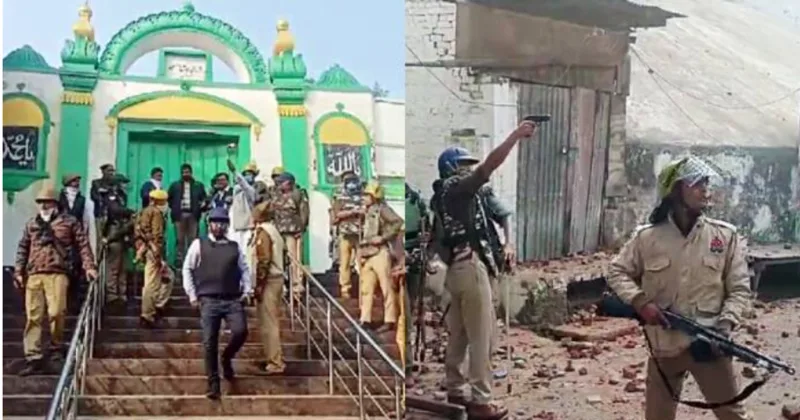
Site of violence in Sambhal (Image Source ANI)

Site of violence in Sambhal (Image Source ANI)

FacebookTwitterWhatsAppTelegramEmail

The judicial commission formed to investigate the communal violence in Sambhal district of Uttar Pradesh in November 2024 has recently submitted its 450-page report to Chief Minister Yogi Adityanath. This report is not merely a narration of one riot’s incidents; it is a crucial document highlighting 75 years of demographic changes and communal transformation in Sambhal.

The most startling revelation is that while Hindus once made up about 45 per cent of the population at the time of Independence, their numbers have now dwindled to just 15–20 per cent. In contrast, the Muslim population has risen to nearly 85 per cent.

Historical Background: Sambhal’s Identity and Struggles

Sambhal’s history is deeply rooted in rich cultural and religious heritage. It was once known as a center of ancient Hindu worship, particularly around the revered Harihar Temple.

Also Read: Assam Will Not Be a Dumping Ground: A rebuttal to Syeda Hameed and her enablers

From the Mughal period to modern India, Sambhal has always been a witness to coexistence as well as conflict. After 1947, it was expected that democracy would foster equality and harmony, but the report reveals that recurring riots and appeasement politics drove the city toward one-sided demographic change.

From Independence to Present: The Shifting Population Balance

According to the report, before 1947 the Hindu-Muslim ratio in Sambhal was roughly 45:55.
Over seven decades:

  • The Hindu population steadily declined.
  • The Muslim population increased sharply.

Today, Hindus are confined to just 15–20 per cent of the population. The report does not consider this merely the result of natural growth rates; instead, it attributes the shift to systematic pressure, fear, and violence.

  • A Cycle of Riots: 1947 to 2019: The judicial report records over 15 major riots in Sambhal between 1947 and 2019.
  • Each riot followed a similar pattern: Disputes over religious sites; Minor incidents deliberately escalated into large-scale violence.
  • Administrative inaction and appeasement.

These recurring riots consistently pushed the Hindu community into a state of insecurity, eventually resulting in migration and exodus.

Appeasement Politics and Its Consequences

The report suggests that Sambhal’s demographic transformation is not solely due to social circumstances but also the result of decades of appeasement politics.

  • Certain groups were protected for electoral gain.
  • Genuine culprits in communal violence often escaped punishment.
  • Unequal distribution of welfare schemes and resources.
  • Such practices laid the foundation for fear and imbalance within society.
  • Decline of the Hindu Population: Psychological and Social Impact
  • The shrinking Hindu population is not just a statistic; it carries a deep psychological and social message.
  • Mass migration of Hindu families.
  • Shrinking of religious festivals.
  • Decline of temples and cultural institutions.
  • Reduced opportunities in education and employment for Hindu children.

All these factors created an atmosphere of fear, insecurity, and inferiority, weakening the social fabric.

A Hub of Terrorist Activities: Sambhal’s International Links

  • The report also notes that Sambhal gradually became a hub for terrorist activities.
  • Organisations like Al-Qaeda and Harakat-ul-Mujahideen were reported to be active.
  • Foreign-manufactured weapons were used during riots.
  • Radical groups succeeded in recruiting local youth.

This shows that the transformation in Sambhal was not just a product of local politics but also linked to international extremist networks.

Harihar Temple and Cultural Heritage

The report makes specific reference to the historical Harihar Temple. The existence of such ancient temples proves that Sambhal was once a prominent Hindu religious-cultural center.
But over time:

  • Temples were eroded or encroached upon.
  • Hindu religious identity was systematically weakened.

This represents not only religious imbalance but also the destruction of cultural heritage.

Challenges Before the Government: The Road Ahead

With the report now in Chief Minister Yogi Adityanath’s hands, the government faces several pressing challenges:
Presentation before Cabinet and Assembly – making the report public.

  • Strict action against culprits – whether political or administrative.
  • Preventing Hindu migration – by restoring security, jobs, and trust.
  • Preservation of cultural heritage – revival of temples and historical institutions.
  • Strengthening law and order – to prevent recurrence of such incidents.

A Warning for the Future

The Sambhal riot judicial report is not just about one district; it is a warning document for all of India.

If demographic imbalance and appeasement politics are not addressed, the consequences will not remain confined to Sambhal but will threaten national unity and cultural identity.

It is therefore essential that the government does not let this report gather dust in files but takes concrete and practical measures to ensure equality, security, and harmony in society.
Topics: HinduAl QaedaSambhal Riot Judicial ReportHarakat-ul-Mujahideen
ShareTweetSendShareSend
✮ Subscribe Organiser YouTube Channel. ✮
✮ Join Organiser's WhatsApp channel for Nationalist views beyond the news. ✮
Previous News

Syeda Hameed’s U-Turn on Bangladeshis: Damage already done, Assamese identity is not up for sale

Next News

US: Gunmen open fire in Minneapolis church killing 2 children and injuring others; Reflects spike in gun culture

Related News

Germany: Sri Ganesha temple opens in Berlin: Europe’s largest Hindu Mandir reflects India’s cultural & dharmic spirit

Beneath the Minaret: The Hindu and Jain legacy burried under Qutub Minar

Statue of Saraswati Maa

Bhojshala: The culture of knowledge, embodied by Maa Vagdevi pervades from Dhar to Indonesia and Washington

Smoke and gunfire engulf Bamako as coordinated attacks targeting military bases linked to the Wagner Group trigger panic, with the al-Qaeda-linked Jamaat Nusrat al-Islam wal-Muslimeen suspected behind the assault.

Mali Under Siege: Coordinated terror attacks hit Bamako; Al-Qaeda-linked Jamaat Nusrat al-Islam wal-Muslimeen suspected

Manikarnika Ghat in Varanasi: Where life and death co-exist

Balendra Shah, the newly elected Prime Minister of Nepal

Balendra Shah to take oath as Nepal Prime Minister on Ram Navami; Hindu rituals to resonate during the ceremony

Load More

Latest News

Prime Minister Narendra Modi

G7 Summit 2026: PM Modi says Global South wants partnership, not assistance

ED summons hoteliers in Gulmarg Land Scam

J&K: ED cracks down on Gulmarg land scam: 9 hoteliers including Mushtaq Chaya summoned in Roshni scheme probe

U.S. Consulate General Hyderabad Office
(Inside box- Telangana CM Revanth Reddy)

BJP Telangana questions Congress and CM Revanth Reddy over renaming a road in Hyderabad as ‘Donald Trump Avenue’

ABVP protests at Telangana School Education Directorate over closure of 24,000 government schools

Rabindranath Tagore

Rabindranath Tagore and the revival of Hindu civilisational pride

Representative Image

Viksit Bharat Shiksha Adhishthan Bill 2025: Mandate to promote Bharatiya ‘Gyan’ & ‘Bhasha’

Uttar Pradesh: Digital democracy dialogue ‘Triveni’ concludes; Focused on inclusive growth & cultural discourses

RSS Pune organises workshop on “Preparing for the AI Era”; Experts stress on AI literacy and Atmanirbharata in AI

Assam Governor Lakshman Prasad Acharya leads sacred Buddha relics mission to Mongolia

India- Mongolia Relations: Celebrating the spiritual neighbourhood

The AN-32: Service, sacrifice and the search for a successor

Load More
  • Privacy
  • Terms
  • Cookie Policy
  • Refund and Cancellation
  • Delivery and Shipping

© Bharat Prakashan (Delhi) Limited.
Tech-enabled by Ananthapuri Technologies

  • Home
  • Search Organiser
  • Bharat
    • Assam
    • Bihar
    • Chhattisgarh
    • Jharkhand
    • Maharashtra
    • View All States
  • World
    • Asia
    • Africa
    • North America
    • South America
    • Europe
    • Australia
  • Editorial
  • Operation Sindoor
  • Opinion
  • Analysis
  • Defence
  • Culture
  • Sports
  • Business
  • RSS @ 100
  • Entertainment
  • More ..
    • Sci & Tech
    • Vocal4Local
    • Special Report
    • Education
    • Employment
    • Books
    • Interviews
    • Travel
    • Health
    • Politics
    • Law
    • Economy
    • Obituary
  • Subscribe Magazine
  • Read Ecopy
  • Advertise
  • Circulation
  • Careers
  • About Us
  • Contact Us
  • Policies & Terms
    • Privacy Policy
    • Cookie Policy
    • Refund and Cancellation
    • Terms of Use

© Bharat Prakashan (Delhi) Limited.
Tech-enabled by Ananthapuri Technologies