
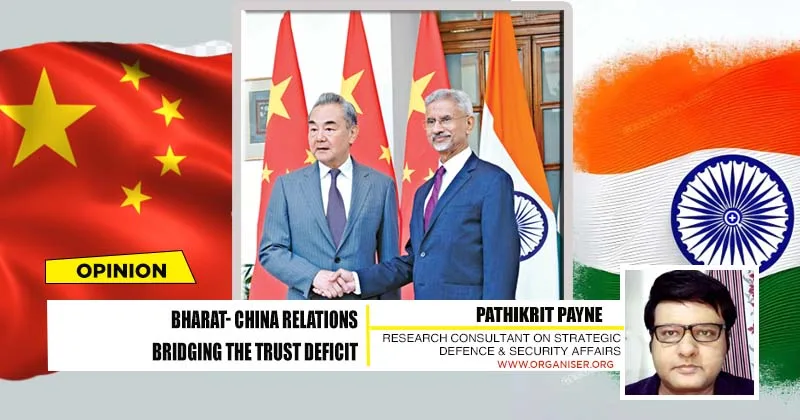
The third week of August, when looked from a panoramic view, exemplifies the dynamics of a complex geopolitical riddle that New Delhi has been managing with deft elan and precise moves. Each move may seem to be distinct, objective-driven and yet potentially perhaps delicately woven with one another.
Even as Chinese Foreign Minister Wang Yi visited India on an official two-day trip on August 18, the US Deputy Assistant Secretary of Defence (South and Southeast Asia) from US Department of Defence, Dr. Andrew Byers, was meeting a Joint Secretary level official at the Ministry of Defence, and “discussed key issues of defence procurement and reaffirmed commitment to further strengthen the India-US defence partnership.”
Boost to Indo-Russia Trade Ties
After having crucial meetings with visiting Chinese Foreign Minister, India’s External Affairs Minister Dr S Jaishankar went on an official visit to Russia on August 19, which was aimed at deepening Indo-Russia trade and economic relations through removal of various tariff and non-tariff barriers, logistical bottlenecks and to give final shape to the proposed India-Russia Free Trade Agreement with an aim to push Indo-Russian annual trade to $100 billion.
Go-Ahead for Tejas
Meanwhile, Prime Minister Modi led Cabinet Committee on Security (CCS) gave final approval for acquisition of 97 more Tejas MK1A that are to be powered by GE F-404 engines, thereby reaffirming India’s firm commitment to the Indo-US strategic partnership in spite of recent challenges posed by Trump administration. On the other hand, India’s August import of crude oil from Russia peaked to almost 2 million barrels per day, a reflection of India’s defiant strategic principle.
Bharat’s First’ Policy: Guiding Factor
It is important to accept that India is entering a critical phase of a complex geopolitical game of balancing, even while remaining firm on its stated principles of strategic autonomy and ‘India First’ approach. Against this backdrop, what is extremely critical for India, is to navigate its economic aspirations, quest for development of supply chain resilience with smart and nimble-footed geopolitical moves.
Push to Atmanirbhar Bharat Abhiyan
There is no denial that the Indo-China relationship reached its nadir during the Galwan face-off. Over the next few years, even as the relationship reached the point of stalemate, one positive thing that happened was that there was no breakdown of communications. Both sides kept the point of contact and correspondence alive, through official and unofficial routes, at various levels. The Galwan face-off, followed by the COVID-9 disruptions on supply chains, made India realise the importance of developing domestic resilient supply chains. PM Modi’s massive push for Atmanirbhar Bharat Abhiyan, brought in a renewed push towards making India a key component of the global manufacturing supply chain. As things stand now, in the words of Tim Cook, Apple’s CEO,
‘The vast majority of the iPhones sold in the US….have a country of origin in India’.
While India’s GDP projections defied all disruptions to emerge as the fourth largest economy of the world, China did realise two things. That India is no pushover and that India is not the lackey of the West. India’s massive military modernisation, capacity build-up in rapid deployment, its vast array of ballistic and cruise missiles, are indicative enough that it can defend its own turf, and can reach regions as far as 5,000 km away with precision. Yet over the last three years, India’s refusal to toe to the Western dictums on the issue of Russia-Ukraine war, its steadfast support for Russia, its clarion call for reforms in multilateral institutions, its refusal to abide by unilateral sanctions of the West, it becoming voice of Global South, may have raised eyebrows in Beijing, with second thoughts on whether they faltered in their perceptions about India.
Did Trump Bring India China Closer?
In the aftermath of Operation Sindoor, as tensions between India and Trump administration soared with President Trump trying desperately to appropriate credit for the ceasefire, belittling for India’s stellar blitzkrieg like military operations against Pakistan Armed Forces, and terror groups, that brought Rawalpindi to its knees, Modi Government made it clear that there was no mediation or external intervention that led to the cessation of conflict.
This was followed by strange overtures by the Trump administration towards Pakistan’s military top brass, followed by recalcitrant demands to India to open up its dairy, fisheries, poultry and farm sector to imports from the US. Modi Government refused to budge even in the face of threats of tariff hikes, followed by mockery. Perhaps China watched with awe as India vindicated once more why it can’t be treated as a pushover. With a far lesser dependence on exports as part of GDP, Modi Government has been confident that it would be capable of dealing with the temporary tariff shocks. At most a mere one per cent of India’s GDP might get impacted, and India has enough inbuilt capacity to absorb it. This is where China stepped it, and India responded at top speed. It was no charity. Both needed to sustain the working relationship.
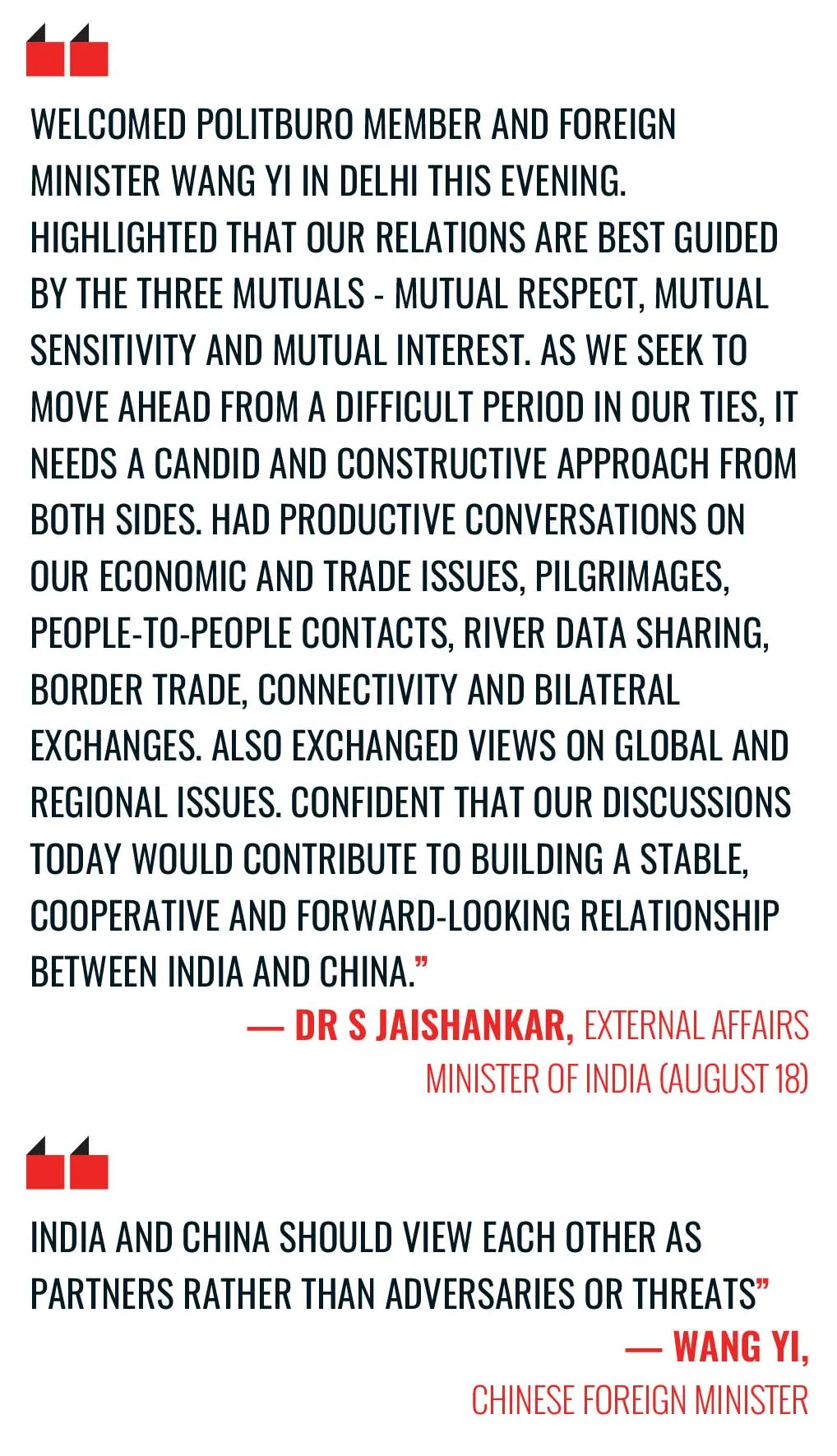
While China has agreed to address India’s concerns and lift the restrictions on exports of rare earth magnets, fertilizers and tunnel boring machines to India, New Delhi reciprocated with resumption of flights to China. PM Modi tweeted, ‘Glad to meet Foreign Minister Wang Yi. Since my meeting with President Xi in Kazan last year, India-China relations have made steady progress guided by respect for each other’s interests and sensitivities’. Wang Yi reciprocated by stating that India and China must view each other as ‘partners’ and not as ‘adversaries or threats’.
It is imperative for China to realise that India’s rise is not at the cost of China but may work as a compliment for mutual and shared growth
As PM Modi is slated to participate in the SCO Summit in China, the Sino-Indian relation can be defined as one where work on areas of convergence continues, while issues of divergence and status-quo remain profound. No one has an iota of doubt how much China arms Pakistan but India does not complain anymore. It reciprocates with arming China’s adversaries in South China Sea, namely Philippines and Vietnam, and by showing its ability to decisively deal with Pakistani misadventures.
While sensitive sectors and spheres of critical infrastructures in India, would continue to remain strictly no-go area for China, it appears that India may consider relaxing norms for Chinese investments in non-sensitive sectors such as consumer durables or renewable energy, and even electronics, albeit with provisions for tech-transfers and not just mere assembly work.
It is imperative for China to realise that India’s rise is not at the cost of China but may work as a compliment for mutual and shared growth. President Trump’s tilt towards Pakistan is perhaps also one more reason for China to change its stance towards India, but if Washington presumed that threats of tariffs would disintegrate BRICS bonhomie, the very opposite of the same appears to be happening now. President Trump may have made the impossible look possible, even as India remains committed to its strategic partnership with the US.