India’s manufacturing sector is in the midst of a historic transformation, powered by the Production Linked Incentive (PLI) Scheme, a flagship initiative that has redefined the nation’s industrial ambitions. Launched in April 2020 with an outlay of Rs 1.97 lakh crore, the PLI scheme was designed not just as an incentive framework, but as a strategic intervention to propel India’s manufacturing share to 25 percent of GDP and establish the country as a global industrial powerhouse.
Nearly five years later, the results are beginning to show. By March 2025, the government had approved 806 applications across 14 strategic sectors, attracting investments worth Rs 1.76 lakh crore and generating more than 12 lakh direct and indirect jobs. These figures underline how the scheme is not only reshaping industrial production but also catalysing job creation, innovation, and foreign investments.
Success in electronics
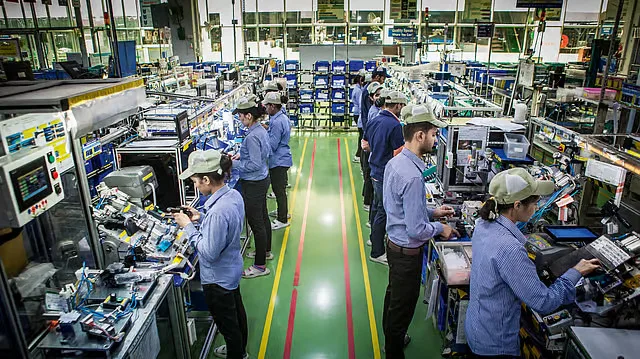
Among the many sectors, electronics manufacturing stands out as one of the PLI scheme’s biggest success stories. Backed by the National Policy on Electronics (2019), the PLI framework has enabled India to climb up the global electronics value chain, attracting leading smartphone makers and component manufacturers.
The results have been remarkable. Production surged by 146 percent over four years, jumping from Rs 2.13 lakh crore in FY 2020-21 to Rs 5.25 lakh crore in FY 2024-25. India has now emerged as the second-largest mobile phone manufacturing hub in the world, with exports of smartphones and electronic devices reaching new highs.
This transformation is not only fueling economic growth but also contributing to the Digital India initiative, ensuring that technology becomes more accessible and affordable for the masses. In effect, the PLI scheme has made India a critical node in global electronics supply chains.
Automobiles & electric mobility push
The automobile and auto components sector has also seen significant traction. With Rs 67,690 crore in committed investments, of which Rs 14,043 crore had already been realised by March 2024, the sector has created more than 28,884 jobs.
What makes this growth even more impactful is its alignment with India’s FAME (Faster Adoption and Manufacturing of Hybrid & Electric Vehicles) initiative. By incentivising 19 categories of advanced automotive technology vehicles and 103 categories of components, the scheme is accelerating India’s transition towards electric mobility.
Within the next decade, India could establish itself as a global hub for electric vehicles (EVs) and clean mobility solutions, reducing dependency on fuel imports while contributing to climate goals.
Pharma Industry: From deficit to surplus
One of the most compelling success stories comes from the pharmaceutical sector. Once heavily reliant on imports for bulk drugs and key raw materials, India has managed to reverse its trade balance in just three years under the PLI scheme.
The numbers tell the story: from a Rs 1,930 crore trade deficit in FY 2021-22, the pharma sector recorded a Rs 2,280 crore surplus in FY 2024-25. Sales under the scheme crossed Rs 2.66 lakh crore, with exports contributing a staggering Rs 1.70 lakh crore. Domestic value addition in pharmaceuticals touched 83.7 percent by March 2025, marking a decisive shift towards self-reliance in healthcare manufacturing.
This turnaround is not just about numbers; it reflects India’s growing capacity to become the pharmacy of the world, supplying affordable medicines to global markets while ensuring domestic security in essential drugs.
Renewable energy & solar push
The push for renewable energy has been another area where the PLI scheme has shown significant impact. Under the PLI program for high-efficiency solar PV modules, India is on track to build 48 GW of fully integrated domestic capacity.
With Rs 48,120 crore in committed investments, the sector has already created nearly 38,500 direct jobs as of June 2025. More importantly, this initiative is expected to drastically reduce India’s import dependency on solar modules, strengthening the country’s energy security under the National Solar Mission.
By promoting clean energy manufacturing, the PLI scheme is aligning industrial growth with India’s climate commitments and sustainability goals.
Semiconductors & advanced tech
Perhaps the most strategic success of the PLI framework is in semiconductors and advanced electronics. The India Semiconductor Mission, backed by a Rs 76,000 crore allocation, has already approved six projects, with four new manufacturing units being set up in Odisha, Punjab, and Andhra Pradesh.
With an additional Rs 4,600 crore investment, these projects are expected to generate over 2,034 skilled jobs while creating thousands of indirect employment opportunities.
By integrating into global semiconductor value chains, India aims to reduce its heavy dependence on chip imports, which are vital for everything from smartphones to electric vehicles. Building a resilient domestic semiconductor ecosystem is seen as a game-changer for India’s technological sovereignty.
Other sectors benefiting
Beyond the known sectors, several other industries are seeing significant gains:
1. Textiles: With a Rs 10,683 crore outlay, India’s man-made fibre exports reached Rs 525 crore, while technical textile exports hit Rs 294 crore in FY 2024-25.
2. Food Processing: The sector has attracted Rs 8,910 crore in investments across 171 approved projects, complementing initiatives like PM-FME and PMKSY.
3. White Goods (ACs & LED lights): The PLI scheme is transforming India from a low-value assembly hub to a high-value manufacturing base, with targets of 75-80 percent domestic value addition by 2028-29.
Each of these sectors reflects the broad-based nature of the scheme, covering everything from daily-use appliances to high-tech innovations.
Beyond Numbers
The impact of the PLI scheme goes beyond immediate investments and job numbers. It is fostering industrial clusters, building supplier networks, and drawing foreign direct investments into strategic hubs.
For example, semiconductor parks in Gujarat and medical device hubs in Andhra Pradesh and Tamil Nadu are strengthening region-specific industrial ecosystems. These clusters not only attract large companies but also nurture MSMEs (Micro, Small & Medium Enterprises) as suppliers and vendors, ensuring more inclusive growth.
In essence, the scheme is helping India move up the global value chain, from assembly-driven growth to innovation-led manufacturing.
The government’s rising budget allocations for 2025–26 highlight its commitment to sustaining this momentum. Policymakers envision the PLI framework delivering on several fronts:
- Achieving zero import dependency in critical sectors.
- Promoting job-intensive growth through skilling and formalisation.
- Expanding exports, making India a stronger player in global supply chains.
- Advancing the vision of Atmanirbhar Bharat and the $5 trillion economy goal.
The PLI scheme is far more than an incentive mechanism; it represents a catalyst for India’s industrial renaissance.
By fueling manufacturing growth, generating employment, boosting exports, and reducing import dependencies, it is laying the foundation for a self-reliant yet globally competitive India.
As the country accelerates towards the vision of becoming a $5 trillion economy, the Production Linked Incentive framework is set to remain a cornerstone of India’s growth story, transforming both its industrial and economic future.