India’s road network expands 60 percent under Modi government
September 3, 2026
  • Read Ecopy
  • Circulation
  • Advertise
  • Careers
  • About Us
  • Contact Us
Android AppiPhone AppArattai
Organiser
  • ‌
  • Bharat
    • Assam
    • Bihar
    • Chhattisgarh
    • Jharkhand
    • Maharashtra
    • View All States
  • World
    • Asia
    • Europe
    • North America
    • South America
    • Africa
    • Australia
  • Editorial
  • International
  • Opinion
  • RSS @ 100
  • More
    • Op Sindoor
    • Analysis
    • Sports
    • Defence
    • Politics
    • Business
    • Economy
    • Culture
    • Special Report
    • Sci & Tech
    • Entertainment
    • G20
    • Azadi Ka Amrit Mahotsav
    • Vocal4Local
    • Web Stories
    • Education
    • Employment
    • Books
    • Interviews
    • Travel
    • Law
    • Health
    • Obituary
  • Subscribe
    • Subscribe Print Edition
    • Subscribe Ecopy
    • Read Ecopy
  • ‌
  • Bharat
    • Assam
    • Bihar
    • Chhattisgarh
    • Jharkhand
    • Maharashtra
    • View All States
  • World
    • Asia
    • Europe
    • North America
    • South America
    • Africa
    • Australia
  • Editorial
  • International
  • Opinion
  • RSS @ 100
  • More
    • Op Sindoor
    • Analysis
    • Sports
    • Defence
    • Politics
    • Business
    • Economy
    • Culture
    • Special Report
    • Sci & Tech
    • Entertainment
    • G20
    • Azadi Ka Amrit Mahotsav
    • Vocal4Local
    • Web Stories
    • Education
    • Employment
    • Books
    • Interviews
    • Travel
    • Law
    • Health
    • Obituary
  • Subscribe
    • Subscribe Print Edition
    • Subscribe Ecopy
    • Read Ecopy
Organiser
  • Home
  • Bharat
  • World
  • Operation Sindoor
  • Editorial
  • Analysis
  • Opinion
  • Culture
  • Defence
  • International Edition
  • RSS @ 100
  • Magazine
  • Read Ecopy
Home Bharat

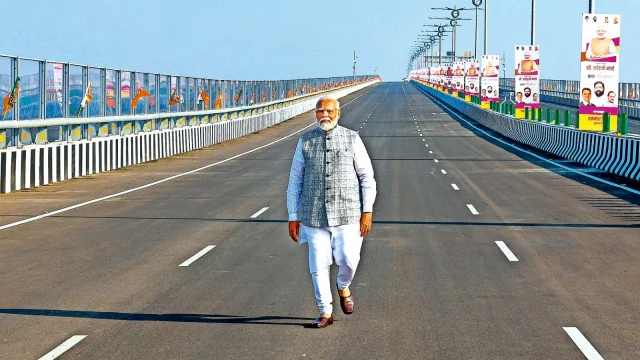
A decade of transformation: How the Indian road network expanded 60% under Modi govt

India’s road and highway sector has witnessed an unprecedented transformation under Prime Minister Narendra Modi’s leadership. With a 60 percent expansion of the national highway network in just a decade

Shashank Kumar DwivediShashank Kumar Dwivedi
Aug 23, 2025, 10:40 pm IST
inBharat, Business, Economy
Follow on Google News
Prime Minister Narendra Modi

Prime Minister Narendra Modi

Facebook
Twitter
WhatsAppTelegramEmail

The road and highway sector has emerged as a cornerstone of India’s infrastructure revolution, reflecting the vision of Prime Minister Narendra Modi to transform connectivity, spur trade, and improve everyday life. In 2014, India’s national highway network stood at 91,287 km. By 2024, this figure had expanded to 146,000 km, marking a 60 percent growth and making India’s network the second largest in the world after the United States.

This historic leap has helped India surpass China in total road network size, a feat that shows the government’s determination to build a stronger and more connected India.

The transformation has been fuelled by massive investments of over Rs 3 lakh crore annually in road infrastructure. The Prime Minister has often emphasised that roads are not just pathways but lifelines of development, enabling economic growth, social unity, and cultural integration.

Projects like Setu Bharatam, which replaced thousands of unsafe bridges across the country, showcase the government’s commitment to safety and modernisation. Each rupee spent on roads has delivered a return of 3.2 percent to GDP, demonstrating the unmatched economic multiplier of this sector.

Under the ambitious Bharatmala Pariyojana, India targeted 34,800 km of highways, of which over 26,000 km have been awarded and nearly 20,000 km completed by early 2025.

Flagship projects include:

1. Delhi–Mumbai Expressway drastically cutting travel time and improves freight efficiency.

2. Purvanchal, Bundelkhand, and Ganga Expressways in Uttar Pradesh, opening up eastern and central regions for growth.

3. Dwarka Expressway and Urban Extension Road-II in Delhi-NCR, built at a cost of Rs 11,000 crore, easing traffic congestion and improving regional connectivity.

The upcoming Capital Region Ring Road, a six-lane controlled-access highway, promises to further smoothen traffic flow around the national capital.

These expressways have unlocked immense opportunities by connecting backwards regions with major trade hubs, ensuring inclusive growth.

The Pradhan Mantri Gram Sadak Yojana (PMGSY) has transformed rural connectivity, building 3.5 lakh km of village roads and creating 650 crore man-days of employment in the last five years. This has ensured that farmers can reach markets, students can access schools, and healthcare is within easier reach for rural households.

Religious and border infrastructure have also seen dramatic upgrades:

1. All-weather Char Dham roads in Uttarakhand and a new route to Kailash Mansarovar via Pithoragarh.

2. Enhanced connectivity to Ayodhya, Varanasi, Prayagraj, and Chitrakoot, enriching spiritual tourism.

3. The Aunta-Simaria bridge in Bihar (Rs 1,870 crore), with its 1.86-km six-lane span over the Ganga, inaugurated by the Prime Minister, has cut long detours for freight and pilgrims alike.

Every region of India has benefited:

1. Northeast: Nearly 10,000 km of highways added since 2014 with an outlay of Rs 1.07 lakh crore, strengthening ties with neighbours under the Act East Policy. Another 5,000 km is under construction.

2. India’s South: Bengaluru’s NICE Road corridor expansion, Hyderabad’s Outer Ring Road, and Chennai’s Peripheral Ring Road have decongested urban traffic.

3. East: The Dankuni Expressway and Eastern Metropolitan Bypass in Kolkata ease movement, while the Raipur–Visakhapatnam corridor strengthens industrial links.

4. West: The Mumbai Trans Harbour Link, India’s longest sea bridge, ties Mumbai with Navi Mumbai. The Samruddhi Mahamarg, connecting Mumbai to Nagpur, has become a trade backbone for Maharashtra.

These projects showcase how highways are engines of regional balance, ensuring no part of India is left behind.

The pace of development has only accelerated in Prime Minister Modi’s third term. Within the first 100 days, infrastructure commitments exceeded Rs 11 lakh crore, with roads as a major beneficiary. The highway construction rate now averages 33 km per day, compared to just 8–11 km a decade ago.

The PM Gati Shakti Master Plan has further streamlined project execution, reducing logistics costs from 14 percent to an expected 8 percent of GDP by 2030. The 2025-26 Union Budget allocated over Rs 11 lakh crore for capital outlay, with a large share directed at highway development.

Private sector participation has been reinvigorated through the Hybrid Annuity Model, ensuring faster and more efficient project completion.

India’s roads today are more than just stretches of concrete; they are lifelines of growth, unity, and prosperity. They link remote villages to bustling cities, holy shrines to pilgrims, and industries to global markets. With three times the return on every rupee invested, highways have become the backbone of India’s journey towards becoming a developed nation by 2047.

The Modi government’s relentless focus on roads and highways has not only changed India’s landscape but has also redefined its future, one expressway, one bridge, and one village road at a time.

Topics: expressways in IndiaPradhan Mantri Gram Sadak YojanaBharatmala PariyojanaModi government highwaysIndia road network growthSetu Bharatam project
Share
Tweet
SendShareSend
✮ Subscribe Organiser YouTube Channel. ✮
✮ Join Organiser's WhatsApp channel for Nationalist views beyond the news. ✮
Previous News

How Pradhan Mantri Matsya Sampada scheme doubled fish production to 195 lakh tonnes in a decade?

Next News

India terminates postal services to US temporarily from August 25th in the wake of new custom regulations by the US

Related News

From Guns to Handlooms: Former Naxal Women Walk the Ramp in Raipur

From Bastar’s forests to ramp: Surrendered women Maoists steal show at fashion event in Raipur

Prime Minister Narendra Modi and Minister of Road Transport and Highways Nitin Gadkari (Image Source: X)

India’s mega highway expansion nears finish line: Over 22,000 Km built under Bharatmala programme

ED's zonal office Raipur, Source ANI

Chhattisgarh: ED raids 9 places in Bharatmala land compensation case

Eternally Atal: A life dedicated to the nation

A tribal woman cooking food on gas stove in Madhya Pradesh's Shivpuri (Photo: Subhi Vishwakarma)

SBI Report: India’s Rural poverty down to 4.86 per cent from 25.7 per cent in 12 years

Panchjanya Sagar Samvad 2.0: “In today’s Bharat, development has got new momentum,” says Nitin Gadkari

Load More

Latest News

Temple Mobile Ban: Tamil Nadu Devotees Slam Phone Deposit Fee

Tamil Nadu: Mobile ban in temple sparks fury; Devotees question charging Rs 5 fee for depositing phones

Retired Air Marshal Jeetendra Mishra: From Operation Sindoor to Ram Mandir CEO

Air Marshal Jeetendra Mishra (Retd): The commander of Operation Sindoor is now the Ram Mandir’s 1st CEO

Akbaruddin Owaisi’s remarks on Bhagwan Ram were prima facie ‘planned’ and ‘measured’: Bombay HC refuses to quash plea

Agony of Nepal due to floods (This image is generated by AI)

Nepal’s Agony: The Himalayan warning India cannot ignore

Austria’s Chancellor Christian Stocker moves to constitutionally ban political Islam, citing concerns over equality, the rule of law and democratic institutions

Austria moves to constitutionally ban Political Islam, calling it incompatible with democracy and western values

Kanthapuram A.P. Abubaker Musaliyar and Keralam CM VD Satheesan

Keralam CM VD Satheesan rejects Kanthapuram’s remarks on women, calls them ‘19th-century thinking’

Vande Mataram remains an enduring symbol of Bharat’s civilisational heritage, national unity and deep-rooted love for the motherland

Vande Mataram: Reclaiming a civilisational legacy against opposition cynicism

DUSU Elections 2026: ABVP’s 13 Probable Candidates Launch Pre-Campaign Outreach Across Campuses

DUSU Polls Pre-Campaign: ABVP’s 13 probable candidates reach out to students across various Delhi University colleges

India has partnered with UNESCO to develop AI-powered immersive learning tools for more engaging and personalised classrooms

India-UNESCO Partnership: IIT Madras to develop AI-powered immersive learning technology for classrooms worldwide

Congress Parliamentary Party Chairperson Sonia Gandhi and Congress President Mallikarjun Kharge speak with a party worker during the rendition of Vande Mataram at the 80th Independence Day celebrations at Congress headquarters, in New Delhi on August 15. Lok Sabha LoP Rahul Gandhi is also present

Vande Mataram and dirty politics of Congress: Appeasement DNA of ideological unease

Load More
  • Privacy
  • Terms
  • Cookie Policy
  • Refund and Cancellation
  • Delivery and Shipping

© Bharat Prakashan (Delhi) Limited.
Tech-enabled by Ananthapuri Technologies

  • Home
  • Search Organiser
  • Bharat
    • Assam
    • Bihar
    • Chhattisgarh
    • Jharkhand
    • Maharashtra
    • View All States
  • World
    • Asia
    • Africa
    • North America
    • South America
    • Europe
    • Australia
  • Editorial
  • Operation Sindoor
  • Opinion
  • Analysis
  • Defence
  • Culture
  • Sports
  • Business
  • RSS @ 100
  • Entertainment
  • More ..
    • Sci & Tech
    • Vocal4Local
    • Special Report
    • Education
    • Employment
    • Books
    • Interviews
    • Travel
    • Health
    • Politics
    • Law
    • Economy
    • Obituary
  • Subscribe Magazine
  • Read Ecopy
  • Advertise
  • Circulation
  • Careers
  • About Us
  • Contact Us
  • Policies & Terms
    • Privacy Policy
    • Cookie Policy
    • Refund and Cancellation
    • Terms of Use

© Bharat Prakashan (Delhi) Limited.
Tech-enabled by Ananthapuri Technologies