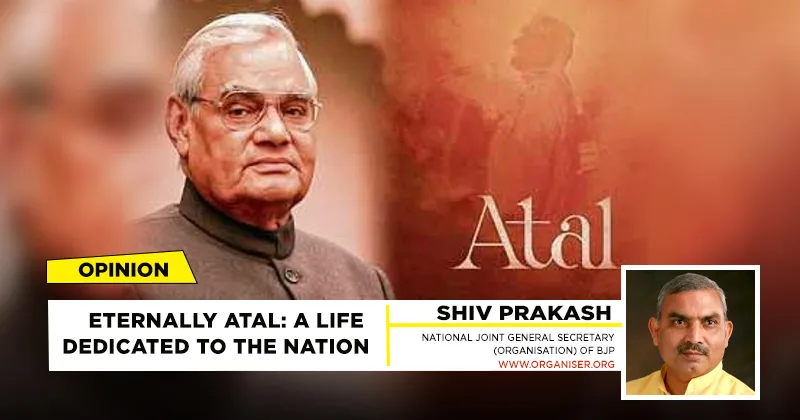
The birth centenary of Bharat Ratna, former Prime Minister of India, the late Shri Atal Bihari Vajpayee, is not merely an occasion for remembrance; it is a moment of national reflection. Born on December 25, 1924 in Gwalior, Madhya Pradesh, to Krishna Devi and Krishna Bihari Vajpayee, Atal Ji devoted every breath of his 94-year-long life to the service of the nation. He left this mortal world on August 16, 2018, but his ideas, ideals, and inspiration continue to guide Bharat’s journey.
Atal Bihari Vajpayee was a rare blend of intellect, sensitivity, courage, and statesmanship. A brilliant student, a powerful orator, a freedom fighter, a sensitive journalist, a poet of deep national consciousness, and a fearless yet compassionate administrator—his life represented the finest traditions of Bharatiya public life. Such was the dignity of his conduct and the depth of his vision that he commanded respect not only from his supporters but also from his ideological opponents. Reflecting this global regard, Russian President Vladimir Putin once remarked that Atal Ji was an outstanding statesman whose name is inseparably linked with an entire era of Indian politics.
National unity and territorial integrity were central to Atal Ji’s political life. From his early years, he stood shoulder to shoulder with Dr Syama Prasad Mookerjee on the issue of the complete integration of Jammu and Kashmir with Bharat. Dr Mookerjee’s sacrifice left an indelible mark on Atal Ji’s mind and heart. Whether in opposition or as Prime Minister, Atal Ji remained committed to resolving the Kashmir issue with firmness, dignity, and national interest at its centre.
Atal Ji consistently opposed what he considered short-sighted and weak policies on Kashmir and refugee rehabilitation during the Nehru era. He also emerged as one of the strongest parliamentary voices against Chinese expansionism. He firmly believed that the occupation of Tibet by China posed a direct threat to Bharat’s northern borders. His historic statement in Parliament in 1959—“We cannot build a palace of friendship with China on the corpse of Tibet’s freedom”—remains a defining moment in Bharat’s strategic discourse.
During the 1961 liberation of Goa, Daman, and Diu, Atal Ji supported decisive military action, declaring that it was not a war but the recovery of Bharat’s lost breath and self-respect. Similarly, during the Berubari territorial debate, he warned Parliament that no government had the authority to donate national land, asserting that the territory of Bharat was not the private property of any ruler or regime.
Atal Bihari Vajpayee entered public life through journalism, working with publications such as Rashtradharma, Panchajanya, Veer Arjun, and Swadesh. He believed journalism was not merely about reporting events but about guiding society and strengthening the nation’s moral compass. To him, a newspaper was both a mirror and a lamp—reflecting reality while illuminating the path ahead. In today’s turbulent media landscape, his vision of nationalist and responsible journalism remains profoundly relevant.
As Prime Minister, Atal Ji opened new chapters in Bharat’s development journey. His governance combined compassion with decisiveness. Leading a coalition government of 24 diverse parties, he demonstrated exceptional balance, coordination, and respect for constitutional institutions. Even within a multi-party framework, he elevated the dignity of the Prime Minister’s office and upheld democratic traditions.
His landmark infrastructure initiatives—most notably the Golden Quadrilateral Highway Project and the Pradhan Mantri Gram Sadak Yojana—laid the foundation for Bharat’s economic acceleration. He firmly believed that roads are the arteries of a nation, and if they stop, development comes to a halt. For him, connectivity was the key to national progress.
Understanding the deep link between illiteracy and poverty, Atal Ji launched the Sarva Shiksha Abhiyan to universalise education. At the same time, his Antyodaya Anna Yojana ensured food security for the poorest citizens, even amidst fiscal constraints. His advocacy of river-linking projects highlighted his long-term vision for water management and drought mitigation. Bharat’s communication revolution and the democratisation of mobile telephony were also major milestones of his tenure. By adding “Jai Vigyan” to the traditional slogan “Jai Jawan, Jai Kisan”, he placed science and innovation at the heart of nation-building.
The nuclear tests conducted at Pokhran on May 11 & 13, 1998 symbolised Atal Ji’s indomitable courage, strategic clarity, and unwavering national pride. Managing secrecy, overcoming international sanctions, and asserting Bharat’s position as a responsible nuclear power reflected his exceptional leadership. His strong response to global critics—challenging nuclear-armed nations that lectured Bharat—was characteristic of his fearless yet dignified style.
In foreign policy, Atal Ji upheld Bharat’s strategic autonomy while fostering strong relations with major powers, including the United States and China. He worked to build global consensus against terrorism and pursued peace with strength as the guiding principle of diplomacy. His historic bus journey to Lahore reflected his sincere commitment to peace, while Bharat’s decisive victory during the Kargil conflict under his leadership demonstrated that peace efforts would never come at the cost of national security. He was both a messenger of peace and a victorious wartime leader.
Atal Ji embodied the principle of Nation First throughout his political life. Even in opposition, he rose above partisan politics when national interests were at stake—supporting Prime Minister Indira Gandhi during the Bangladesh Liberation War and leading Bharat’s parliamentary delegation on Kashmir in 1994 at the request of Prime Minister Narasimha Rao. His cooperation with Prime Minister Chandra Shekhar on economic reforms reflected the highest standards of democratic opposition.
A lover of the Hindi language and Bharatiya sanskriti, Atal Ji’s speech in Hindi at the United Nations was a proud moment for Bharat’s linguistic heritage. He consistently advocated education in the mother tongue, a vision that is being realised today through the National Education Policy under Prime Minister Narendra Modi. His letter to US President Bill Clinton following the nuclear tests—asserting that Bharat would not bow to external pressure—sent a clear message of self-respect and sovereignty.
A celebrated poet and unmatched orator, Atal Ji’s words carried both lyrical beauty and moral authority. His speeches captivated Parliament and the masses alike, while his poetry reflected deep love for democracy, freedom, and the unity of Bharat.
Committed to democratic values, he endured imprisonment during the Emergency despite failing health and chose to relinquish power rather than compromise ethical principles. His entire life was a testament to integrity in public life.
For Atal Bihari Vajpayee, Bharat was not merely a piece of land but a living national soul—where every particle was sacred, every river holy, and service to the nation the highest duty. His belief that one must live and die for the nation continues to inspire millions.
As the nation commemorates his birth centenary, the truest tribute to Atal Ji lies in our collective resolve to build a prosperous, powerful, and developed Bharat.