The skies between New Delhi and Washington may be calm, but the corridors of trade policy are buzzing with turbulence from last ten days. What began as a series of trade disagreements over market access and duties has now crystallised into a tariff war between Bharat and the United States. While tariffs are traditionally the stuff of economic policy, their impact on strategic sectors particularly defence has become impossible to ignore.
A major shift in Bharat’s procurement strategy by taking the decision to walk away from the highly anticipated F-35 stealth fighter deal with the US. The F-35 was considered as a stronghold in deepening Indo-US defence ties, offering cutting-edge capability and interoperability. In mid of tariff war, competing industrial priorities and sharper focus on self-reliance has made Bharat to step off that runway.
For Washington it was a blow to expectations. For New Delhi it was a clear message that strategic autonomy and self-esteem of farmers and citizens of Bharat will not be compromised as said by Prime Minister Narendra Modi. The domestic defence industrialisation would take precedence over dependence on imported platforms.
#WATCH | Varanasi, UP: Prime Minister Narendra Modi says, "… There is an atmosphere of global instability. All countries are focusing on their individual interests. India is going to become the third biggest economy in the world and that is why India will have to stay alert as… pic.twitter.com/rNb3Yu4HK6
— ANI (@ANI) August 2, 2025
From Buyer to Builder: Soaring Defence Production
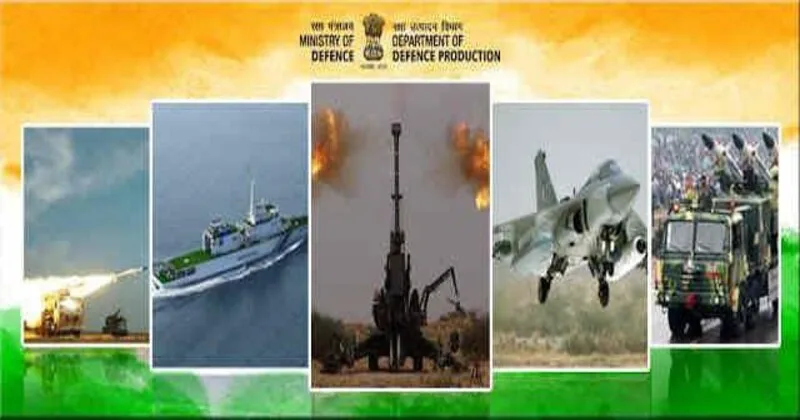
In the cloud of tension, the annual defence production has soared to an all-time high figure of Rs 1,50,590 crore in the Financial Year (FY) 2024-25. This represents a robust 18 per cent growth over the previous fiscal’s Rs 1.27 lakh crore, and a staggering 90% increase since FY 2019-20, when the figure was Rs 79,071 crore. This achievement is not born out of humbleness or perseverance, it is backed by will power of the state.
Defence Minister Rajnath Singh called it a testament to the collective efforts of the Department of Defence Production, Defence Public Sector Undertakings (DPSUs), public manufacturers and private industry. He also stressed that it is a sign that Bharat’s defence industrial base is no longer an aspirational goal rather it is a functioning reality.
Of this record output DPSUs and other PSUs accounted for approximately 77 per cent, while the private sector contributed 23 per cent. The private sector’s share has risen from 21 per cent in FY 2023-24 to 23 per cent in FY 2024-25 marking a yearly growth of 28 per cent as compared to the public sector’s growth of 16 per cent.
This is more than a statistical aside, it is a reflection of the success of reforms in process of de-licensing, streamlining procurement procedures and encouraging partnerships. During the last decade, present government emphasises on indigenisation under Aatmanirbhar Bharat, which has turned private firms to work as marginal suppliers to government entities. So, that procurement delays and supply chain could become better.
Exports: Taking Bharat’s Arsenal from Local to Global
Tariffs might slow trade in some sectors, but Bharat’s defence exports has already shown a record pace. In FY 2024-25, defence exports has reached to Rs 23,622 crore, a rise of Rs 2,539 crore or 12.04 per cent over FY 2023-24’s Rs 21,083 crore.
The government target is ambitious, by the end of 2025 defence export would reach Rs 35,000 crore and Rs 50,000 crore by 2028-29. Achieving the in 2025 target would need exports to be increases by 66 per cent over the FY 2023-24 levels, the trajectory is steep but its highly promising. Even after this much of efforts Bharat share only of 0.2 per cent in the global arms export market between 2016 and 2023, compared to the US (39 per cent), Russia (15 per cent) and France (9 per cent). If Bharat reaches the goal by 2028-29 then it could become a potential player in defence sector. To continue this increased momentum, the Ministry of Defence has announced 2025 as the “Year of Reforms”. Its agenda includes:
Integration of Command: A Progress towards integrated theatre commands.
Emerging Domains: Enhancing capability in cyber, space, artificial intelligence and robotics.
Simplified Procurement: Reducing procurement timelines with easy supply chain management and bureaucracy.
Civil–Defence Collaborations: Expediting technology transfer and knowledge sharing with civilian industries.
These reforms would make Bharat as an increasing production hub which is realized in terms of battlefield gains and export competitiveness.
Budget Realities and Strategic Choices
As per the Stockholm International Peace Research Institute (SIPRI), Bharat’s military spending was the fourth-highest in 2023 at $84 billion, including paramilitary forces. In GDP terms Bharat spends more than some major powers but less than China, whose larger economy allows it to spend over 3.5 times more in absolute terms.
The discussion whether to increase defence spending to 3 per cent of GDP continues in Bharat. In FY 2025-26, this budget expenditure would be of Rs 10.7 lakh crore or 21 per cent of the Centre’s budgeted outlay. Policymakers also warn that sharp budget jumps could run ahead of the military’s capacity to absorb, highlighting the importance of incremental, strategic investment.
The 2021 reorganisation of the Ordnance Factory Board into seven specialised DPSUs has been a major step. These PSUs produce everything from ammunition and explosives to vehicles, weapons, equipment and parachutes. Their role in replacing imports and developing export-ready products is critical to meet the Rs 3 lakh crore indigenous production target by 2028-29. To reach this goal, production must grow at 19 per cent annually over the 2023-24 baseline, more than double the 8% average annual growth between 2016-17 and 2023-24.
F-35 Decision in Perspective of Promoting Aatmanirbhar Bharat
In the context of tariff war government stands on F35 purchase cancellation is of greater significance. The stealth, avionics and interoperability of the aircraft were tempting. But in a tariff-affected trade scenario, where Washington being hesitating on transfer of technology, the purchase threatened to set Bharat up as a dependant buyer like the Pakistan.
Bharat is doubling down its locally based projects for the LCA Tejas Mk-II and the Advanced Medium Combat Aircraft programme. Collaborations with France on the Rafale, co-development with Russia and technology advancement and procurement with Japan are being pursued with a focus on co-production, localize production and export markets.
Tariff negotiations between the US and Bharat are not just about steel, aluminium or Agri-products. They have set up a negotiating environment in which defence contracts become completely dependent with trade concessions. Reason behind Bharat’s confronting US is:
Access to technology: US export controls continue to be a point of contention, restricting Bharat’s attempts to integrate locally produced platforms with imported systems.
Market Leverage: Both countries view defence sales as part of a larger trade package, where tariff tensions can bleed into procurement negotiations.
Strategic Signalling: Bharat’s shift to indigenous production is an economic strategy as well as a diplomatic declaration of self-sufficiency.
The Road to 2028-29: A Climb of Aatmanirbhar Bharat
Bharat will have to reach a production target of Rs 3 lakh crore and an export level of Rs 50,000 crore by 2028-29, which will require a multi-faceted approach. This comprises of increasing the volume of production to reduce unit costs, upskilling the manpower to enable advanced manufacturing processes. Sustained innovation through continuous investments in R&D for future systems and inducing resilience by creating supply chain that will reduce dependency on geopolitical players. The two front war situations from Pakistan and China could be easily contained.
The tariff war may have set the stage, but Bharat’s strategic shift is driven by a broader ambition, to move from being the world’s largest arms importer to a top-tier producer and exporter. The F-35 cancellation is not a back off stage from capability but a redirection of investment into homegrown strength.
With record production of Rs 1,50,590 crore, surging exports and a reform, Bharat 2025 ahead is signalling that its defence future will be built in its own factories, tested in its own proving grounds and when ready the export will be done on its rules. The road ahead is steep, but the engines are running, the runway is clear and the flight plan is firmly set for strategic autonomy.