
Bharat is huge and diverse. Nonetheless, an invisible but distant unifying force keeps the nation alive. This power is Bharat’s culture, which Pandit Deendayal Upadhyay refers to as “Virat.” Bharat continues to live when great civilisations such as Egypt, Greece, and Rome are extinct. Bharat has a long history of influencing global philosophy and culture (China, Japan, and most of Southeast Asia), and it is still needed in the twenty-first century. Bharat must have a rich cultural history to share. It can no longer be restrained by the shackles of words and ideas plucked from elsewhere. Bharatiya wisdom has enormous potential to serve humanity in an unconstrained manner. However, as a first step, the Bharatiyas must redefine, re-describe, and repackage the timeless nature of their Motherland in modern terms for their own assimilation.
According to Deen Dayal Upadhyaya, Chiti offers power and energy, also known as Virat. It protects the nation against distortions and irregularities and encourages national awakening. He believes that only by enabling Chiti and Virat would the nation and its people prosper, experience all forms of temporal and spiritual joys, triumph in the world, and gain glory.
The role of “Virat” in the life of a nation is similar to that of Prana in the body. Just as ‘Prana’ energises various organs of the body, refreshes the mind, and keeps body and soul together, a strong ‘Virat’ is essential for democracy to succeed and the government to work properly. Our country’s diversity does not threaten its cohesiveness. Language, occupation, and other distinctions occur everywhere. When the ‘Virat’ is awake, difference does not lead to conflict, and individuals work together as if they were the many limbs of a human body made up of family members.
Thoughts of Golwarkar Guruji on Swa
The most important job of a newly independent nation’s leadership is to achieve the necessary transition in the mental makeup of its population. Shri Guruji was well aware of the mindset of the newly independent Bharat. The British had subjugated Bharat not just politically and financially, but also culturally and socially. They had been quite effective in their malevolent schemes. The leaders of our Independence War recognised this reality and strove to eradicate this suicidal mindset by promoting Swadeshi, Goraksha, Swabhasha and so on. Following Doctorji, Shri Guruji launched numerous endeavours to enhance public knowledge of these principles through the Sangha. His beliefs about Swadeshi were all-encompassing. His philosophy of Swadeshi extended beyond the use of indigenous commodities and included all aspects of daily life, such as sending marriage invites or program greetings in our native languages and celebrating birthdays in the Hindu tradition, among other things.
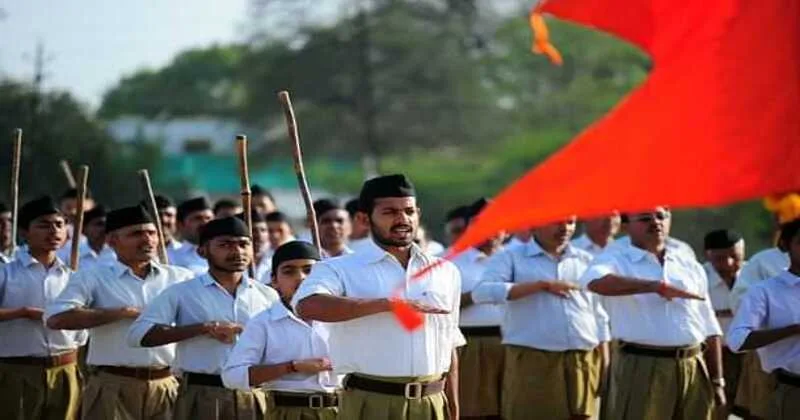
When RSS celebrates its centenary year, and our nation enters the “Amrut Kal” era. To make our nation great and contribute to a better world by 2047, we must follow the philosophies of Swami Vivekananda and Pandit Deendayal Upadhyay. As a society, we must work together with the government to attain these global good goals. RSS thought extensively and developed five points known as “Panch Parivartan”. These are essentially key points.
1. Swa Bodh
2. The Environment
3. Social Equanimity
4. Civic Etiquette
5. Kutumb Prabodhan (Family Enlightenment).
Working on these crucial points will shape the fortunes of our nation. In this sequence, let us go through “Swa Bodh”
Since its inception, the Rashtriya Swayamsevak Sangh has followed Swami Vivekananda’s principles. Swami Vivekananda’s aim was to restore the nation’s glory, and he emphasised various variables with a strong cultural and Dharmic foundation to inculcate in our children a sense of self-reliance in Bharat. RSS not only believes in being self-sufficient Bharat, but it also works on the ground with young people, supports businesses, and engages with governments to achieve it.
Self-reliant Bharat is the means to carry out the tasks of the twenty-first century. Bharat’s self-reliance is focused on global happiness, collaboration, and peace. A culture that believes in ‘Jai Jagat’, is concerned with the welfare of mankind, regards the entire world as a family, prefers the thought of ‘Mata Bhumi: Putro Aham Prithivyah’ in its faith, that culture that regards the Earth as Mother, that Bharat Bhumi, when it becomes self-sufficient, ensures the possibility of a happy-prosperous world. Bharat’s progress has always been linked to global progress.
Why is self-reliance in Bharat necessary for growth?
Let us clarify things on a larger scale. For a long time, we were economically and socially decimated by the Mughals, followed by the British. Even after gaining independence, we were misled into believing that we couldn’t compete with China and other wealthy countries in the manufacturing and service sectors. We gradually became addicted to Chinese products; just look around our home to see how many commodities are made in China; we even began purchasing idols and worshipping material, a form of mental slavery and dependence on China for our survival and other needs, a country that has always betrayed us, supporting our enemy nation Pakistan and its terrorists in their attempts to kill our civilians and soldiers. China fosters and promotes maoism in India. Never supported India on a global scale, but instead opposed and participated in terrorising our people. They never consider regions of the Northeast and Kashmir to be part of India.
Nonetheless, the regulations and institutions established by our previous governments produced tough situations and actually mental anguish for anyone wishing to start a manufacturing or service sector, keeping our economy significantly weaker than China’s. Thanks to the tenacity and determination of our pioneers, such as Tata, Ambani, Adani, Mahindra, and many more, who instilled pride and faith in Indians about our capabilities even under tough circumstances.
Given India’s fast-rising population, any government would struggle to produce an equal number of jobs. Rather than focusing solely on job seekers, efforts should be made to produce more entrepreneurs with the requisite knowledge and abilities. This is where RSS focuses its efforts. The recent situation in Russia and Ukraine highlights the need of self-sufficiency; relying largely on imported fuel and other key goods is perilous. Surprisingly, we import numerous things that were originally invented in India centuries ago, with the appropriate abilities. However, entrepreneurs and employment that could easily be developed in India have become dependent on China. The RSS and affiliated organisations work with the government and other institutions to equip our youth with the essential knowledge and skills.
The situation is changing, and more of these products are being encouraged to be produced in-house and promoted with strong emotional linkages to “Make in India” products. People’s patriotic feelings and pride in Bharatatva have increased, as has their resentment toward adversary nations China and Pakistan. The better the bond between buyer and seller of Indian-made products, the stronger the economy will be year after year, resulting in more jobs. This will essentially make us net exporters. The changing global dynamics will see Bharat play a larger role on the economic front in the coming years, in addition to spiritual and holistic growth-oriented approaches for the benefit of all and balancing and nurturing the environment. The current government’s pro-business policies, as well as a skilled and knowledgeable workforce, will strengthen each sector and propel the economy to new heights in order to compete with China.
Simultaneously, Prime Minister Narendra Modi launched the “Aatmanirbhar Bharat” (Self-Reliant India) program by announcing “Vocal for Local.” According to the Ministry of Commerce, India imports from China smartphones, electrical appliances, power plant inputs, fertilisers, auto components, finished steel products, capital goods such as power plants, telecom equipment, metro rail coaches, iron and steel products, pharmaceutical ingredients, chemicals and plastics, and engineering goods, among other things. This needs to change; hence, a self-reliant movement is required. We are now heading in the correct path toward India’s self-sufficiency by assisting in the in-house manufacturing of various products.
Though our journey to self-reliance in India is bearing fruit thanks to remarkable measures by the central government and a few states, resulting in increased exports, expanding manufacturing, and service activities, we still have a larger market internally, and a larger worldwide market awaits us. Central government initiatives require the backing of all states, bureaucracy, enterprises, industrialists, researchers, scientists, and society as a whole.
Research and Development
Another critical aspect is to prioritise research and development. “The key to success is incremental innovation.” The new education policy emphasises research and development as well as the development of personal and national character. Governments and other stakeholders should focus on implementing it judicially, passionately, and to completion over the next 10 to 15 years. Industry should also focus on and promote innovative ideas, as well as provide youth with new skill sets and opportunities in R&D. It will completely change the mindset of youths to focus on their creative and innovative abilities, indigenous development of new technologies, and providing solutions to the world’s problems.
Indians must understand that our development model is considerably superior and more proven than the European one. India will prosper again if we return to our roots and pursue a development model based on serenity, ethical principles, environmental nurture and balance, and, most importantly, global growth, happiness, and peace.