Ops Sindoor: Chinese weapons fail, Taiwan invasion rethink
June 7, 2026
  • Read Ecopy
  • Circulation
  • Advertise
  • Careers
  • About Us
  • Contact Us
Android AppiPhone AppArattai
Organiser
  • ‌
  • Bharat
    • Assam
    • Bihar
    • Chhattisgarh
    • Jharkhand
    • Maharashtra
    • View All States
  • World
    • Asia
    • Europe
    • North America
    • South America
    • Africa
    • Australia
  • Editorial
  • International
  • Opinion
  • RSS @ 100
  • More
    • Op Sindoor
    • Analysis
    • Sports
    • Defence
    • Politics
    • Business
    • Economy
    • Culture
    • Special Report
    • Sci & Tech
    • Entertainment
    • G20
    • Azadi Ka Amrit Mahotsav
    • Vocal4Local
    • Web Stories
    • Education
    • Employment
    • Books
    • Interviews
    • Travel
    • Law
    • Health
    • Obituary
  • Subscribe
    • Subscribe Print Edition
    • Subscribe Ecopy
    • Read Ecopy
  • ‌
  • Bharat
    • Assam
    • Bihar
    • Chhattisgarh
    • Jharkhand
    • Maharashtra
    • View All States
  • World
    • Asia
    • Europe
    • North America
    • South America
    • Africa
    • Australia
  • Editorial
  • International
  • Opinion
  • RSS @ 100
  • More
    • Op Sindoor
    • Analysis
    • Sports
    • Defence
    • Politics
    • Business
    • Economy
    • Culture
    • Special Report
    • Sci & Tech
    • Entertainment
    • G20
    • Azadi Ka Amrit Mahotsav
    • Vocal4Local
    • Web Stories
    • Education
    • Employment
    • Books
    • Interviews
    • Travel
    • Law
    • Health
    • Obituary
  • Subscribe
    • Subscribe Print Edition
    • Subscribe Ecopy
    • Read Ecopy
Organiser
  • Home
  • Bharat
  • World
  • Operation Sindoor
  • Editorial
  • Analysis
  • Opinion
  • Culture
  • Defence
  • International Edition
  • RSS @ 100
  • Magazine
  • Read Ecopy
Home Bharat

Operation Sindoor shakes Indo-Pacific: How Pakistan defeat exposed Chinese weapons & shattered Taiwan invasion plans

India’s swift and surgical Operation Sindoor not only decimated Pakistan’s terror and military infrastructure but also exposed the glaring weaknesses of Chinese military hardware. The fallout has raised serious questions about Beijing’s ability to execute a future Taiwan invasion

Dr Vishnu AravindDr Vishnu Aravind
Jul 8, 2025, 06:04 pm IST
in Bharat, World, China
Follow on Google News
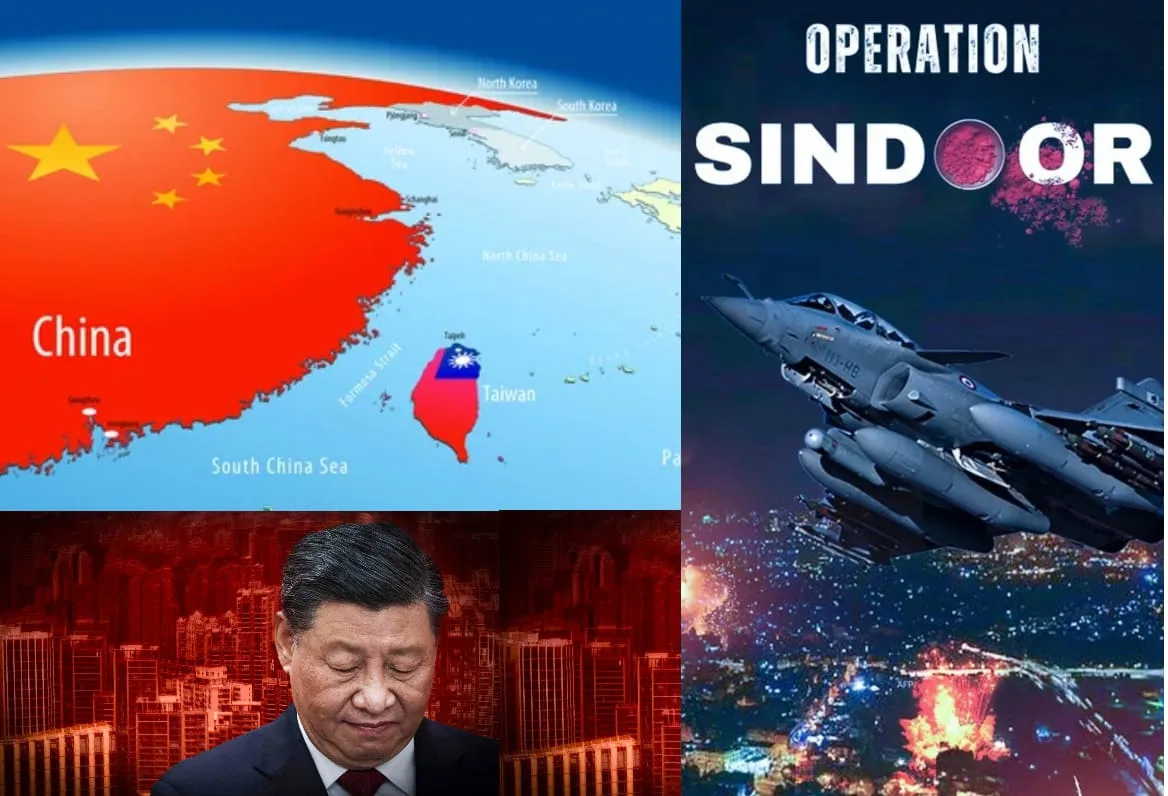
Operation Sindoor Shattered Chinese Plans to Invade Taiwan by 2027

Operation Sindoor Shattered Chinese Plans to Invade Taiwan by 2027

FacebookTwitterWhatsAppTelegramEmail

In a span of just four days, from May 7 to May 10, 2025, India’s Operation Sindoor delivered a decisive blow to Pakistan’s terror and military infrastructure in retaliation for a brutal terrorist attack in Pahalgam that left 26 civilians dead. But beyond its immediate regional impact, the operation has triggered shockwaves in global strategic circles, particularly in Beijing, by exposing the glaring weaknesses in Chinese military hardware. As the world’s eyes increasingly turn towards Taiwan and the possibility of a Chinese invasion, the poor performance of Chinese-supplied weapons in Pakistan has called into question the credibility of China’s military capabilities and its ambitions in the Indo-Pacific.

India’s Precision Strikes Rattle Pakistan’s Defences

India’s carefully calibrated operation, launched in response to the terror strike, saw the Indian Air Force (IAF) carry out precision strikes on Pakistani military sites, including terrorist camps and key airbases like Nur Khan near Islamabad. The IAF deployed a mix of Rafale fighter jets equipped with Xgard electronic warfare decoys, BrahMos-A supersonic cruise missiles, Tata’s ALS-250 loitering munitions, and Israeli-made Harop drones. The outcome was devastating for Pakistan. Despite its air defence shield comprising HQ-9P and HQ-16 systems supplied by China, Pakistan failed to intercept incoming missiles.

Read More: PM Modi at BRICS: “21st century software can’t run on 20th century typewriters,” urges reform of west led institutions

Pakistan, China’s top arms buyer, deployed its front-line Chinese-supplied assets including J-10C fighters, PL-15E beyond visual range missiles, Wing Loong II drones, and HQ-series air defence systems. Yet, they failed to stop Indian strikes or inflict meaningful damage in response. Pakistan claimed it had downed five Indian aircraft, including three Rafales. However, Indian officials and analysts from Jane’s Defence Weekly suggest these were likely Xgard decoys, not actual fighter jets, an assessment bolstered by the lack of wreckage and the continuation of IAF operations.

China’s Military Technology Under the Spotlight

This outcome was more than a military embarrassment for Pakistan; it was a strategic disaster for China. With over 80 per cent of Pakistan’s arsenal being Chinese-made, the conflict inadvertently became a live testing ground for China’s military technology. The results were sobering. The much-vaunted HQ-9P and HQ-16 air defence systems, modeled in part on Russian and Western designs, were unable to stop Indian missiles like BrahMos and SCALP from striking targets near Lahore and Islamabad. Wing Loong II drones, priced economically at $1–2 million, were overwhelmed by India’s electronic warfare and anti-drone systems.

On social media platform X, the performance of Chinese weapons drew widespread ridicule. Prominent accounts like @FrustIndian dubbed it a ‘humiliating outing’ for Beijing’s defence industry. These sentiments were echoed in NDTV’s analysis, which also pointed out critical limitations in the J-10C jets. Notably, the WS-10B engines of the J-10C lack the thrust, fuel efficiency, and survivability of Rafale’s French-built Snecma M88-2 engines. In head-to-head combat scenarios, India’s Rafales had the edge, a worrying sign for the PLA, which fields similar platforms.

Operation Sindoor’s Lessons for Taiwan Conflict Scenarios

For China, the implications extend far beyond the subcontinent. Beijing has been preparing for a potential invasion of Taiwan by 2027, aiming to establish air and naval superiority over the island before any land-based operations. The Taiwan Strait is already patrolled by PLA Air Force J-10C jets armed with PL-15 missiles, the same systems that failed against India. With Taiwan relying on U.S.-supplied F-16Vs, Patriot air defence systems, and U.S. naval reinforcements, the credibility of the PLA’s capabilities now faces deep scrutiny.

A critical vulnerability exposed in Operation Sindoor was the inadequacy of Chinese electronic warfare (EW) systems. India’s Xgard decoys spoofed Pakistan’s Chinese-built KLJ-7A AESA radars, allowing Rafales and missile platforms to evade detection. Analysts like Brendan Mulvaney from the China Aerospace Studies Institute have noted that such EW gaps would be disastrous in a Taiwan conflict, where the U.S. Navy’s EA-18G Growlers and Taiwan’s E-2K AWACS could severely degrade PLA radar and missile lock-on capabilities.

Further, the failure of the PL-15E missiles to effectively engage targets suggests reliability issues in the design or integration of these long-range systems. If the downgraded export version is any indication, even China’s domestic PL-15s may not effectively counter advanced U.S. AIM-120D AMRAAMs. The PLA Rocket Force, which would play a key role in any Taiwan scenario with missile barrages using systems like the DF-21D, will likely need to reassess its assumptions based on the Sindoor outcome.

Repercussions for China’s Arms Market and India’s Strategic Posture

Even China’s intelligence gathering fell short. Despite reportedly using spy satellites and maritime militia in the Indian Ocean to monitor the operation, it failed to anticipate or mitigate the real-time combat failures of its equipment. This gap in real-world performance versus lab-tested assumptions could push the PLA towards a more sobering reassessment of its force readiness, training protocols, and equipment quality.

Financially, the damage is already visible. The initial media hype around Pakistan’s use of J-10Cs had temporarily boosted shares of AVIC Chengdu Aircraft by 40%. But the exposure of ground realities has dented both credibility and market prospects. Countries like Algeria, Egypt, and Sudan, considered potential buyers of Chinese systems, may now reconsider future procurements. China had already faced past criticisms from clients like Bangladesh and Myanmar over defective or underperforming equipment.

India’s success, meanwhile, underscores the advantages of a diversified and integrated arsenal. Combining French Rafales, Israeli drones, Russian missiles, and indigenous platforms like ALS-250, India showcased the value of strategic autonomy and technological resilience. It also highlighted India’s growing edge in electronic warfare and unmanned systems, areas that will be crucial in any future conflict involving the PLA.

For Taiwan and its partners in the Indo-Pacific, Operation Sindoor offers a valuable case study in how PLA weaponry performs under pressure. While a cross-strait conflict would differ in terrain and scope, the lessons from the IAF’s surgical strikes and the meltdown of Pakistan’s Chinese-built defences cannot be ignored. As Shu Hsiao-Huang of Taiwan’s National Defense and Security Research Institute observed, the PLA’s air combat edge may be overstated and that could fundamentally alter Beijing’s invasion calculus.

Operation Sindoor may have been a short operation in a local theatre, but its strategic consequences for Chinese ambitions in Taiwan and beyond are likely to reverberate far longer.


 

Topics: IndiaIndo-PacificPahalgam Terrorist attackOperation Sindoor
ShareTweetSendShareSend
✮ Subscribe Organiser YouTube Channel. ✮
✮ Join Organiser's WhatsApp channel for Nationalist views beyond the news. ✮
Previous News

India sets the record straight at G7: PM Modi rejects US mediation, reinforces sovereign stand on Indo-Pak conflict

Next News

ABVP set to celebrate 77 years of nation-building: Student power illuminates national spirit across Bharat

Related News

Editors of the HAF Wikipedia page run propaganda and disinformation campaign against the organisation, India and Hindu cultural ethos

Wikipedia fuels propaganda against Hindu American Foundation: How anonymous writers demonise Hindu rights group?

The Green Realignment: Why the US-India trade pact is a battle for climate and supply chain security

Indian Army to train 5 lakh personnel in drone operations; Scripting strategic edge in next gen battlefield tactics

Indian surgeon conducts world’s longest cardiac telesurgery; Made-in-India robot echoes indigenous medical prowess

India’s Permanent Representative to the United Nations Ambassador Harish Parvathaneni

India slams Pakistan at UNSC for peddling false narratives on Jammu & Kashmir

A series of high-level engagements signals New Delhi's growing focus on building interoperable security networks across the Indo-Pacific

India strengthens Indo-Pacific security architecture with new defence and maritime partnerships

Load More

Latest News

A representative image generated using AI

Gujarat: Parsi woman Married to a Muslim man cremated with Hindu rites after VHP’s intervention

She showed the "Made in Pakistan" label attached to the bedsheet

Made in Pakistan bedsheet sold at Pune religious fair? Viral video triggers investigation

India's first Prime Minister Jawahar Lal Nehru and India's current Prime Minister Narendra Modi

From ‘Ship to Mouth’ under Nehru to free rations for 80 crore under Modi: Inside India’s food security revolution

Picture from the site of protest

22 million followers, a few hundred on ground: Cockroach Janta Party faces its first reality check at Jantar Mantar

Uttar Pradesh CM Yogi Adityanath

From lawlessness to good governance: How Uttar Pradesh rewrote its law and order story under Yogi Adityanath

Govt mulls Budget press printing for NEET- UG RE-exam question papers (This is an AI generated image)

NEET-UG Re-Exam Security Overhaul: Government mulls budget press printing, IAF transportation to prevent paper leaks

Rahul, Kharge and Jairam vs. India's Great Nicobar Vision (This is an AI generated image)

Great Nicobar Project: Why Congress is opposing Modi government’s strategic mega plan

Union Home Minister Amit Shah and Delhi Police derail sinister plan of Cockroach Janata Party and its founder (This image is generated by AI)

CJP Protest Derailed: How Amit Shah, Delhi Police, Intelligence foiled sinister plan of Cockroach Janata Party

(Left) Victorious Indian Men-s hockey team who who won Gold in U-18 Asia Cup (Right) U-18 Women's hockey team who won bronze medal in the Asia Cup

U18 Asia Cup 2026: Indian Men’s hockey wins gold, women secure bronze medal; PM Modi & Amit Shah hail the teams

India’s semiconductor roadmap shifts from import dependence to silicon sovereignty, aiming for a self-reliant ecosystem by Viksit Bharat 2047

From Import Dependence to Silicon Sovereignty: India’s bold semiconductor roadmap for Viksit Bharat 2047

Load More
  • Privacy
  • Terms
  • Cookie Policy
  • Refund and Cancellation
  • Delivery and Shipping

© Bharat Prakashan (Delhi) Limited.
Tech-enabled by Ananthapuri Technologies

  • Home
  • Search Organiser
  • Bharat
    • Assam
    • Bihar
    • Chhattisgarh
    • Jharkhand
    • Maharashtra
    • View All States
  • World
    • Asia
    • Africa
    • North America
    • South America
    • Europe
    • Australia
  • Editorial
  • Operation Sindoor
  • Opinion
  • Analysis
  • Defence
  • Culture
  • Sports
  • Business
  • RSS @ 100
  • Entertainment
  • More ..
    • Sci & Tech
    • Vocal4Local
    • Special Report
    • Education
    • Employment
    • Books
    • Interviews
    • Travel
    • Health
    • Politics
    • Law
    • Economy
    • Obituary
  • Subscribe Magazine
  • Read Ecopy
  • Advertise
  • Circulation
  • Careers
  • About Us
  • Contact Us
  • Policies & Terms
    • Privacy Policy
    • Cookie Policy
    • Refund and Cancellation
    • Terms of Use

© Bharat Prakashan (Delhi) Limited.
Tech-enabled by Ananthapuri Technologies