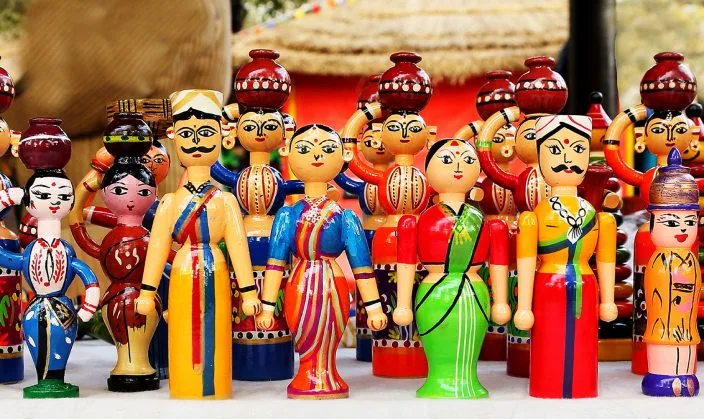
In a stunning turnaround tale fueled by policy changes, quality regulations, and an aggressive ‘Make in India’ drive, India’s toy sector has become one of the best testimonials to the nation’s journey toward Atmanirbharta and international competitiveness. From being utterly dependent on imports, particularly from China, India is now producing toys locally and shipping them out to more than 153 nations, establishing itself as a serious global contender in the toy sector.
At the recently concluded 16th Toy Biz International B2B Expo 2025 in New Delhi, Union Commerce and Industry Minister Shri Piyush Goyal demonstrated this shift, terming it a reflection of India’s growing manufacturing strength and policy continuity under the vision of Atmanirbhar Bharat.
“India’s huge domestic market of 1.4 billion provides a natural advantage to increase toy production scale. Indian toys can go global with good branding, innovative design, and quality focus,” Goyal averred while stating that a new promotional program is being planned by the government to further give a fillip to the industry.
A Spurt in Exports, Dip in Imports
The figures narrate a strong tale of the distance the Indian toy sector has travelled in a matter of just eight years. During 2014-15 to 2022-23, India’s exports of toys grew a whopping 239 per cent from $96 million to $326 million, as per DPIIT data.
During the same time, Indian toy imports experienced a steep fall of 52 per cent, from $332 million to $159 million. This turnaround in trade patterns has practically made India a net exporter of toys, a situation unthinkable a decade back.
One of the major contributors towards this change has been the declining dependence on Chinese imports. India’s Chinese import of toys alone declined drastically from $235 million in the year 2019-20 to mere $39 million in 2022-23. China’s total percentage in the import of toys from India decreased from 84 per cent to 62 per cent, as uncovered in a study done by the Indian Institute of Management (IIM) Lucknow.
Quality at the Center of the Transformation
At the core of India’s success story in the toy sector has been its emphasis on quality improvement and adherence to international standards. The enforcement of the 2020-issued Quality Control Order (QCO) that required strict quality measures for all toys produced and marketed in the country was cited by Minister Goyal. The QCO was applicable from January 2021, making Indian toys comparable to international standards.
“With QCO, India became a quality-focused nation. Our domestic toy makers are now able to cater to international standards and compete on the international stage,” Goyal added.
The Directorate General of Foreign Trade (DGFT) also snapped the noose further around the neck of sub-standard imports by requiring sample testing for all import consignments so that only quality-compliant toys find their way to the Indian markets.
A Manufacturing Ecosystem Built to Last
One of the main results of these policy measures is the quick emergence of a strong domestic manufacturing infrastructure. According to the IIM Lucknow case study “Success Story of Made in India Toys”, India has seen a doubling of toy manufacturing units from 2014 until 2020, a clear sign of confidence and support from the industry as well as the government.
Similarly impressive is the decline in reliance on imported inputs, which has decreased from 33 per cent to 12 per cent over the past six years. This not only enhances India’s position in the global value chain but also protects the industry from outside shocks.
The sector has also witnessed improved labour productivity and a compound annual growth rate (CAGR) of 10 per cent in gross sales value, signalling its economic potential and capacity for scale.
National Action Plan for Toys: A Game-Changer
At the centre of the policy initiative is the National Action Plan for Toys (NAPT), an integrated plan steered by DPIIT and executed by several central ministries. The NAPT identifies 21 action points with a focus on design innovation, quality, skills building, and development of domestic toy clusters.
The Ministry of Micro, Small and Medium Enterprises (MSME) has helped 18 toy clusters in the country, developing regional innovation and production hubs. The clusters have not only increased India’s production capacity but have also generated employment opportunities, especially in rural and traditional sectors.
In addition, specific provisions under the Bureau of Indian Standards (BIS) have facilitated ease of compliance with quality standards for small manufacturers. In excess of 1,200 licenses have been issued to local manufacturers and over 30 to international manufacturers to ensure compliance with quality standards.
The Role of Favourable Tax Regime
A tactical reform of India’s customs tax has also been instrumental in guarding and fostering the local toy sector. The Basic Customs Duty (BCD) on toys was raised from 20 per cent to 60 per cent in February 2020 and further to 70 per cent in March 2023. This has resulted in a level playing field for local manufacturers and curbed the entry of low-cost, low-quality foreign-made toys.
These safety measures have been augmented with positive promotion efforts like The Indian Toy Fair 2021 and Toycathon to foster innovation, promote indigenous products, and create global exposure for Indian brands of toys.
Global Integration: Zero-Duty Access and Beyond
India’s rise as a leading toy exporting nation has been made possible through its globalization into the global value chain. DPIIT Secretary Rajesh Kumar Singh underscored the way zero-duty market access for Indian-origin toys in nations such as the UAE and Australia has created huge export opportunities.
The focus on international cooperation and access to markets is making India a credible alternative to well-established toy manufacturing centers such as China and Vietnam, an objective now being pursued with vigor by the government and the industry players.
“India has emerged as a serious player to be the next big manufacturing hub for toys from around the world. The pieces are in place, and now it’s about scaling, innovation, and international branding,” Singh said.
Startups and Innovation at Centerstage
Innovation is fast becoming the cornerstone of India’s success in the toy industry. Minister Goyal referred to the fact that toy startups have been given great encouragement through schemes such as the Pradhan Mantri Mudra Yojana, expanded to 20 years now, offering collateral-free loans to small enterprises.
The government is also setting up a new marketing scheme for the toy industry, with the intent of improving design strength, packaging, and brand creation. This, alongside the push from the Vocal for Local and Local Goes Global campaigns, will further boost India’s position in the international toy market.
India’s Natural Advantage: A Huge Domestic Market
With 1.4 billion consumers, India has a huge captive market for toys. This, Goyal asserted, puts Indian industry in a particular advantage in ramping up production, realizing cost economy, and eventually competing with international giants.
The expanding domestic market not only ensures stability for the manufacturers but also acts as a guinea pig for innovation, design superiority, and diversification of products.
Quality, Branding, and Design
Still, for this growth path to be maintained and for India to compete favorably internationally, the country’s toy industry needs to focus on three areas which are quality, branding, and design with utmost importance. Minister Goyal emphasized that without excellent product design, catchy packaging, and international-quality standards, it would be challenging to take a greater percentage of the global market.
This feeling was reiterated in the IIM Lucknow report, which highlighted that India would have to adopt technology, utilize e-commerce, invest in brand creation, and partner to solidify its position in the global value chain of toys.
A Shift from Quantity to Value
While production figures and export quantities are staggering, analysts say the next level of growth for India’s toy industry has to be in terms of value addition, creation of intellectual property, and building iconic Indian brands.
To this end, interaction with teachers, parents, and child development specialists to ensure that toys not only entertain but also educate and are culturally relevant is a vital step.
India’s Toy Story is Just Beginning
The turn of fortunes of India’s toy industry from a net importer to a net exporter is a strong testament of what can be achieved through policy targeting, quality regulation, and coordination with the industry by the government.
With its natural scale advantage, policy incentive, and expanding domestic ecosystem, India is set to become not merely the next toy manufacturing giant, but a global leader in defining the toy industry.