In the shadow of progress, the slow death of the Himalayas
August 14, 2026
  • Read Ecopy
  • Circulation
  • Advertise
  • Careers
  • About Us
  • Contact Us
Android AppiPhone AppArattai
Organiser
  • ‌
  • Bharat
    • Assam
    • Bihar
    • Chhattisgarh
    • Jharkhand
    • Maharashtra
    • View All States
  • World
    • Asia
    • Europe
    • North America
    • South America
    • Africa
    • Australia
  • Editorial
  • International
  • Opinion
  • RSS @ 100
  • More
    • Op Sindoor
    • Analysis
    • Sports
    • Defence
    • Politics
    • Business
    • Economy
    • Culture
    • Special Report
    • Sci & Tech
    • Entertainment
    • G20
    • Azadi Ka Amrit Mahotsav
    • Vocal4Local
    • Web Stories
    • Education
    • Employment
    • Books
    • Interviews
    • Travel
    • Law
    • Health
    • Obituary
  • Subscribe
    • Subscribe Print Edition
    • Subscribe Ecopy
    • Read Ecopy
  • ‌
  • Bharat
    • Assam
    • Bihar
    • Chhattisgarh
    • Jharkhand
    • Maharashtra
    • View All States
  • World
    • Asia
    • Europe
    • North America
    • South America
    • Africa
    • Australia
  • Editorial
  • International
  • Opinion
  • RSS @ 100
  • More
    • Op Sindoor
    • Analysis
    • Sports
    • Defence
    • Politics
    • Business
    • Economy
    • Culture
    • Special Report
    • Sci & Tech
    • Entertainment
    • G20
    • Azadi Ka Amrit Mahotsav
    • Vocal4Local
    • Web Stories
    • Education
    • Employment
    • Books
    • Interviews
    • Travel
    • Law
    • Health
    • Obituary
  • Subscribe
    • Subscribe Print Edition
    • Subscribe Ecopy
    • Read Ecopy
Organiser
  • Home
  • Bharat
  • World
  • Operation Sindoor
  • Editorial
  • Analysis
  • Opinion
  • Culture
  • Defence
  • International Edition
  • RSS @ 100
  • Magazine
  • Read Ecopy
Home Bharat

In the shadow of progress, the slow death of the Himalayas

Himachal Pradesh faces a grave ecological crisis driven by unscientific development, climate change, and a nexus of land, mining, and forest mafias. As landslides and floods worsen, the state's fragile Himalayan ecosystem teeters on the brink of irreversible collapse.

Adv Karan ThakurAdv Karan Thakur
Jul 4, 2025, 09:00 pm IST
inBharat
Follow on Google News
Facebook
Twitter
WhatsAppTelegramEmail

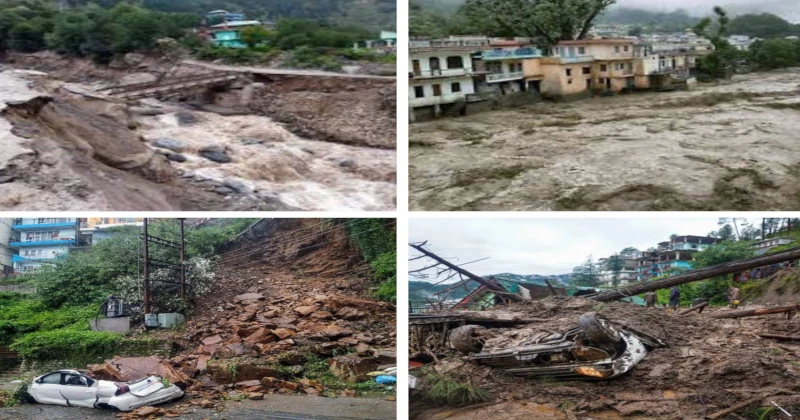
When ancient hills tremble, rivers rage, and forests fall, it is not simply an act of nature. It is a scream. A scream against exploitation. Against mindless greed. Against forgetting our roots. Himachal Pradesh, the land of snow-clad peaks, deodar forests, and spiritual sanctity, is today trembling under the weight of its own betrayal, not by nature, but by man.

In recent years, our beautiful state has become synonymous with destruction, landslides swallowing homes, cloudbursts washing away villages, rivers tearing through valleys, and roads collapsing like paper. These are not isolated events. They are warnings, symptoms of a much deeper disease: ecological degradation brought upon by unsustainable development, institutional failure, and the unchecked rise of mafias that have carved the hills for profit.

The truth is hard, but it must be spoken: nature is reacting, but it is man who has provoked.

Our infrastructure development is unscientific and reckless. Mountains are being hollowed out for tunnels and highways without any consideration of geological fragility. Slopes are cut at impossible angles, retaining walls are token gestures, and disaster risk mapping is ignored. When monsoon rains come, the soil has no roots to cling to, and the land crumbles, because we have severed its spine in the name of progress. In the blind race to build, we have forgotten that mountain ecosystems do not forgive easily.

The climate crisis has added fuel to this fire. Rainfall is no longer seasonal and predictable. Instead, cloudbursts , sudden, violent outpourings of water are becoming frequent. In 2023 and 2024, 2025 Kullu, Mandi, Sirmaur, and Sainj witnessed terrifying scenes: not just flash floods, but torrents filled with cut timber, heavy wooden sleepers, and massive logs. These were not merely trees felled by rain, they were signs of a forest mafia at work. Logs hidden deep in illegal caches flowed openly during floods, exposing a rot that runs far deeper than the roots of any tree.

But the crisis goes beyond water and soil. A dangerous nexus has emerged ,a triangle of destruction , the mining mafia, the land mafia, and the forest mafia. Riverbeds like those of the Swan, Beas, and Ravi are being mercilessly mined, their sand and gravel stolen under the cover of night. Hillsides are scarred with illegal construction. Forest land is mutated on paper, sold for luxury resorts, and passed off as “apple orchards.” Native forests are cleared systematically, sometimes under the pretext of development, sometimes with forged permissions. Entire ecosystems are being converted into monoculture commercial apple plantations , not by local farmers in need, but by outsiders and corporations driven purely by profits. These orchards use pesticides, reduce biodiversity, dry up traditional water sources, and destabilize already fragile slopes.

The land mafia doesn’t just steal soil , it buries truth. Forests are labeled “diseased” to allow logging. Mines operate in eco-sensitive zones with falsified Environmental Impact Assessments (EIAs). Local villagers, whose lives are directly endangered, are rarely consulted. Entire mountains are being handed over, not to protectors, but to plunderers.

And what of accountability? Where are the regulators? Where are the alarms? Unfortunately, most government action is reactive , only responding after lives are lost. There is no comprehensive policy enforcing slope stability studies, or binding carrying capacity audits of hill towns. Towns like Shimla, Manali, and Dharamshala continue to expand unchecked, with no thought for where their water will come from, or where their waste will go.

What’s needed now is not another bureaucratic committee, but a bold, urgent transformation rooted in ecology, not economy. We need strict zoning laws and Himalayan-specific building codes. Every single road, tunnel, or hotel project must be geo-technically audited. A real-time disaster warning system using AI and satellite data must be implemented village-by-village. Local communities must be empowered to participate in decision-making and protect their forests. Native afforestation, watershed revival, and traditional water systems like naulas and khuls must be brought back from the edge of extinction.

Most importantly, the grip of the mafias must be broken. Forest officers and local administrators complicit in illegal timber, mining, or land conversions must be held accountable through an independent investigation monitored by the judiciary or an autonomous environmental commission. The mountains cannot survive if their protectors have become partners in their destruction.

Also Read: DAC unleashes ‘Atmanirbhar Bharat’ power with Rs 1.05 lakh crore boost

I write not as an outsider, but as someone born in these hills , someone who drank from its springs, walked barefoot through pine needles, and watched the clouds roll in like sacred prayers. My first classroom was beneath a peepal tree. My ancestors lived by the rhythm of nature, not in defiance of it. Today, when I see timber logs racing down the floods, I do not see just trees, I see corruption uprooted. When I see hills cracking, I do not see mere landslides , I see the truth bursting through the lies we have built.

We are running out of time. If we do not act now, more people will die , more villages will vanish and more rivers will carry away what little remains of our conscience. If Himachal continues down this path, it will not just be an ecological tragedy, it will be a civilizational one. For in the fall of the Himalayas, falls the soul of our nation.

The Himalayas are speaking. Not in words, but in floods, fires, and falling stones. Will we listen or will we wait until there is no one left to answer?
Topics: Himalayassustainable developmentForest MafiaForest ExploitationEcological Degradation
Share
Tweet
SendShareSend
✮ Subscribe Organiser YouTube Channel. ✮
✮ Join Organiser's WhatsApp channel for Nationalist views beyond the news. ✮
Previous News

Saraswat River: No more mystical

Next News

Kerala Congress shared distorted Bharat map, showing Kashmir as part of Pakistan, deletes after backlash

Related News

Representative Image

Indian Army pitches for 2,715 logistical drones: UAVs will power troops at high-altitude Himalayan battlefields

PM Modi recieves Seychelles ‘Guardian of the Blue Horizon’ title for environmental leadership & sustainable development

World Environment Day: A green future demands more than planting trees

Mountaineer Arun Kumar Tiwari’s tragic death on Everest; Family says he reunited with Bhagwan Shiva in Himalayas

India’s renewable energy revolution is transforming the nation into a global leader in sustainable development and clean energy innovation

India’s Renewable Energy Revolution: Leading the world towards a sustainable future

Kedarnath Dhaam opens from April 22, Wednesday

Kedarnath Opens: A sacred journey into India’s timeless spiritual consciousness

Load More

Latest News

From Guns to Handlooms: Former Naxal Women Walk the Ramp in Raipur

From Bastar’s forests to ramp: Surrendered women Maoists steal show at fashion event in Raipur

1947 Partition and Remembrance Day: When Congress preached unity but fueled the Islamist bloodbath

Remembrance Day and Partition’s Other Architect: The CPI’s role in dividing India

Dr Hedgewar participating in the 1930 satyagraha against the British

Remembrance Day: RSS’ silent shield in India’s twilight hour of Partition in 1947

Fujisawa residents raise concerns over religious practices and the growing presence of non-native culture in their community

Protest against Japan’s Fujisawa Mosque Deepens: Locals oppose Islamic burials and sermons, cite water & air pollution

Partition Remembrance Day

Partition Horrors Remembrance Day: Sindhis committed to nation-building, despite losing the homeland of Sindh

Partition Horrors Remembrance Day

Partition Horrors Remembrance Day: Know why it is important to remember those who became victims of mindless violence

Ram Temple CEO Candidates Faced No Questions on Religion or Personal Lifestyle

Ram Mandir Trust’s CEO Interview: Professional governance takes precedence over personal life in selection process

Representative Image

Why Bharat needs to pursue independence from big tech

India corner opens at Kenya school library; Echoes nation’s freedom struggle, civilisational heritage & growth story

Load More
  • Privacy
  • Terms
  • Cookie Policy
  • Refund and Cancellation
  • Delivery and Shipping

© Bharat Prakashan (Delhi) Limited.
Tech-enabled by Ananthapuri Technologies

  • Home
  • Search Organiser
  • Bharat
    • Assam
    • Bihar
    • Chhattisgarh
    • Jharkhand
    • Maharashtra
    • View All States
  • World
    • Asia
    • Africa
    • North America
    • South America
    • Europe
    • Australia
  • Editorial
  • Operation Sindoor
  • Opinion
  • Analysis
  • Defence
  • Culture
  • Sports
  • Business
  • RSS @ 100
  • Entertainment
  • More ..
    • Sci & Tech
    • Vocal4Local
    • Special Report
    • Education
    • Employment
    • Books
    • Interviews
    • Travel
    • Health
    • Politics
    • Law
    • Economy
    • Obituary
  • Subscribe Magazine
  • Read Ecopy
  • Advertise
  • Circulation
  • Careers
  • About Us
  • Contact Us
  • Policies & Terms
    • Privacy Policy
    • Cookie Policy
    • Refund and Cancellation
    • Terms of Use

© Bharat Prakashan (Delhi) Limited.
Tech-enabled by Ananthapuri Technologies