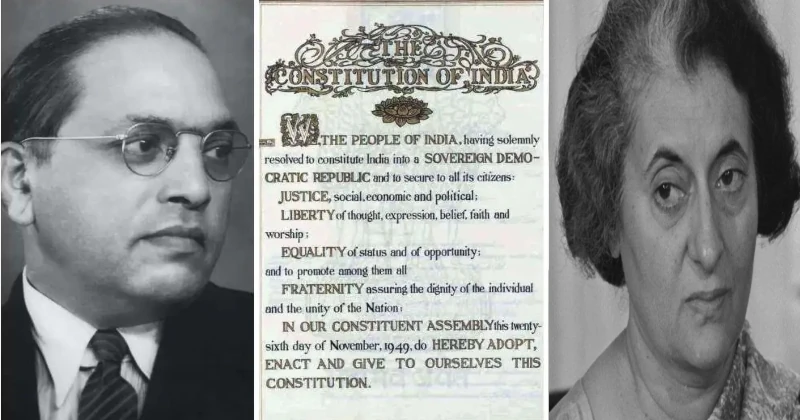
On June 26, 2025, Rashtriya Swayamsevak Sangh (RSS) Sarkaryawah Dattatreya Hosabale, speaking at an event in New Delhi commemorating 50 years of the Emergency, urged a national debate on the inclusion of “secular” and “socialist” in the Preamble of India’s Constitution. Addressing the gathering at the Ambedkar International Centre, Sarkaryavah emphasised that these words, inserted during the Emergency through the 42nd Amendment of 1976, were not part of the original Constitution drafted by Dr BR Ambedkar. His call resonates with the democratic principles championed by Ambedkar and the Constituent Assembly, which rejected a similar proposal in 1948. This is a necessary discussion to honour the Constitution’s original intent while exposing the Congress party’s hypocrisy in accusing the BJP-RSS of threatening the Constitution when it was Congress that altered it during an authoritarian era.
The Constituent Assembly Debates of November 15, 1948 (Volume VII, 7.53.24–45) provide critical insight into this issue. Prof. K.T. Shah proposed amending Article 1 to describe India as a “Secular, Federal, Socialist Union of States.” Shah argued that “secular” would affirm the state’s neutrality toward all religions, citing India’s communal history to underscore the need for equality (7.53.26–28). He defined “socialism” as ensuring economic justice and equal opportunity without eliminating private property (7.53.29–31). Dr. Ambedkar, the Drafting Committee Chairman, opposed Shah’s Amendment with compelling reasoning. He argued that the Constitution should serve as a framework for governance, not a platform for imposing specific ideologies. “What should be the policy of the State, how the Society should be organised in its social and economic side are matters which must be decided by the people themselves according to time and circumstances,” he stated (7.53.42). Embedding “socialist” would restrict future generations’ freedom to choose their social order, as “thinking people” might devise better systems than socialism (7.53.43). Ambedkar also deemed the Amendment unnecessary, as the Directive Principles of State Policy (Part IV) already incorporated socialistic goals, such as equitable distribution of resources. “If these directive principles… are not socialistic in their direction and in their content, I fail to understand what more socialism can be,” he remarked (7.53.44). On “secular,” Ambedkar remained silent, likely because Fundamental Rights (Articles 25–28) already guaranteed religious equality and non-discrimination, rendering the term redundant. The Constituent Assembly, guided by Ambedkar’s logic, rejected Shah’s Amendment, preserving the Constitution’s ideological flexibility.
This historical context contrasts sharply with the Congress party’s actions during the Emergency (1975–77). Under Indira Gandhi’s leadership, the Congress government imposed 21 months of authoritarian rule, suspending fundamental rights, imprisoning over one lakh citizens, and enforcing mass sterilisations of over 60 lakh people. The judiciary was crippled, and the press was silenced. During this period, the 42nd Amendment was enacted, inserting “secular” and “socialist” into the Preamble without meaningful parliamentary debate or public consensus. This act was a direct affront to the democratic process Ambedkar championed, as it exploited a climate of fear to alter the Constitution’s core identity.
Hinduism, with its ancient philosophy of Vasudhaiva Kutumbakam—the world is one family—has been a fundamental force in shaping India’s secular ethos for centuries, long before the word “secular” was added to the Preamble in 1976. Rooted in pluralism, Hinduism embraces diverse paths to truth, promoting coexistence and respect for all faiths, as seen in India’s historical assimilation of Jainism, Buddhism, Sikhism, and later Christianity and Islam. This intrinsic inclusivity, reflected in texts like the Rig Veda (“Ekam Sat Vipra Bahudha Vadanti” – truth is one, sages call it by many names), has enabled India to remain a vibrant mosaic of religions without needing a constitutional label to define its secular character.
The Supreme Court has addressed the Preamble’s amendments in landmark cases. In Kesavananda Bharati v. State of Kerala (1973), the Court established the “basic structure doctrine,” limiting Parliament’s power to amend essential features of the Constitution. In S.R. Bommai v. Union of India (1994), the Court upheld secularism as part of the basic structure, defining it as equal treatment of all religions, consistent with India’s cultural ethos, but did not explicitly rule on the 1976 insertion. These rulings leave room for debate on whether “secular” and “socialist” are indispensable to the Constitution’s core, supporting Sarkaryavah’s call for discussion.
Congress’s current narrative, accusing the BJP-RSS of plotting to undermine the Constitution, is a masterclass in hypocrisy. Leaders like Rahul Gandhi wave the Constitution at rallies yet fail to acknowledge their party’s role in violating it during the Emergency. Congress has never apologised for jailing dissenters, curbing freedoms, or amending the Preamble under duress. Their 42nd Amendment was a political manoeuvre, not a reflection of the Constituent Assembly’s deliberative process. In contrast, Sarkaryavah’s remarks seek an open dialogue to align the Constitution with Ambedkar’s vision of a democratic framework that empowers future generations.
The Sarkaryavah’s call is not about dismantling the Constitution but about restoring its original spirit, free from the distortions of Congress’s Emergency-era policies. India’s youth must learn about the Emergency’s atrocities and the Constituent Assembly’s wisdom. We should stand for a Bharat rooted in its civilisational values, where democracy thrives through debate, not diktats. Congress must own its past and apologise before preaching constitutional sanctity. Let us honour Ambedkar by discussing the integrity of the Preamble, ensuring our Constitution remains a beacon of democratic freedom.