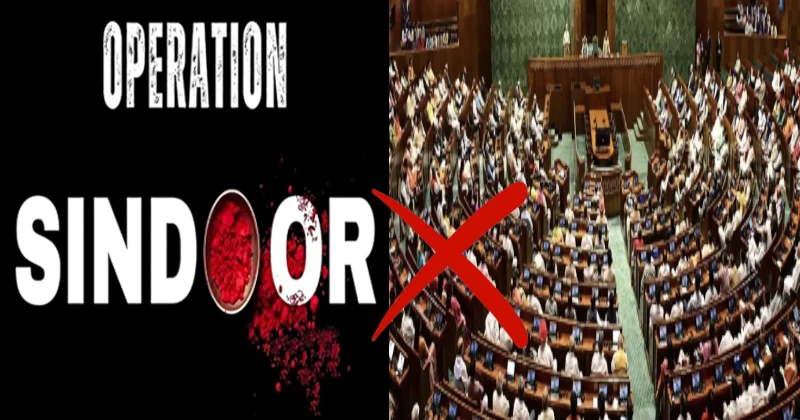
A demand for a special session of Parliament on Operation Sindoor by some opposition parties has generated intense discussion on the subject. The Modi government has already announced the Monsoon session of Parliament, scheduled to take place from July 21 to August 13. The government’s stand is that all issues related to Operation Sindoor should be raised in the impending session, which is just a month away. The first phase of Operation Sindoor, from May 7 to 10, resulted in an outstanding military victory for India over Pakistan. India has only temporarily halted operations against Pakistan, and thus Operation Sindoor continues. It is essential to assess how a special session of Parliament at this stage affects the precious time required to enhance operational preparedness.
Let us also understand how the armed forces prepare for a special session of Parliament, particularly when it is dedicated only to security issues. The statement of the government is drafted by each Service HQ and invariably approved by the respective Service Chief. Extra time will be needed to draft the military response and address likely questions from Members of Parliament. There will be internal discussions under the chairmanship of the Raksha Mantri, and all the Service Chiefs and the CDS may have to spend considerable time refining the official statements and declarations. In my opinion, such precious time should be spent on enhancing operational preparedness and boosting the morale of the forces.
Some opposition parties are presenting a peculiar logic, suggesting that a special session of Parliament was held even during the 1962 war with China. They need to be informed that today’s warfare and conflict management are significantly different from those of the 1960s. Incidentally, this is the only war that India has lost since independence. Additionally, no special session of Parliament was convened during the 1965 and 1971 Indo-Pakistani wars. Nor any special session was held during the 1999 Kargil War (Operation Vijay) with Pakistan. Therefore, there is little precedent little precedent for a special session of Parliament during war or similar war-like situations. The demand is politically motivated.
More importantly, the military and strategic implications of holding such a special session must be put in the correct perspective. After the cessation of hostilities with Pakistan on May 10, the Indian armed forces and the border-guarding paramilitary forces are still on high alert. In the last month, the Indian armed forces would have quickly analysed the threat from Pakistan. Indian intelligence agencies must examine how Pakistan is enhancing its defence capabilities in the short and long term. In future, Pakistan is expected to be militarily better prepared in a conflict with India, mainly with China and Turkey’s assistance. Thus, India must also be fully prepared to deal with new challenges from Pakistan.
The American support for Pakistan and the reported invitation to its Army Chief Asim Munir to attend the Army Day parade in the US is more out of a strategic necessity. But such a position from the US also suggests that India cannot depend on the Americans for unilateral support in the fight against terrorism, particularly that emanating from Pakistan. Russia is once again deeply embroiled in a war against Ukraine and thus may not be in a position to supply critical military hardware to India in time. Israel, another strategic partner of India, is engaged in war with Iran. Indian military leadership must, therefore, be extra busy, along with officials from the Ministry of Defence (MoD), to address internal deficiencies, undertake emergency acquisitions from new sources, and plan the long-term delivery of military hardware.
The focus at this point should be to encourage public and private industries to manufacture military hardware, arms, ammunition, and specialised equipment on a priority basis. This important attribute of self-reliance in defence should not be left just to the MoD. The public defence industry is located all over the country, and the local political leadership should provide an enabling environment for the workers of these industries. The private defence industry has performed well over the last five years and is now actively involved in manufacturing key force multipliers, such as drones and UAVs. A complete synergy of efforts is needed to ensure sufficient reserves of arms and ammunition in case of a prolonged conflict with Pakistan.
Now comes the question of the Indian government’s stand on the heinous terror attack at Pahalgam on April 22 and Operation Sindoor in its aftermath. India conducted daily briefings during Operation Sindoor through two serving women officers from the Army and Air Force in the presence e of the Foreign Secretary. A detailed interaction with the media was conducted by the DGMOs of the Army, Navy, and Air Force on May 11 and 12, during which all essential aspects of military operations were conveyed to the public.
Prime Minister Narendra Modi addressed the nation on May 12. The key highlights of this address convey India’s new policy against terrorism. PM Modi said that terror and trade cannot go hand in hand, and he gave a message to Pakistan that IWT will remain held in abeyance. The second highlight was that India will not make any distinction between the terrorists and the country that sponsors them. The third highlight was that India will not tolerate nuclear blackmail and target the terrorist bases operating under the guise of such threats. Essentially, Operation Sindoor is the ‘new normal’ of India against terrorism, and the operation has just been paused. PM Modi also said that it was Pakistan which pleaded for a ceasefire and that the decision to halt the operation was a bilateral one between India and Pakistan.
Now, every piece of piece of information that the country needed to know has been conveyed. What has not been intimated is reserved for conveyance once Operation Sindoor is successfully concluded on India’s terms. Therefore, opposition seeking details of how many aircraft India lost is premature. Mind you, Pakistan has suffered very severe losses and yet Pakistan’s armed forces have not confirmed any such details. Instead, they are claiming victory over India. This is not surprising considering that Pakistan still does not accept that it lost the 1971 war with India, where East Pakistan became independent Bangladesh. Therefore, in the larger interest of national security and strategy, no unnecessary details of Operation Sindoor should be divulged, which would strengthen Pakistan’s false narrative.
Given the above, I have the following suggestions to make. Firstly, the government should convene an all-party meeting sometime around 17-18 July. It should share all the information as considered relevant to the leaders of the opposition parties. This exercise should be strictly confidential to prevent any information from the meeting from being leaked into the public domain. Before this event, all parliamentarians should be briefed by the Indian Army, Navy, and Air Force on how modern war is prosecuted and what is expected of them to strengthen India’s narrative and perception management against Pakistan and China. Only then would all our esteemed parliamentarians be on the same page to convey India’s strategic viewpoint.
During the Monsoon session of Parliament, both the ruling and the opposition should be seen and heard, conveying Pakistan’s role in sponsoring terrorism in India and its links with terror elsewhere. The session should also convey a clear message about India’s new normal in combating terrorism to the US, China, and other major international powers. The tone and tenor of the speeches should be similar to what our seven all-party delegations achieved around the globe. After the session, the Indian Parliament should adopt unanimous resolutions against terrorism and in support of its new policy towards terrorism. The Parliament can also reiterate the 1994 Parliament resolution on Pakistan-Occupied Jammu & Kashmir (POJK). India should hereafter use the term POJK in all official communication.
In an increasingly fragmented world, India’s greatest strength lies in the unity of its people. Every Indian has celebrated the victory of the Indian armed forces in Operation Sindoor. Since all the political parties gave their unconditional support to the Modi government following the Pahalgam terror attack, the success of Operation Success can be seen as a victory for all political parties as well. The next session of Parliament should further demonstrate to the world that India remains fully united politically, too, in its fight against terrorism and in safeguarding its national security interests. Jai Bharat!