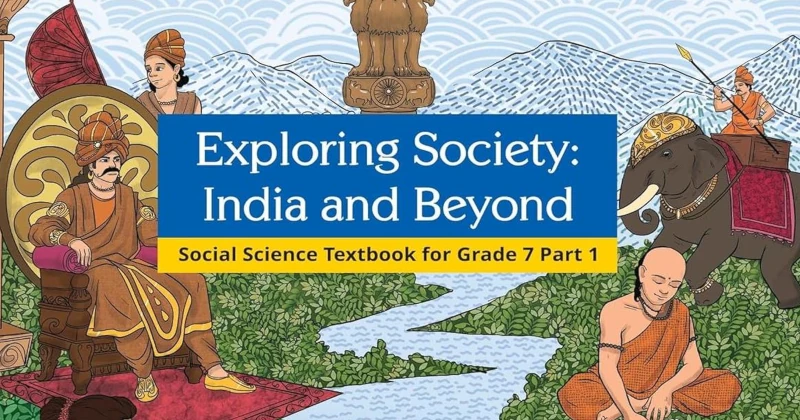
In a significant step aligned with the National Education Policy (NEP) 2020, the National Council of Educational Research and Training (NCERT) has released its much-awaited new textbooks for Class VII. Among the highlights is the fully integrated Social Science textbook, which brings together History, Geography, Political Science, and Economics into a single, cohesive volume. The textbook not only aims to streamline content but also offers a more relatable, Indian-centric, and visually engaging learning experience.
The new textbook moves away from the old style of teaching that was heavily influenced by colonial thinking and focused mostly on memorizing facts and dates. For many years, students had to study Social Science subjects like History, Geography, Civics, and Economics from separate books, often without understanding how they were connected. The new book has changed that by bringing all these subjects together in one volume. Now, each chapter is designed to show how different topics relate to each other. For example, how a historical event affected geography, how political decisions shaped the economy, or how natural resources influenced people’s way of life.
The new NCERT textbooks for class VII are out. Below are images of the integrated social science textbook (history, economics, geography etc). Note that the images are clear and in colour, the economics section teach ideas using modern examples, and history tries to focus on… pic.twitter.com/hB7oMpscog
— Sanjeev Sanyal (@sanjeevsanyal) June 10, 2025
One of the most noticeable changes is the visual design of the book. The pages are printed in full colour, with high-resolution images, infographics, illustrations, and maps. Every chapter includes QR codes that link to videos, government portals, and digital quizzes, many of which are hosted on the government’s DIKSHA platform. These digital features are expected to make learning interactive and accessible, particularly in rural areas where students increasingly rely on smartphones. The change also addresses previous complaints about outdated visuals and poorly printed content in older NCERT books.
“This is not just a change in structure; it’s a change in philosophy,” an NCERT official said. “We are moving away from a fragmented model towards a more holistic understanding of society.”
Officials confirmed that this new format was crafted after months of expert consultations, field feedback, and review of global best practices, all within the framework of the NEP 2020 vision.
One of the most visible transformations is in the History section. Gone are the long lists of dates, monotonous timelines, and dry event summaries. The new History chapters have been written in a storytelling format, allowing students to emotionally engage with events and understand their broader cultural and social context.
Instead of focusing predominantly on colonial encounters, the textbook gives prominence to lesser-known but impactful Indian dynasties, local heroes, and indigenous knowledge systems.
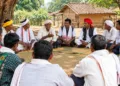
For example, a chapter titled “Journeys Through Time” traces the evolution of communities through stories, folk narratives, and oral histories. Another chapter highlights the concept of local governance in ancient India through examples of village republics and assemblies, subtly promoting pride in India’s democratic roots long before colonial influences.
Experts believe this approach will help students relate better to the material and move beyond a victimhood narrative often associated with colonial historiography. Rather than teaching through graphs and heavy terminology, the chapters now use modern-day scenarios to illustrate fundamental economic concepts.
A chapter on trade, for instance, features the journey of a fruit vendor using digital payments to expand her small business. It discusses not only supply and demand but also access to credit, the role of government schemes, and the impact of local entrepreneurship. Students are introduced to terms like microeconomy, value chain, and market forces using examples from their own surroundings: rural mandis, mobile apps, and even school canteens.
Government initiatives such as the PM SVANidhi Scheme, Jan Dhan Yojana, and UPI are featured as real-world case studies, reinforcing the idea that economics is not just theory but a living, breathing part of their daily lives.
The Political Science section, traditionally seen as dry and abstract, has also undergone major restructuring. Titled “Civics and You”, the section explains governance, rights, and responsibilities through student-led initiatives, school parliaments, and community interactions.
Children are guided to explore questions such as: How is a school council elected? What happens in a Gram Sabha? Why are public spaces important for democracy?
Instead of asking students to memorize constitutional provisions, the textbook encourages them to participate, question, and reflect. This participatory pedagogy fits squarely within the government’s Jan Bhagidari (citizen participation) ethos.
Aligning with NEP 2020: Skill-Based, Inquiry-Driven
The new textbook aligns closely with the core goals of NEP 2020 especially its focus on reducing content load, promoting conceptual clarity, and encouraging critical thinking. Each chapter concludes with sections titled “Think and Reflect”, “Discuss with Friends”, and “Explore More”, designed to build skills in inquiry, dialogue, and expression.
In another shift, traditional textbook exercises have been replaced by activity-based learning tasks. In one activity, students are asked to map the water usage of their family and compare it with national averages, thereby learning not only data analysis but also the importance of resource conservation.
Recognising that such a transformative textbook would also require a shift in teaching methodology, NCERT and the Ministry of Education have launched a nation-wide teacher training initiative. More than 1.5 lakh teachers have already undergone training through online and hybrid formats. New teaching guides have also been released, providing sample lesson plans, activity ideas, and tips for evaluation.
The Ministry has also made available interactive e-versions of the textbook for free through the ePathshala and DIKSHA platforms. One of the long-standing criticisms of Indian school education was its excessive dependence on colonial historiography, imported theories, and western frameworks. The new Class VII textbook consciously tries to change that narrative.
Without denying the darker periods of history, the book places a stronger emphasis on India’s indigenous knowledge systems, traditional livelihoods, ancient democratic structures, and the strength of community life. The textbook highlights Indian thinkers, scientists, and philosophers many of whom were omitted or marginalised in earlier syllabi. The objective is clear: to foster national pride without turning history into propaganda.
Speaking on the release, an NCERT advisor said, “We are not whitewashing history. We are simply making space for the stories that were long left out.”
Future Editions and Feedback Mechanism
The NCERT has also confirmed that this is part of a phased rollout. Textbooks for other classes will be introduced gradually, with Class VI and IX scheduled next. A new online Textbook Feedback Portal has been launched where teachers, parents, and students can submit suggestions, ensuring that the material remains dynamic and responsive. “This is not the final product, but the first big step,” the official added. “With every edition, we’ll improve based on feedback.”