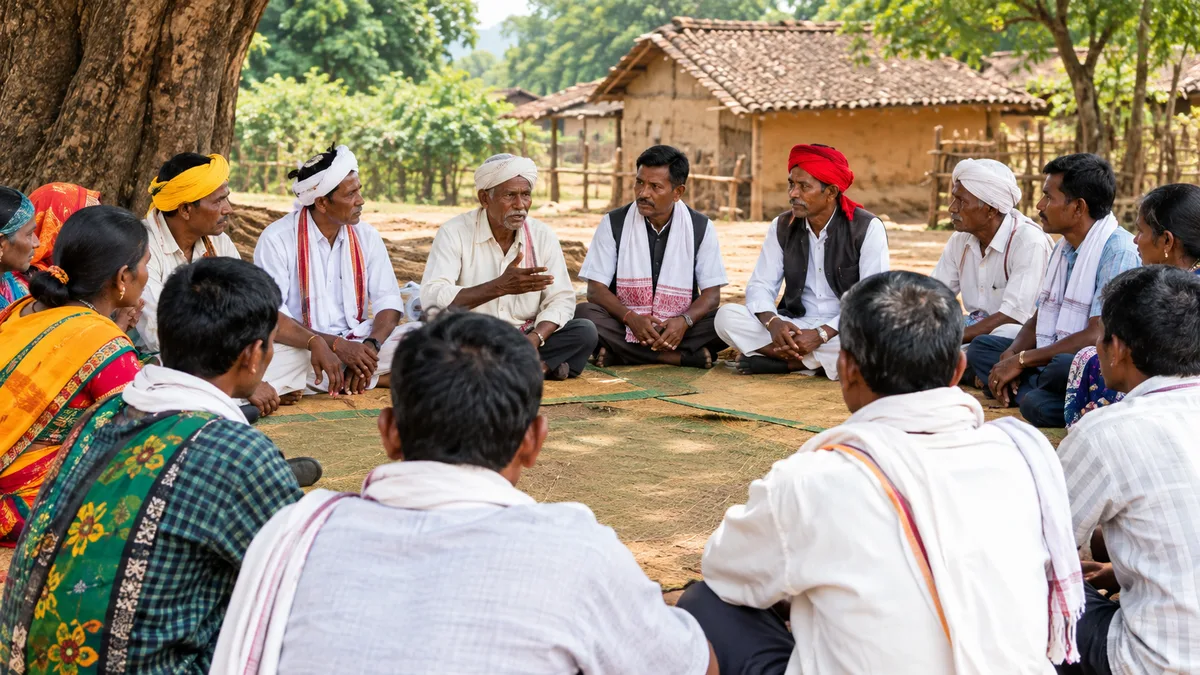
Kanker: An important meeting of the heads of the traditional social system was held in Rengawahi village of Metta Pargana, located in the Koylibeda block of Kanker district, Chhattisgarh. At the meeting, the Majhis, Gaitas and Patels held detailed discussions on issues related to the community’s identity, cultural heritage, traditions and community rights.
After lengthy deliberations, a unanimous decision was taken to keep the community connected with its traditional roots and strengthen its customs and traditions. It was also decided that people from several villages in Koylibeda block will now leave the Christian faith and return to their tribal culture.
Deliberations held in the presence of traditional leadership
The meeting held in Rengawahi village was attended by the traditional leaders of Metta Pargana, including the Gaitas, Patels and Majhis. The main objective of the meeting was to collectively deliberate on issues related to the community’s present social environment, unity, existence, identity and development. The social leaders said that the strength of any community lies in its collective consciousness and in remaining connected with its cultural roots.
Discussion on constitutional rights in the context of religious conversion
The issue of illegal religious conversions reportedly emerging in the area was also discussed in detail at the meeting. The social leaders said that it was essential to ensure that every member of the community was made aware of the provisions available under the Constitution and the law to deal with such cases. Particular emphasis was placed on raising awareness within the community about constitutional rights and legal remedies.
Emphasis on the fifth schedule and PESA
Speakers also placed the provisions of the Fifth Schedule applicable to Scheduled Areas and the Panchayats (Extension to Scheduled Areas) Act, or PESA, at the centre of the discussions. They said that an understanding of these constitutional and legal provisions was essential for protecting community rights relating to water, forests, land and local cultural traditions. Those present at the meeting were informed of the need to raise awareness about these rights and protect them at the community level.
Supreme Court judgements cited
Various historic judgements of the Supreme Court were referred to during the meeting to explain the community’s legal and constitutional rights. The social leaders said that, in the absence of adequate knowledge of their rights, communities are unable to effectively use the constitutional protections and legal remedies available to them. Therefore, they said, raising awareness among members of the community about their rights, duties and the remedies available under the law is the need of the hour.
Unanimous decision to strengthen traditions
Following detailed deliberations, the meeting unanimously decided that the community would remain connected with its traditional roots and cultural identity. Collective efforts would also be made to further strengthen traditional customs and social practices. The social leaders acknowledged that, amid changing times, safeguarding cultural identity is important for the future of the community.
Meeting concludes with a resolve for unity
At the conclusion of the meeting, a resolve was made to maintain social harmony, strengthen mutual unity and work together on issues concerning the welfare of the community. The decision taken in the presence of the Majhis, Gaitas and Patels is being regarded as an important step towards strengthening the community’s traditional social system and cultural identity.