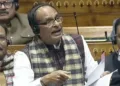
In a shocking revelation, Bharatiya Janata Party (BJP) MP Nishikant Dubey has reignited a political firestorm by sharing a declassified letter from March 25, 1987, sent by then-US President Ronald Reagan to former Indian Prime Minister Rajiv Gandhi. Dubey alleges that Rajiv Gandhi sought US assistance in negotiations with Pakistan, a move that appears to contravene the 1972 Shimla Agreement, which mandates bilateral resolution of disputes between India and Pakistan without third-party mediation. This disclosure, coupled with Dubey’s critique of the Congress party’s historical decisions, raises questions about the party’s commitment to India’s sovereignty and its handling of national security, particularly in the context of recent tensions following the Pahalgam terror attack and Operation Sindoor in 2025.
The 1987 Letter: A Breach of the Shimla Agreement?
The letter, delivered by the US Ambassador to India, reveals that Rajiv Gandhi proposed the inclusion of American drug liaison agents in bilateral talks with Pakistan on cross-border narcotics smuggling. Reagan responded positively, stating, “I was particularly interested in the proposal in your letter of January 7 that American drug liaison agents be associated with your bilateral narcotics consultations… I assure you we will be happy to assist in whatever ways you and the government of Pakistan find helpful.”
While the letter does not explicitly confirm a request for direct mediation in broader India-Pakistan disputes, it suggests a willingness to involve the US in sensitive bilateral discussions, which Dubey argues undermines the Shimla Agreement’s core principle of excluding third parties.
Dubey’s post on X sharply questioned this move: “It is not easy to be Gandhi. This letter is in reply to a letter written by US President Ronald Reagan to the then Indian Prime Minister Rajiv Gandhi. When it was decided under the 1972 Shimla Agreement that any dispute between India and Pakistan would be negotiated only between the two countries and there would be no mediator, why did the then Indian Prime Minister Rajiv Gandhi ask for US President Reagan’s help in negotiating with Pakistan?” This accusation frames Rajiv’s outreach as a betrayal of India’s commitment to bilateralism, a stance India has consistently upheld, especially in the context of Jammu and Kashmir.
The timing of this revelation is significant, coming amid heightened India-Pakistan tensions following the April 22, 2025, Pahalgam terror attack, which killed 26 civilians, and India’s retaliatory Operation Sindoor. The operation showcased India’s indigenous defence capabilities, including the BrahMos missile and Akash SAM system, thereby reinforcing the country’s self-reliance. Dubey’s critique leverages this backdrop to question Congress’s historical reliance on foreign powers, contrasting it with the current government’s firm rejection of US mediation claims by President Donald Trump and Secretary of State Marco Rubio in 2025.
Congress’s Historical Pattern
Dubey’s allegations extend beyond Rajiv Gandhi, painting a broader picture of the Congress party’s alleged willingness to compromise national interests through foreign involvement. Previously, he cited a declassified 1971 US intelligence cable, claiming that former Prime Minister Indira Gandhi, Rajiv’s mother, succumbed to American pressure during the Bangladesh Liberation War, halting military operations despite opposition from then-Defence Minister Jagjivan Ram and Army Chief Sam Manekshaw. Dubey argues that Indira prioritised the creation of Bangladesh over reclaiming Pakistan-occupied Kashmir (PoK) and securing assets like the Kartarpur Gurdwara, questioning, “Was the priority for India to take back its land and the Kartarpur Gurdwara, or to create Bangladesh?”
This narrative suggests a pattern of Congress leaders seeking external intervention, undermining India’s sovereignty. Dubey’s reference to the 1971 war implies that Indira’s decision was influenced by fear of China and US pressure, a claim that resonates with the claims that Congress has historically prioritised geopolitical compromises over territorial integrity. The 1987 letter, in this context, is presented as another instance of the Gandhi family’s alleged deference to foreign powers, particularly the US, at critical junctures.
Congress’s Controversial History under Scrutiny
Dubey’s accusations align with other historical incidents that have fueled skepticism about Congress’s national security decisions. One notable example is the Bhopal Gas Tragedy of 1984, where Rajiv Gandhi’s administration faced allegations of facilitating the escape of Union Carbide CEO Warren Anderson, the prime accused in the disaster.
Reports suggest that US President Reagan personally called Rajiv to secure Anderson’s release, raising suspicions of a quid pro quo. This incident coincided with Reagan granting clemency to Adil Shahryar, a close friend of Rajiv, convicted of serious charges in the US. BJP leaders have speculated that Rajiv’s leniency toward Anderson was a trade-off for Shahryar’s pardon, further tarnishing Congress’s image as compromising national interests for personal or diplomatic gains.
Additionally, Rajiv Gandhi’s foreign policy decisions, such as sending the Indian Peace Keeping Force (IPKF) to Sri Lanka in 1987, have been criticised for entangling India in a costly conflict with the Liberation Tigers of Tamil Eelam (LTTE). The IPKF’s deployment, followed by its withdrawal amid heavy losses, and Rajiv’s subsequent assassination by an LTTE suicide bomber in 1991, highlight the repercussions of his foreign interventions. The Jain Commission report later named suspects, including cleric Chandraswami, in the assassination, pointing to a web of international connections that critics argue Congress failed to manage effectively.
Rajiv’s reversal of the 1988 Maldives coup and his handling of the Punjab insurgency, including Operation Black Thunder, also reflect a mixed record. While Congress supporters credit him with decisive action, opponents argue these moves often relied on external advice or support, diluting India’s autonomy. The Rajiv-Longowal Accord of 1985, intended to resolve the Punjab crisis, collapsed due to deteriorating law and order, leading to President’s rule in 1987, further questioning Congress’ ability to handle internal security without external crutches.
Operation Sindoor and the Current Context
The 2025 Pahalgam terror attack and India’s Operation Sindoor have intensified scrutiny of India-Pakistan relations, making Dubey’s revelations particularly potent. Operation Sindoor showcased India’s indigenous defence prowess, with systems like BrahMos, Akash, and D4 anti-drone technology effectively countering Pakistani threats. This success has bolstered the BJP’s narrative of self-reliance, contrasting sharply with Congress’ alleged history of seeking foreign assistance. Dubey’s posts on X frame Congress’ actions—both in 1971 and 1987—as compromises that weakened India’s strategic position, especially on issues like PoK, which remains a flashpoint.
The letter’s reference to narcotics consultations also raises questions about Rajiv’s intent. While cross-border smuggling was a concern in the 1980s, involving the US in bilateral talks could be seen as a pragmatic move to leverage American expertise. However, Dubey argues it opened the door to broader US influence, inconsistent with India’s non-aligned stance and the Shimla Agreement’s spirit.
BJP MP Nishikant Dubey’s revelation of Rajiv Gandhi’s 1987 letter to Ronald Reagan has reignited debates about Congress’ historical approach to national security and sovereignty. By alleging that Rajiv sought US involvement in India-Pakistan talks, Dubey challenges the party’s adherence to the 1972 Shimla Agreement, framing it as part of a pattern of compromising national interests, from the 1971 ceasefire to the Bhopal tragedy. While Congress disputes these claims, arguing the letter pertains to narcotics cooperation, the controversy underscores persistent questions about the party’s legacy.
In the wake of Operation Sindoor’s success, which highlighted India’s self-reliant defence capabilities, Dubey’s critique amplifies the BJP’s narrative of a stronger, independent India, free from the foreign entanglements allegedly favoured by Congress. As the debate unfolds, the 1987 letter remains a flashpoint, inviting further scrutiny of India’s diplomatic history and its implications for current geopolitics.