A shocking terrorist attack close to Pahalgam in Kashmir resulted in the death of 26 unarmed Hindu pilgrims and tourists. The over-the-top violence was more than just terrorism; it was an inhumane act that infringed upon humanity’s core values. Bharat as a nation mourned, but when the incident needed global attention the most, headlines from major Western media outlets showed disdainful bias.
Western media’s use of the terms “gunmen” instead of directly stating terrorists, shows their attempt to soften the blow whilst ignoring the religious affiliation of the victims. It seems they do not intend to give full-fledged truth to the world. Such neglect poses a risk to democratic freedom around the globe. Disguising bias and hate under press freedom is a perilous reality. It is an assault on truth and justice which the entire world strives for.
Why Not Call Them “Terrorists”?
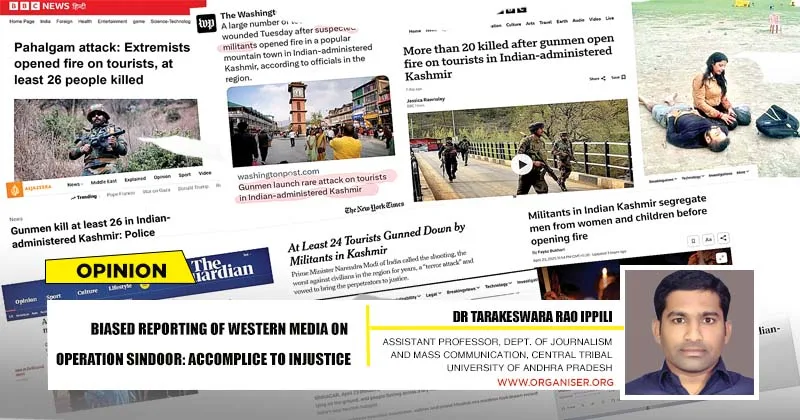
The BBC, The New York Times, Deutsche Welle, Washington Post, Reuters, and Al Jazeera all refrained from using the word “terrorist” in the context of the Pahalgam attack. Rather, they preferred “gunmen,” “suspected militants,” or “attackers.” This is more than a case of matter of semantics. This is narrative framing. Words very much determine perceptions. They influence understanding. Were there such attacks on Europeans or Americans, such media outlets would have, without hesitation used, “Terrorist Attack” in prominent headers. But, when it comes to Bharat, more so, when the subjects are Hindus, the coverage is slow, disoriented, or devoid of urgency altogether. Understanding the context is not as important as constructing a narrative that fits a desired mould, downplays religious motivation behind the attack on purpose, leaving the audience devoid of empathy toward the victims and understanding. Why these media organisations choose to operate this way, however, calls into serious question the very principles these institutions propagate. It is particularly troubling that the victims in question, the Hindus, were actively erased from the narrative, and so was this gap in coverage by the Western media. Such a blatant attempt ignores the severe security risks posed to Hindus in specific parts of the country, and internationally. A lack of any response from global human rights organisations is equally troubling. Such a selective focus undermines credibility, further highlighting a targeted approach that addresses religious violence.
Western Historical Bias
This is not the first time Bharat has dealt with such blatant hypocrisy. After the Mumbai terror attacks in 2008, the Pulwama bombing, and the Uri attack, the Western media has reported with a balanced and composed approach without explicitly mentioning Pakistan while also labelling Bharat’s claims as “allegations” and “unverified.” Contrarily, the Russian attack on Ukraine was swiftly and heavily condemned the world over. This highlights a deeper, more worrying global phenomenon: the policies that frame world events are crafted to fit convenient narratives and aligned political agendas.
Ignoring the wealth of evidence corroborating the claims of numerous attacks stemming from terror cells within Pakistan, the Western media persists in putting forward narratives of “incomplete information.” Even sponsoring state Pakistan was included on the FATF’s grey list for supporting terrorism, some Western narratives still held threads of guarded neutrality and non-partisanship.
Interestingly, the US House Foreign Affairs Committee directly questioned The New York Times for using the phrase “Tourists gunned Down by Militants in Kashmir” in its report on the Pahalgam attack. The committee bluntly asked, “This is a clear terrorist attack. What’s stopping you from calling it that?” This incident brought the integrity of Western media into question. Prominent voices in America criticised the lack of journalistic responsibility and courage to report the truth. Bharatiya-origin US senators and congressional members also raised their voices, urging media outlets to stop using double standards in reporting terrorism and to show due respect to the victims. Massive protests by Hindu communities in New York highlighted a growing mistrust in media credibility, particularly on social platforms.
Victim Narrative Double Standards
When Muslim victims are involved, the Western reporters tend to focus on “Islamophobia” or “racism” as the foundation driving the incident. In the case of Hindus, the event is captured as another example of everyday violence without deeper socio-political exploration. Take the 2021 French knife attack for example. Everyone involved labelled the assailant a “terrorist,” yet that word is rarely used in Bharat. This suggests a “victim hierarchy,” where the identity of the victims determines how much attention and empathy they receive.Such a narrative approach distorts the sense of equality among global democracies. Labelling a similar attack differently depending on the country not only raises ethical questions about journalism but also exposes a political bias in the construction of international narratives. When Hindus are victims, the silence of global human rights organisations and the Western press effectively mutes their suffering.
Recently, the Western media have been preoccupied with narratives like “India: The Flawed Democracy”, repeatedly emphasising the conditions of Bharatiya Muslims. But when it comes to religiously motivated attacks in Majnoor, Pahalgam, or Anantnag, the response is weak and uninspired. Isn’t this selective response a political manipulation of facts? It appears to be an effort to mould Bharatiya realities to fit the Western “progressive” standards. Such portrayals aim to depict Bharat as an intolerant nation. But the real issue is that critics often view Bharat from a distance, failing to understand the complex relationships and diverse experiences of its people. Bharat is a land of multiple faiths and practices coexisting, and while there are issues, viewing them through a single lens is unjust. Yes, problems faced by the Muslim community deserve attention, but so do the challenges and violence endured by Hindus and others. Ignoring them distorts the ethical framework of human rights discourse.
Organisations like the Hindu American Foundation (HAF) promptly responded to the Western media coverage, launching campaigns under the slogan “Words Matter” and advocating for the phrase “Not gunmen, but terrorists.” This activism reflects the pain and frustration of the Bharatiya diaspora in the US. The support this campaign is gaining from global influencers and digital content creators may push the Western media to become more objective in the future. Pressure from the diaspora is now fuelling a global conversation, challenging international media to rethink their reporting norms. Just as distortion of facts can cause harm, the rise of public consciousness and information freedom can redefine contemporary journalism.
In the face of such silent complicity, how can Bharatiya democracy uphold its values? Bharat is a democratic nation that respects religious freedom. It deserves media coverage that objectively reflects how terrorism impacts such a diverse society. We must boldly criticise any attempt to frame Bharat’s sanskritik values, freedom of expression, or religious tolerance in a skewed manner. Journalism should be about courage and truth, with a responsibility toward justice for victims. Silence and distortion in the name of neutrality only dishonour these values.The double standards shown by the Western media in the case of the Pahalgam attack raise serious doubts about their commitment to fair journalism. If the global press truly believes in truth and democracy, why do they behave differently when it comes to Bharat? This is not just a question for Bharat but for the global democratic order itself. Hiding behind press freedom to propagate bias is a threat to fundamental journalistic ethics. The world deserves journalism that is accountable, just, and humane. We must remember silence, too, can be an accomplice to injustice.