President Murmu questions Supreme Court in setting deadlines on powers of President and Governors to clear bills
September 20, 2026
  • Read Ecopy
  • Circulation
  • Advertise
  • Careers
  • About Us
  • Contact Us
Android AppiPhone AppArattai
Organiser
  • ‌
  • Bharat
    • Assam
    • Bihar
    • Chhattisgarh
    • Jharkhand
    • Maharashtra
    • View All States
  • World
    • Asia
    • Europe
    • North America
    • South America
    • Africa
    • Australia
  • Editorial
  • International
  • Opinion
  • RSS @ 100
  • More
    • World Hindu Congress 2026
    • Op Sindoor
    • Analysis
    • Sports
    • Defence
    • Politics
    • Business
    • Economy
    • Culture
    • Special Report
    • Sci & Tech
    • Entertainment
    • G20
    • Azadi Ka Amrit Mahotsav
    • Vocal4Local
    • Web Stories
    • Education
    • Employment
    • Books
    • Interviews
    • Travel
    • Law
    • Health
    • Obituary
  • Subscribe
    • Subscribe Print Edition
    • Subscribe Ecopy
    • Read Ecopy
  • ‌
  • Bharat
    • Assam
    • Bihar
    • Chhattisgarh
    • Jharkhand
    • Maharashtra
    • View All States
  • World
    • Asia
    • Europe
    • North America
    • South America
    • Africa
    • Australia
  • Editorial
  • International
  • Opinion
  • RSS @ 100
  • More
    • World Hindu Congress 2026
    • Op Sindoor
    • Analysis
    • Sports
    • Defence
    • Politics
    • Business
    • Economy
    • Culture
    • Special Report
    • Sci & Tech
    • Entertainment
    • G20
    • Azadi Ka Amrit Mahotsav
    • Vocal4Local
    • Web Stories
    • Education
    • Employment
    • Books
    • Interviews
    • Travel
    • Law
    • Health
    • Obituary
  • Subscribe
    • Subscribe Print Edition
    • Subscribe Ecopy
    • Read Ecopy
Organiser
  • Home
  • Bharat
  • World
  • Operation Sindoor
  • Editorial
  • Analysis
  • Opinion
  • Culture
  • Defence
  • International Edition
  • RSS @ 100
  • Magazine
  • Read Ecopy
Home Bharat

President Murmu questions Supreme Court in setting deadlines on powers of President and Governors to clear bills

The Central Government has now invoked the President’s powers under Article 143(1) of the Constitution to seek the Supreme Court’s opinion on a plethora of contentious issues raised by the 8 March judgement.

TS VenkatesanTS Venkatesan
May 15, 2025, 12:45 pm IST
inBharat, Tamil Nadu
Follow on Google News
Facebook
Twitter
WhatsAppTelegramEmail

As expected in legal circles following the 8 March division bench order fixing deadlines for Presidents and Governors to give assent to Bills passed by State Legislatures — and for the President to act on State Bills — in the Tamil Nadu vs Governor case, the President of India has now sought legal opinion through 14 questions. The President also raised the question of whether the Supreme Court can fix deadlines for the President and Governors to give their nod to Bills.

On 8 March, while disposing of a petition moved by the Tamil Nadu government, the apex court bench comprising Justices J.B. Pardiwala and R. Mahadevan fixed a timeline for the Governor and the President to clear Bills passed by State Assemblies. This evoked sharp reactions from political and legal circles, describing it as an act of judicial overreach and inconsistent with the Constitution. However, the DMK hailed the verdict, stating that it reaffirmed the rights of the States and compelled the Governor to follow or give assent to Bills passed by the Legislatures.

Chief Minister M.K. Stalin, on 27 April, honoured Supreme Court lawyers who represented the State in the important case concerning the Governor’s approval of Bills passed by the Tamil Nadu Assembly. He congratulated senior advocates Abhishek Singhvi, Rakesh Dwivedi, and P. Wilson — who is also a DMK Rajya Sabha member. Former Attorney General Mukul Rohatgi, who had also argued for Tamil Nadu in the case, could not attend the event.

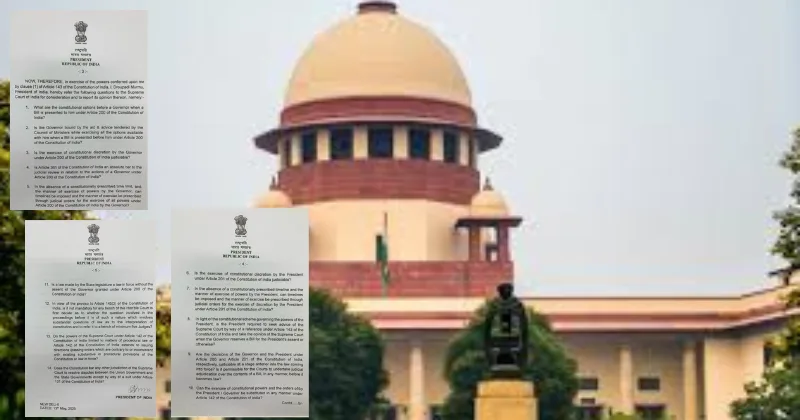
In this background, President Droupadi Murmu has made a reference to the Supreme Court to determine whether such actions can be directed through judicial orders in the absence of any constitutionally prescribed timeline. The Central Government has now invoked the President’s powers under Article 143(1) of the Constitution to seek the Supreme Court’s opinion on a plethora of contentious issues raised by the 8 March judgement.

This advisory jurisdiction allows the President to consult the apex court on significant questions. In the reference made on 13 May 2025, the President sought the opinion of the Supreme Court on 14 questions — including whether the exercise of constitutional discretion by the President under Article 201 of the Constitution of India is justiciable.

The questions raised are as given:

1. What are the constitutional options before a Governor when a Bill is presented to him under Article 200 of the Constitution of India?

2. Is the Governor bound by the aid & advice tendered by the Council of Ministers while exercising all the options available with him when a Bill is presented before him under Article 200 of the Constitution of India?

3. Is the exercise of constitutional discretion by the Governor under Article 200 of the Constitution of India justiciable?

4. Is Article 361 of the Constitution of India an absolute bar to the judicial review in relation to the actions of a Governor under Article 200 of the Constitution of India?

5. In the absence of a constitutionally prescribed time limit, and the manner of exercise of powers by the Governor, can timelines be imposed and the manner of exercise be prescribed through judicial orders for the exercise of all powers under Article 200 of the Constitution of India by the Governor?

6. Is the exercise of constitutional discretion by the President under Article 201 of the Constitution of India justiciable?

7.  In the absence of a constitutionally prescribed timeline and the manner of exercise of powers by the President, can timelines be imposed and the manner of exercise be prescribed through judicial orders for the exercise of discretion by the President under Article 201 of the Constitution of India?

8.  In light of the constitutional scheme governing the powers of the President, is the President required to seek advice of the Supreme Court by way of a reference under Article 143 of the Constitution of India and take the opinion of the Supreme Court when the Governor reserves a Bill for the President’s assent or otherwise?

9.  Are the decisions of the Governor and the President under Article 200 and Article 201 of the Constitution of India, respectively, justiciable at a stage anterior into the law coming into force? Is it permissible for the Courts to undertake judicial adjudication over the contents of a Bill, in any manner, before it becomes law?

10. Can the exercise of constitutional powers and the orders of/by the President / Governor be substituted in any manner under Article 142 of the Constitution of India?

11. Is a law made by the State legislature a law in force without the assent of the Governor granted under Article 200 of the Constitution of India?

12. In view of the proviso to Article 145(3) of the Constitution of India, is it not mandatory for any bench of this Hon’ble Court to first decide as to whether the question involved in the proceedings before it is of such a nature which involves substantial questions of law as to the interpretation of constitution and to refer it to a bench of minimum five Judges?

13. Do the powers of the Supreme Court under Article 142 of the Constitution of India limited to matters of procedural law or Article 142 of the Constitution of India extends to issuing directions /passing orders which are contrary to or inconsistent with existing substantive or procedural provisions of the Constitution or law in force?

14. Does the Constitution bar any other jurisdiction of the Supreme Court to resolve disputes between the Union Government and the State Governments except by way of a suit under Article 131 of the Constitution of India?
 

Topics: Supreme CourtTamil NaduPresident Droupadi MurmuPresident Droupadi MumruJudicial OverreachPresident and Governor's Nod
Share
Tweet
SendShareSend
✮ Subscribe Organiser YouTube Channel. ✮
✮ Join Organiser's WhatsApp channel for Nationalist views beyond the news. ✮
Previous News

Balochistan is not Pakistan: Baloch leader declares independence from Pakistan, seeks support from India

Next News

UK PM Starmer cracks down on immigration, claims 24,000 deported in bid to ‘Take Back Control’

Related News

Tamil Nadu Social Justice Minister Vanni Arasu and VCK Deputy General Secretary at EV Ramasamy Naicker’s statue on Anna Road in Chennai on September 17, 2026.

Tamil Nadu: VCK Minister Vanni Arasu vows against Sanatana Dharma; BJP demands CM Vijay’s response

Tamil Nadu: SC gives TVK government 3 months to identify land for Navodaya schools, asks reconsider position on Hindi

Pinarayi Vijayan, former CM of Kerala (Left)

Keralam: RTI reveals Pinarayi Vijayan govt spent Rs 245.62 cr on litigations, Kapil Sibal among top beneficiaries

Tamil Nadu: Emerald Murugan murti stolen from Nadu Palani temple recovered from abandoned quarry, three arrested

Vinayaka Chathurthi 2026 in Tamil Nadu: Artisans’ creative hands echo devotion through unique designs

Tamil Nadu: Hindus protest TVK govt restrictions on Vinayaka Chaturthi celebrations in Muslim-dominated areas

Load More

Latest News

A representative image

LPG subsidy rule change from October 1: Aadhaar biometric authentication mandatory

NITI Aayog Focuses over the Strategies for Empowering Caregivers in the path of Viksit Bharat@2047

Reimagining Caregiving: Bharat’s action for empowering the hands that hold us

BMS launches National Organisation for Digital Employees (NODE) for IT workforce; aims to strengthen employee welfare

GalaxEye’s US patent for OptoSAR marks a major boost for India’s private space sector, advancing its global Earth-observation ambitions

GalaxEye secures US patent for OptoSAR technology, boosting India’s private space and deep-tech ambitions

The arrested Bangladeshi national

Keralam: Series of Bangladeshi arrests raises questions over alleged support ecosystem of fake IDs, jobs and shelter

The Indian Army has launched AASHVAST to detect hidden software and electronic vulnerabilities in military drones

Indian Army strengthens drone security with AASHVAST lab to detect software vulnerabilities & Chinese components

Nileema Mishra’s grassroots work empowered women and helped transform more than 200 villages across Maharashtra

Nileema Mishra: The woman who transformed more than 200 villages across rural Maharashtra

Shree Stambheshwar Mahadev Mandir in Gujarat

Shiva Mandir that disappears into the sea and returns with the tide: The fascinating story of Stambheshwar Mahadev

Vishwa Hindu Parishad (VHP) spokesperson Surendra Jain (file photo0

VHP condemns Hamid Ansari over remarks citing Nehru on Hindu right-wing communalism

Ganesh murti visarjan incidents raise concerns over radical Islamic intolerance and law and order in Tamil Nadu

Load More
  • Privacy
  • Terms
  • Cookie Policy
  • Refund and Cancellation
  • Delivery and Shipping

© Bharat Prakashan (Delhi) Limited.
Tech-enabled by Ananthapuri Technologies

  • Home
  • Search Organiser
  • Bharat
    • Assam
    • Bihar
    • Chhattisgarh
    • Jharkhand
    • Maharashtra
    • View All States
  • World
    • Asia
    • Africa
    • North America
    • South America
    • Europe
    • Australia
  • Editorial
  • Operation Sindoor
  • Opinion
  • Analysis
  • Defence
  • Culture
  • Sports
  • Business
  • RSS @ 100
  • Entertainment
  • More ..
    • Sci & Tech
    • Vocal4Local
    • Special Report
    • Education
    • Employment
    • Books
    • Interviews
    • Travel
    • Health
    • Politics
    • Law
    • Economy
    • Obituary
  • Subscribe Magazine
  • Read Ecopy
  • Advertise
  • Circulation
  • Careers
  • About Us
  • Contact Us
  • Policies & Terms
    • Privacy Policy
    • Cookie Policy
    • Refund and Cancellation
    • Terms of Use

© Bharat Prakashan (Delhi) Limited.
Tech-enabled by Ananthapuri Technologies