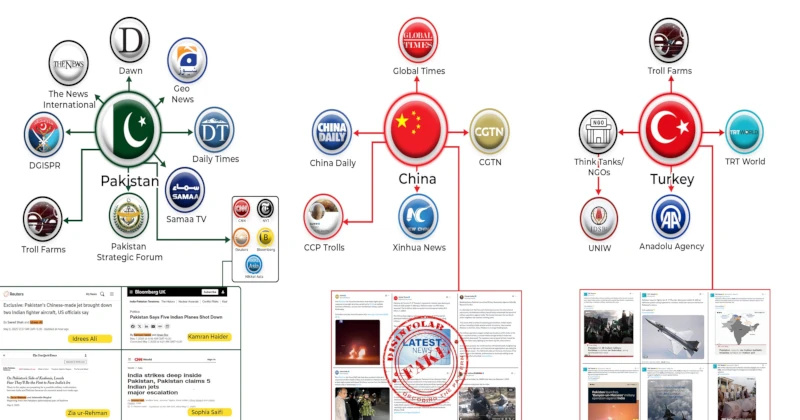
While the guns fell silent after the intense military exchanges between India and Pakistan during Operation Sindoor, the battlefield only shifted. The war wasn’t just fought with missiles and Mirage 2000s. It raged on digital frontlines, where hashtags, doctored videos, deepfakes, and synthetic narratives became weapons of mass deception. Spearheaded by Pakistan’s DGISPR and amplified by its geopolitical allies—Turkey, China, and even Bangladesh—this full-blown information warfare was not only an attempt to manipulate global perception but also a strategic campaign to undermine India’s credibility on the international stage.
This meticulously coordinated disinformation blitzkrieg marks one of the largest digital misinformation-ops against a sovereign democracy in recent times.
Pahalgam Terrorist Attack
The entire information assault gained traction in the aftermath of the gruesome Pahalgam terror attack in April 2025. Instead of condemning the carnage, Pakistan turned the tragedy into an opportunity to shift blame and deflect accountability. Using its access to major Western media networks—thanks to Pakistani-origin journalists embedded in outlets like CNN, Reuters, Bloomberg, and The New York Times—Pakistan began disseminating baseless claims, asserting that the attack was a “false flag” operation orchestrated by India.
What followed was not spontaneous—it was a calculated, multi-layered, multi-platform propaganda campaign designed to obfuscate facts, manipulate emotions, and distort reality.
DGISPR: Nerve Center of Disinformation
The Inter-Services Public Relations (DGISPR), the media wing of Pakistan’s military, functioned as the central command for this digital warfare. On May 8, DGISPR released an official statement denying any Pakistani attack on civilian areas in Amritsar, labeling India’s reports as “false flags.” Ironically, just a day later, DGISPR released another statement celebrating the supposed success of Pakistan’s attack in Amritsar—an embarrassing contradiction that laid bare their own lies.
Pakistan
Exhibit A:
On May 8, DGISPR peddled their first official blatant lie that they didn't attack civilian areas in Amritsar and accused India of 'false flag'. Just the next day they forgot about it and instead thumped their chest celebrating Pak's attack in Amritsar!
4/n pic.twitter.com/9YOJ3tAKcF
— DisInfo Lab (@DisinfoLab) May 14, 2025
In another audacious move, DGISPR released a manipulated video of Indian Wing Commander Vyomika Singh. The video was edited to show her “admitting” that Pakistan had only targeted military installations. What the ISPR edited out was her clear statement condemning Pakistan’s targeting of civilian areas—revealing the video to be a doctored piece of propaganda.
Exhibit B:
DGISPR officially ran this propaganda when they played a doctored clip of Wing Commander Vyomika Singh 'admitting' to Pakistan's attack, & damage only on military targets in India.
FACT: DGISPR conveniently cut out the part from the video mentioning how Pakistan… pic.twitter.com/2dVXnl1MiU
— DisInfo Lab (@DisinfoLab) May 14, 2025
On May 1, DGISPR even went as far as to circulate alleged “classified RAW documents” to implicate India in covert operations. These were later exposed as fakes. This joint misinformation-op was reportedly conducted in collaboration with the Pakistan Strategic Forum (PSF) and proxy terror outfit The Resistance Front (TRF).

The Resistance Front (TRF), an ISI-backed terror outfit active in Jammu & Kashmir, played a pivotal role in Pakistan’s narrative warfare. While TRF has often operated as a ground-level insurgency front, its evolution into a digital propaganda tool was stark during Operation Sindoor. TRF-affiliated Telegram and Twitter accounts spread doctored videos, fake martyrdom visuals, and anti-India narratives. It ran parallel to DGISPR’s misinformation-ops, flooding social media with hashtags like #KashmirBleeds and #IndiaIsLying, often in coordination with handles from Turkey and Bangladesh.
And the lies didn’t stop there.
On May 11, DGISPR used a two-year-old image from 2023 to falsely depict its current naval preparedness. The agency also edited a video clip from Aaj Tak, twisting the visuals to show destruction of an Indian airfield, when in reality, the footage was of a Pakistani airbase hit by Indian strikes.
Even worse, DGISPR manipulated a clip from India TV News to claim Indian media had admitted to the destruction of Indian airbases. In truth, it was another blatant case of context flipping.
Perhaps the most laughable—but dangerous—incident was when Pakistan’s official government handle shared a video game clip, passing it off as real footage of their air defence shooting down Indian aircraft. The footage was from a PC simulation showing a Close-In Weapon System firing at a target. Pakistan’s Information Minister, Attaullah Tarar, even praised this as a “nerve-wracking” response.
Other false claims included the alleged capture of Wing Commander Shivangi Singh—complete fiction. Al Jazeera initially ran with the story before issuing a correction. DGISPR eventually confessed that they had not captured any Indian pilot.
Another fabrication involved a 2019 video showing Pakistani soldiers retrieving bodies from a conflict zone. DGISPR claimed the video showed Indian soldiers surrendering with white flags. Fact-checkers quickly debunked the lie.
Pakistan even recycled old footage from Khyber Pakhtunkhwa sectarian clashes and presented it as the result of an “attack on Srinagar Airbase”—another attempt at manipulating public perception using unrelated visuals.

To further stoke anti-India sentiment, DGISPR falsely claimed it had shot down five Indian fighter jets. The accompanying images were traced back to a 2024 MiG-29 crash in Rajasthan and a 2014 Su-30MKI incident in Maharashtra. Indian Air Marshal S. R. Khurana confirmed that all pilots from Operation Sindoor had returned safely.
Turkey: Amplifier-in-Chief
Pakistan’s propaganda was not confined to its borders. It found an enthusiastic amplifier in Turkey. State-run outlets like TRT World and Anadolu Agency echoed DGISPR’s narratives almost verbatim. Despite providing zero evidence, TRT World ran stories claiming Indian airbase destruction, based entirely on doctored and unverified visuals.
TRT World’s bias is not new. The outlet had previously published over 30 stories critical of India during the abrogation of Article 370 and 35A—14 of which were directly recommended by Pakistan’s Ministry of Foreign Affairs.

One notable figure given repeated space on TRT World was Nasir Qadri of the Legal Forum for Kashmir (LFOVK), who painted India as following “Israel-style settler colonialism.” These narratives were linked to a transnational alliance involving Pakistan, the Muslim Brotherhood, and Jamaat-e-Islami.
Qadri’s organisation worked closely with UK-based firm Stoke White, run by Hakan Camuz—a Turkish national with close ties to the Erdogan regime. They ran campaigns to smear the Indian Army and Home Minister Amit Shah with false human rights violation charges.
Turkey-based social media handles on X and Telegram, especially “Clash Report” led by Cüneyt Polat, a former TÜBİTAK operative, played a pivotal role. This account retweeted ISPR’s content, translated it, and helped it trend globally, adding a false veneer of legitimacy. “Clash Report” has since been withheld in India.
Bangladesh: Fringe Turns Focal
Surprisingly, several Bangladeshi accounts also jumped on the anti-India bandwagon. The handle @revolt_71 was one of the most active, claiming the Pahalgam attack was a false flag operation and pushing the #IndiaOut campaign. Posts from this handle garnered thousands of retweets, spreading venomous narratives calling India a “demon” that must be “crushed.”
Mainstream Bangladeshi media outlets like Ekattor and Jamuna TV went further, claiming that Indian forces had attacked Bangladeshi civilians during Operation Sindoor. The images they used were traced back to unrelated conflict zones and debunked by Indian agencies.

Shockingly, some Bangladeshi social media accounts threatened that if India attacked Pakistan, Bangladesh would lay claim to the “seven sister” states of Northeast India—an ominous indicator of regional hostility fueled by disinformation.
China’s role, too, was far from neutral. As Pakistan’s “iron brother,” China supplied missile systems like the HQ-9 and PL-15 to Pakistan during the conflict. But its support extended far beyond conventional warfare. Chinese social media and state-backed propaganda machines, including China Daily, churned out fake news at an alarming rate. This included false reports of Indian jets crashing in J&K—using recycled images from 2019.
A Chinese company even released a doctored satellite image showing supposed damage to India’s Adampur Airbase. Open-source intelligence analyst @detresfa_ exposed the image as outdated and manipulated. Multiple CCP-linked handles made spurious claims about Indian military casualties, aircraft losses, and civilian unrest—none of which were backed by credible sources or satellite evidence.
(The story is based on a X thread by Disinfolab)