
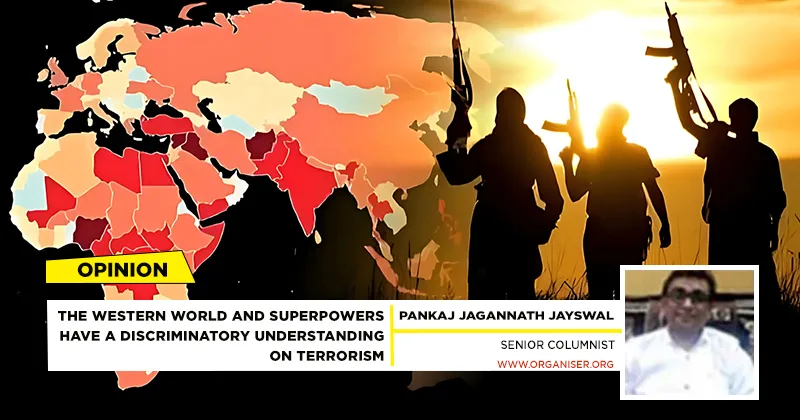
India has been suffering from Pakistan-sponsored terrorism for many decades. Thousands of Indians have been slaughtered by Pakistani terrorists in the name of “jihad”. The biased international community, particularly the Western world, has a different perspective on terrorism. If terrorism harms their country, they believe in strong action; however, if terrorism takes place in another country and it helps them grow stronger economically and maintain or increase their superpower status, they support and encourage terrorist groups and countries. Is this humanity? India has been a victim of such bigotry for many decades.
When it comes to Pakistan, it is a cancer. Top Pakistani and international leaders clearly know and acknowledge that cancer cells are difficult to eradicate, regardless of the amount of radiation therapy or surgery performed. One encouraging development is the international community’s strong support for the unavoidable necessity of coordinated action against terrorism and the establishment of the United Nations Office of Counter-Terrorism [UNOCT] in June 2017 through a UN General Assembly Resolution to fight terrorism on a national, regional, and worldwide scale. Even though everyone seems to agree that fighting terrorism is important, the international community unfortunately doesn’t live up to its rhetoric. Nevertheless, America, China, and other nations have continuously provided financial support, as well as weapons and ammunition, to this terrorist nation in order to bolster their influence in South Asia and undermine the Indian economy by sustaining instability through the use of the ISI, an army-controlled government and Pakistani terrorist organisations.
The following quotations from Pakistani and foreign authorities demonstrate that despite Pakistan’s status as a terrorist state, China and the West continue to support its barbaric practices.
“When you talk about militant groups, we still have about 30,000-40,000 armed people who have been trained and fought in some part of Afghanistan or Kashmir,” stated Pakistan’s then-prime minister, Imran Khan, during a 2019 visit to the United States.
Pakistan’s defence minister, Khawaja Asif, acknowledged Islamabad’s lengthy history of aiding terrorist groups, but he attempted to avoid being implicated by claiming, “We have been doing this dirty work for the US and the West, including Britain, for three decades,” when questioned about it earlier this month.
India’s External Affairs Minister S Jaishankar was not divulging a secret when he said, “Terrorism is not something that is being conducted in dark corners of Pakistan; it’s done in broad daylight.” Instead, he was articulating something that the world was well aware of. In his 2018 tweet, US President Donald Trump claimed that “they [Pakistan’s government and army] give safe haven to the terrorists we hunt in Afghanistan.” Did he not say the exact same thing?
However, Trump is not the first to reveal that the Pakistan Army promotes terrorist organisations. “I think it’s very important for President Musharraf to make a clear statement to the world that he intends to crack down on terror,” President George W. Bush told reporters back in 2002. “The very strong feeling in the international community is that people want to see the circumstances brought about where dialogue and the political process can take the place of extremism and terrorism,” cautioned Pakistan, the then-prime minister of the United Kingdom, Tony Blair.
In addition, the European Foundation for South Asia Studies [EFSAS] confirmed in 2017 that “the ISI [Pakistan Army’s spy agency] has fundamentally altered the dimensions of the conflict in Kashmir by transforming it to a movement being carried out by foreign militants on Pan-Islamic religious terms, aside from training and funding the terrorist organisations.” Two years later, Pakistan must “continue addressing terrorism including clear and sustained actions targeting not only all UN-listed transnational terrorist groups but also individuals claiming responsibility for such attacks,” according to the European Union.
Despite the international community’s obvious acceptance of terrorism committed by Pakistan against India and numerous other terrorist attacks around the world, including 9/11, they have received special support from America and China for their own self-interest, and no one brings up the humanitarian concerns against these two superpowers. During the war, the International Monetary Fund always provided Pakistan with financial support. It indicates that banks controlled by the West hold nearly all of the dirty money required for dirty politics. In the future, the economic superpowers, China and America, will undoubtedly bear the burden of their anti-humanitarian actions.
India demonstrated the new international order and willingness to fight terrorism against all circumstances.
The five days of combat between India and the terrorist nation Pakistan demonstrated to the entire world the effectiveness of contemporary military tactics used by India, combining both domestic and foreign technology with accuracy and lasting influence. India’s ability to protect itself from American and Chinese drone, missile, and fighter aircraft threats was demonstrated by its in-house Air Defence System and Navics. Many countries’ trust in Chinese and American weapons and ammunition was shattered by the ability of Indian jet fighters, missiles, and drones to penetrate the enemy’s air defence system, which was created by China. Why did China and the United States try to defuse the situation? After witnessing the terrible devastation at many air bases, Pakistan and ISI understood they were losing the war and began pleading for a ceasefire through China, the United States, and Saudi Arabia. Indian leaders were then addressed by the US vice president and other officials. Since war is not the best option, India agreed to a truce with terms that favoured its interests. But why did America show such interest in a ceasefire when India never requested mediation from US President Donald Trump? The causes may include…
Since we haven’t had a significant peer-to-peer conflict in decades, the US was ultimately concerned that its own weapons might be revealed for their strengths and shortcomings. Having said that, the confrontation between India and Pakistan provided a glimpse of how it might unfold and challenged the belief in the unstoppable military and technological power of the United States. Since war is ultimately a struggle of perception and an extension of politics, any interruptions will affect American influence in other international affairs.
In addition, Trump has another significant challenge at hand: negotiating a tariff fight with China, which has a significant stake in its investments in Pakistan and its $100 billion commerce with India. It would appear that maintaining peace would assist the US in negotiating an advantageous agreement with China.
Has PM Modi sought mediation?
India abides by the Shimla Agreement and the Lahore Declaration, and any border disputes must be resolved amicably. Trump’s remarks have stirred the political system and caused some controversy for Modi. Trump has found success with this minor strategy, but India would never use a third party to settle the Kashmir dispute.
Even throughout Donald Trump’s first term as president, neither PM Modi nor the Indian government requested mediation. Donald Trump repeatedly requested mediation, but each time it was turned down. In 2019, Congressman Brad Sherman tweeted, “I just apologised to Indian Ambassador Harsh Shringla for Trump’s amateurish and embarrassing mistake,” shortly after Trump’s shocking assertion that Prime Minister Narendra Modi had asked him to mediate or arbitrate the Kashmir dispute. Therefore, Donald Trump’s unwarranted remarks on the “X” platform regarding ceasefire mediation are just a power struggle against China in the South Asian region. India is never going to request mediation.
Though India will have to work on multiple fronts, it has demonstrated its political and military strength to the globe, and the international order will undoubtedly shift soon.