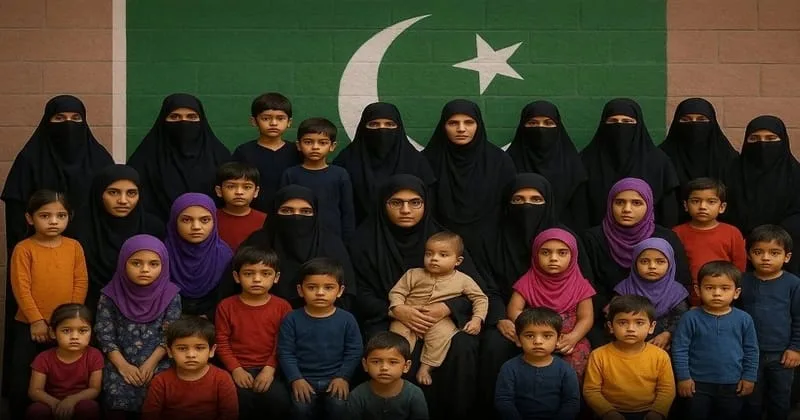
Twenty-two Pakistani women residing in Moradabad, who entered India after marrying local men, continue to live in legal limbo while raising nearly 100 children. Despite holding Aadhaar, PAN, and ration cards, they remain foreign nationals under Indian law—raising questions about how they secured such documents without formal citizenship and fueling concerns over the misuse of welfare systems.
22 Pakistani women came to Moradabad. All are on Long-Term Visas, not Indian citizens.
~ These 22 gave birth to 95 children. 35% of these have become grandmothers. Family tree count has SURPASSED 500. All have Aadhar. Take Ration from Govt 🤯World's Biggest DHARMSHALA? pic.twitter.com/bG1ub53RhS
— The Analyzer (News Updates🗞️) (@Indian_Analyzer) May 5, 2025
Though they have integrated into local communities, these women arrived in India after the December 31, 2014 cutoff date, making them ineligible for regularization under the Citizenship Amendment Act (CAA), which excludes Muslims. Their continued stay is permitted under long-term visas (LTVs), but critics argue that leniency in enforcement opens doors for security risks and potential abuse of the system.
There is no country on earth which has defeated itself repeatedly more than India. This self-harm is the single biggest trait of our history. pic.twitter.com/tYiEXeKs4V
— HindolSengupta (@HindolSengupta) May 5, 2025
The recent terror attack in Pahalgam on April 24, 2025—which killed 26 civilians, has reignited fears about foreign infiltration. In this climate of heightened security alert, the presence of Pakistani nationals—especially those living in sensitive border-adjacent states—has drawn increased scrutiny. Authorities worry that delays in processing or deportation are being exploited by individuals who may not have entered India through secure or verified channels.
Following the Pahalgam attack, Indian authorities have deported Pakistani nationals on short-term visas and intensified scrutiny of those on long-term stays. Moradabad Superintendent of Police (City) Kumar Ranvijay Singh said that the police are compiling data on visa status, ration card usage, family size, and connections abroad.
Even as their Indian-born children may qualify for citizenship under the Citizenship Act of 1955, the mothers remain outside the framework of legal recognition. Their possession of key identity documents without legal citizenship has prompted questions about lapses in administrative oversight. Some officials warn that such cases could set a dangerous precedent, undermining immigration law and weakening internal security protocols.
While their supporters frame their situation as a humanitarian issue, others view it as a potential threat to national integrity—particularly when diplomatic relations with Pakistan are at a historic low. With cross-border tensions escalating and reciprocal visa bans in place, the likelihood of these women gaining Indian citizenship appears increasingly slim. Their continued residence in India, despite legal and diplomatic barriers, has sparked a broader debate over national identity, selective enforcement, and the fine line between compassion and compliance.