US President Donald Trump has announced that he has directed the Department of Commerce and the US Trade Representative to immediately start the process of imposing a 100 per cent tariff on all movies coming into the US that are produced in other nations.
He said that the movie industry in the US is “dying” a very fast death and added that other nations were offering incentives to draw the American filmmakers and studios away from the US and termed it a “national threat.”
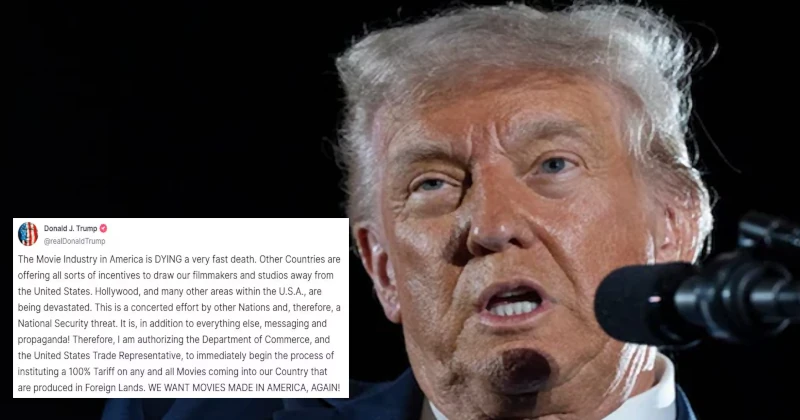
In a post shared on his social media platform Truth Social, Trump stated, “The Movie Industry in America is DYING a very fast death. Other Countries are offering all sorts of incentives to draw our filmmakers and studios away from the United States. Hollywood, and many other areas within the U.S.A., are being devastated. This is a concerted effort by other Nations and, therefore, a National Security threat. It is, in addition to everything else, messaging and propaganda! Therefore, I am authorizing the Department of Commerce, and the United States Trade Representative, to immediately begin the process of instituting a 100 per cent Tariff on any and all Movies coming into our Country that are produced in Foreign Lands. WE WANT MOVIES MADE IN AMERICA, AGAIN.”
The Movie Industry in America is DYING a very fast death. Other Countries are offering all sorts of incentives to draw our filmmakers and studios away from the United States. Hollywood, and many other areas within the U.S.A., are being devastated. This is a concerted effort by…
— Commentary Trump Daily Posts (@TrumpDailyPosts) May 4, 2025
Howard Lutnick, the United States Secretary of Commerce, swiftly backed the directive, stating, “We’re on it.”
We’re on it. https://t.co/r5zCLxZrem
— Howard Lutnick (@howardlutnick) May 4, 2025
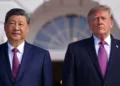
Trump’s decision comes amid the ongoing tariff war between the US and China. On April 10, China announced that it has decided to “moderately reduce” the release of Hollywood films in the Chinese market. China’s National Film Administration directly connected its decision to tariffs imposed by the US on Chinese products.
California Governor Gavin Newsom has proposed major tax credits to retain film jobs and revive Hollywood, but industry insiders warn it may be too late without federal intervention.
Trump’s sweeping tariffs add to a growing list of economic disruptions tied to his trade policies. Since returning to office, he has slapped hefty levies on a wide array of imported goods, including a 145% tariff on Chinese products. China retaliated with a 125 per cent tariff on US exports, triggering a trade war that continues to rattle global markets.
The fallout is visible: U.S. GDP contracted by 0.3 per cent in Q1 2025, imports and consumer spending are down, and ocean container bookings from China have plummeted 60 per cent. Shipping firms are canceling up to a quarter of sailings, and arrivals at the Port of Los Angeles are projected to decline by 35 per cent.
Economists are sounding alarms over the deepening economic strain. “All of it,” said Boston College economist Brian Bethune, when asked how much of the downturn could be traced to Trump’s trade tactics.
International partners are also expressing frustration. Trump’s administration touts “privileged” trade talks with nations like Switzerland, South Korea, and Japan, but foreign officials report confusion and a lack of coherent strategy. “They don’t understand completely what the White House wants, nor who they should be negotiating with,” said Josh Lipsky of the Atlantic Council.
In a statement, China’s National Film Administration said, “The wrong move by the US government to abuse tariffs on China will inevitably further reduce the domestic audience’s favourability towards American films”.
It stated, “We will follow market rules, respect the audience’s choice, and moderately reduce the number of American films imported.” Notably, China accepts 10 films a year from Hollywood, and the Chinese market was once considered a key source of revenue for the American film industry.
Reacting to China’s decision, Trump had said that he was untroubled by China’s National Film Administration’s decision to target the film industry. In response to a question, Trump had said, “I think I’ve heard of worse things.”