Teaching a lesson to evil doers is also non-violence: Dr Bhagwat
June 6, 2026
  • Read Ecopy
  • Circulation
  • Advertise
  • Careers
  • About Us
  • Contact Us
Android AppiPhone AppArattai
Organiser
  • ‌
  • Bharat
    • Assam
    • Bihar
    • Chhattisgarh
    • Jharkhand
    • Maharashtra
    • View All States
  • World
    • Asia
    • Europe
    • North America
    • South America
    • Africa
    • Australia
  • Editorial
  • International
  • Opinion
  • RSS @ 100
  • More
    • Op Sindoor
    • Analysis
    • Sports
    • Defence
    • Politics
    • Business
    • Economy
    • Culture
    • Special Report
    • Sci & Tech
    • Entertainment
    • G20
    • Azadi Ka Amrit Mahotsav
    • Vocal4Local
    • Web Stories
    • Education
    • Employment
    • Books
    • Interviews
    • Travel
    • Law
    • Health
    • Obituary
  • Subscribe
    • Subscribe Print Edition
    • Subscribe Ecopy
    • Read Ecopy
  • ‌
  • Bharat
    • Assam
    • Bihar
    • Chhattisgarh
    • Jharkhand
    • Maharashtra
    • View All States
  • World
    • Asia
    • Europe
    • North America
    • South America
    • Africa
    • Australia
  • Editorial
  • International
  • Opinion
  • RSS @ 100
  • More
    • Op Sindoor
    • Analysis
    • Sports
    • Defence
    • Politics
    • Business
    • Economy
    • Culture
    • Special Report
    • Sci & Tech
    • Entertainment
    • G20
    • Azadi Ka Amrit Mahotsav
    • Vocal4Local
    • Web Stories
    • Education
    • Employment
    • Books
    • Interviews
    • Travel
    • Law
    • Health
    • Obituary
  • Subscribe
    • Subscribe Print Edition
    • Subscribe Ecopy
    • Read Ecopy
Organiser
  • Home
  • Bharat
  • World
  • Operation Sindoor
  • Editorial
  • Analysis
  • Opinion
  • Culture
  • Defence
  • International Edition
  • RSS @ 100
  • Magazine
  • Read Ecopy
Home Bharat

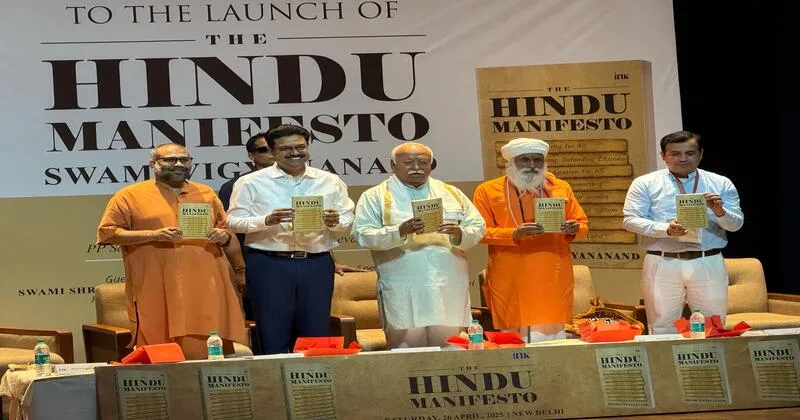
‘Teaching a lesson to evil doers is also non-violence’- Dr Mohan Bhagwat while releasing the Hindu Manifesto

We never cause any harm to our neighbours, but if someone do not follow their dharma and turns evil, then it becomes the duty of the king to protect his people, the king must perform his duty, said RSS Sarsanghchalak Dr Mohan Bhagwat at the book launch of 'The Hindu Manifesto', a new book by Swami Vigyananand at PM Museum in New Delhi

WEBDESKWEBDESK
Apr 26, 2025, 08:25 pm IST
in Bharat, RSS News, Delhi, RSS in News
Follow on Google News
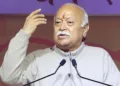
RSS Sarsanghchalak Dr Mohan Bhagwat at the book launch of 'The Hindu Manifesto', a new book by Swami Vigyananand, Joint General Secretary of the Vishva Hindu Parishad (VHP) and initiator of the World Hindu Congress

RSS Sarsanghchalak Dr Mohan Bhagwat at the book launch of 'The Hindu Manifesto', a new book by Swami Vigyananand, Joint General Secretary of the Vishva Hindu Parishad (VHP) and initiator of the World Hindu Congress

FacebookTwitterWhatsAppTelegramEmail

“Non-violence is our basic nature and values. But some people are wilful. I mentioned about Ravan in Mumbai, because Ravan had everything, yet his mind was against non-violence. Bhagwan Ram killed Ravan for his own welfare — it was not an act of violence, but of true non-violence. Non-violence is our dharma. We never cause any harm to our neighbours, but if someone do not follow their dharma and turns evil, then it becomes the duty of the king to protect his public, the king must perform his duty. Gita also teaches about non-violence. It says Arjun should fight and kill the Kauravas because, at that time, this was the only way for their welfare,” said RSS Sarsanghchalak Dr Mohan Bhagwat at the book launch of ‘The Hindu Manifesto’, a new book by Swami Vigyananand, Joint General Secretary of the Vishva Hindu Parishad (VHP) and initiator of the World Hindu Congress, on April 26 at the PM Museum in New Delhi.

He further said, “Even Ravan was killed because he refused to change his mind. Bhgawan Ram killed him only when he did not change”.  Emphasising the tradition of Shastrarth (debate), Dr Bhagwat said, “We have a tradition of Shastrarth, where a proposal is put forth, and everyone expresses their views on it. There are both the initial argument (Purva Paksh) and the counter-argument (Uttar Paksh). The word ‘Manifesto’ is a bit confusing, political parties also release a manifesto during elections, but this Hindu Manifesto is not like that. When discussions are held on such books, a consensus will emerge that will be in harmony with the present times.”

Dr Mohan Bhagwat further reflected on the failure of purely materialistic development models that have led to dissatisfaction and environmental degradation worldwide. He highlighted Bharat’s civilisational path as the “third path” — a harmonious balance between material and spiritual well-being. However, before inspiring the world, Hindus must first embody the principles outlined in Swamiji’s book, which are rooted in the eternal wisdom of the shastras. Historically, Bharat’s influence was widespread without conquest, but complacency and narrow-mindedness led to the neglect of true Dharmic values.

“Hindu saints gathered at Udupi recently reaffirmed that any form of discrimination has no religious sanction in our scriptures”, he said. He aslo acknowledged the need to correct historical deviations. Dr Bhagwat said that the book seeks to reignite debate and bring the authentic Hindu worldview back into consciousness — a worldview that holds no ill will, even towards adversaries. True Dharma emphasises righteous action, societal prosperity, and adherence to the four purusharthas without rejecting worldly responsibilities.

Dr Bhagwat stressed that Dharma is deeper than religious rituals; it embodies universal truths and spiritual wisdom (adhyatmikta). He positioned ‘The Hindu Manifesto’ as an essential reference for Hindus, urging scholars, researchers, and common people alike to engage with it, fostering a contemporary and vibrant understanding of traditional knowledge.

Speaking at the event, Swami Vigyananand explained that the book captures the essence of ancient wisdom, reinterpreted for contemporary times. He emphasized that Hindu thought has always addressed the needs of the present while being firmly rooted in timeless principles distilled into powerful Sutras by Rishis.
The 8 foundational sutras of The Hindu Manifesto emphasise prosperity for all, national security, quality education, responsible democracy, respect for women, social harmony, sacredness of nature, and respect for one’s heritage.

Expounding on these sutras, Swami Vigyananand said that unlike Western capitalism or socialism, Hindu tradition proposes a balanced economic model that values wealth creation alongside fair distribution. True Dharma includes the responsibility to destroy enemies without misplaced mercy, something we forgot in the past with disastrous consequences. The importance of quality education was stressed, recognising the destruction of Bharat’s indigenous education system under colonial rule. Rooted in a republican spirit, Hindu civilization advocates for responsible governance with public participation and rejects the mentality of passive acceptance of rulers.

The second half of the book lays the foundations for a civilizational renaissance, talking about safety, dignity, and respect for women, inspired by figures like Draupadi; a non-discriminatory society based on Dharma, with the correct understanding of Varna and Jati; environmental stewardship, reflecting deep-rooted reverence for nature; and respect for the sacred geography and cultural unity of Bharat.

Prof Yogesh Singh, Vice Chancellor of Delhi University, noted that true education is a blend of knowledge and wisdom, emphasizing the need for a strong treasury and defense for a resilient state. Swami Krishnashah Vidyarthi, Mahant of Rashtriya Valmiki Mandir, said that this book promises to be transformative as it contains the essence of our Dharmic thought.

Also Read: From Pahalgam to Murshidabad: Can India’s pluralism survive the Jihadist onslaught

The book ‘The Hindu Manifesto’ offers a transformative framework for prosperity, governance and justice in modern times, rooted in the principles of Dharma and the timeless wisdom of ancient Hindu texts such as the Vedas, Ramayana, Mahabharata, Arthashastra, and Shukranitisar. Swami Vigyananand has crafted The Hindu Manifesto as a blueprint for civilisational renaissance, based on eight guiding principles, or Sutras, that emphasise prosperity for all, national security, quality education, responsible democracy, respect for women, soctal harmony, sacredness of nature, and respect for one’s heritage.

The book presents a Dharma-centred model to foster a just, prosperous, and harmonious future for the world. It advocates for responsible democracy, drawing inspiration from Ram Rajya, where sovernance is rooted in justice and public welfare. It also redefines social structures, dispelling misconceptions about Varna and Jati and advocating for a non-discriminatory society.

‘The Hindu Manifesto’ maintains that a nation’s strength and longevity depend on two fundamental aspects: a solid foundational framework that ensures stability and progress, and a civilisational framework that nurtures values, identity and sustainability. Together, these aspects form the core philosophy of this book, with each of the eight Sutras representing a crucial pillar of a thriving society.

By blending ancient wisdom with contemporary Ideas, the book guides us to realign society with enduring civilisational values and power Bharat’s rise in the changing world order. A two-minute silence was also observed at the book launch to honour the innocent lives lost in the Pahalgam terrorist attack.
Topics: RSSRSS Sarsanghchalak Dr Mohan BhagwatSwami VigyananandThe Hindu ManifestoPahalgam Terrorist attackJoint General Secretary of the Vishva Hindu Parishad (VHP)
ShareTweetSendShareSend
✮ Subscribe Organiser YouTube Channel. ✮
✮ Join Organiser's WhatsApp channel for Nationalist views beyond the news. ✮
Previous News

From Pahalgam to Murshidabad: Can India’s pluralism survive the Jihadist onslaught

Next News

Modi’s Strategic Offensive: Exposing Congress’s hypocrisy on Waqf, reservations, and governance

Related News

RSS Sarsanghchalak Dr Mohan Bhagwat

The time of Bharat has arrived; we need to expedite our preparation: Dr Bhagwat at RSS Karyakarta Vikas Varg 2

Padma Bhushan awardee and noted industrialist Kumar Mangalam Birla Kumar Mangalam Birla addressing the Samapana Samaroh (Valedictory Function) of the Rashtriya Swayamsevak Sangh Karyakarta Vikas Varg – Dwitiya at Nagpur, on June 4, 2026

“RSS always stood by the society and nation”, Kumar Mangalam Birla at RSS Karyakarta Vikas Varg 2 in Nagpur

Madras High Court quashes case against RSS swayamsevaks linked to centenary celebrations in Ambur on Vijayadashami 2025

Veteran actress, dancer and Padma Shri awardee Mamata Shankar has openly expressed her admiration for the Rashtriya Swayamsevak Sangh (RSS), stating that she strongly supports its ideals, discipline and efforts to preserve India's cultural heritage

Exclusive: BJP and RSS will preserve our culture; I support their ideals and work — Mamata Shankar

VHP International President Alok Kumar

No place for Jihadi extremism in the modern world; ideological supporters must also be held accountable: Alok Kumar Ji

J. Nandakumar addresses the Citizens programme

Hindutva is Bharat’s identity and intellectual foundation, Says J Nandakumar

Load More

Latest News

Police in AAP-Ruled state of Punjab lathi charge sit-in protesters

Punjab: ITI candidates seeking jobs lathi-charged outside PSPCL HQ; opposition slams AAP Govt over police action

From constables to DGP, India's police system follows a structured chain of command that governs law enforcement across the country

From Constable to DGP: Understanding India’s police hierarchy, powers & recruitment system

The terracotta dice that challenges historical assumptions and highlights India's millennia-old civilisational heritage

How a 4,500-year-old terracotta dice is reviving the debate on India’s civilisational continuity & Vedic heritage

The Porumamilla inscription and the ancient science behind a reservoir that survived 650 years

India’s 655-Year-Old Water Policy: The Porumamilla inscription that turned stone into a manual of hydrology

India’s Permanent Representative to the United Nations Ambassador Harish Parvathaneni

India slams Pakistan at UNSC for peddling false narratives on Jammu & Kashmir

Keralam: Pathanamthitta temple property occupied beyond lease period reclaimed by devotees

A series of high-level engagements signals New Delhi's growing focus on building interoperable security networks across the Indo-Pacific

India strengthens Indo-Pacific security architecture with new defence and maritime partnerships

Prime Minister Narendra Modi

“Makes every Indian proud”: PM Modi hails India’s 7.7 per cent GDP growth in FY 2025-26

Once known for maoist violence, Minpa now leads healthcare revolution with telemedicine services in Sukma

From Maoist Stronghold to Healthcare Hub: How Chhattisgarh’s Minpa is transforming through telemedicine & development

Dr Surendra Jain, Joint General secretary, VHP

VHP Demands Audit of Waqf Properties Amid Encroachment Claims: “Land should go to rightful owner,” says Surendra Jain

Load More
  • Privacy
  • Terms
  • Cookie Policy
  • Refund and Cancellation
  • Delivery and Shipping

© Bharat Prakashan (Delhi) Limited.
Tech-enabled by Ananthapuri Technologies

  • Home
  • Search Organiser
  • Bharat
    • Assam
    • Bihar
    • Chhattisgarh
    • Jharkhand
    • Maharashtra
    • View All States
  • World
    • Asia
    • Africa
    • North America
    • South America
    • Europe
    • Australia
  • Editorial
  • Operation Sindoor
  • Opinion
  • Analysis
  • Defence
  • Culture
  • Sports
  • Business
  • RSS @ 100
  • Entertainment
  • More ..
    • Sci & Tech
    • Vocal4Local
    • Special Report
    • Education
    • Employment
    • Books
    • Interviews
    • Travel
    • Health
    • Politics
    • Law
    • Economy
    • Obituary
  • Subscribe Magazine
  • Read Ecopy
  • Advertise
  • Circulation
  • Careers
  • About Us
  • Contact Us
  • Policies & Terms
    • Privacy Policy
    • Cookie Policy
    • Refund and Cancellation
    • Terms of Use

© Bharat Prakashan (Delhi) Limited.
Tech-enabled by Ananthapuri Technologies