Teaching a lesson to evil doers is also non-violence: Dr Bhagwat
June 28, 2026
  • Read Ecopy
  • Circulation
  • Advertise
  • Careers
  • About Us
  • Contact Us
Android AppiPhone AppArattai
Organiser
  • ‌
  • Bharat
    • Assam
    • Bihar
    • Chhattisgarh
    • Jharkhand
    • Maharashtra
    • View All States
  • World
    • Asia
    • Europe
    • North America
    • South America
    • Africa
    • Australia
  • Editorial
  • International
  • Opinion
  • RSS @ 100
  • More
    • Op Sindoor
    • Analysis
    • Sports
    • Defence
    • Politics
    • Business
    • Economy
    • Culture
    • Special Report
    • Sci & Tech
    • Entertainment
    • G20
    • Azadi Ka Amrit Mahotsav
    • Vocal4Local
    • Web Stories
    • Education
    • Employment
    • Books
    • Interviews
    • Travel
    • Law
    • Health
    • Obituary
  • Subscribe
    • Subscribe Print Edition
    • Subscribe Ecopy
    • Read Ecopy
  • ‌
  • Bharat
    • Assam
    • Bihar
    • Chhattisgarh
    • Jharkhand
    • Maharashtra
    • View All States
  • World
    • Asia
    • Europe
    • North America
    • South America
    • Africa
    • Australia
  • Editorial
  • International
  • Opinion
  • RSS @ 100
  • More
    • Op Sindoor
    • Analysis
    • Sports
    • Defence
    • Politics
    • Business
    • Economy
    • Culture
    • Special Report
    • Sci & Tech
    • Entertainment
    • G20
    • Azadi Ka Amrit Mahotsav
    • Vocal4Local
    • Web Stories
    • Education
    • Employment
    • Books
    • Interviews
    • Travel
    • Law
    • Health
    • Obituary
  • Subscribe
    • Subscribe Print Edition
    • Subscribe Ecopy
    • Read Ecopy
Organiser
  • Home
  • Bharat
  • World
  • Operation Sindoor
  • Editorial
  • Analysis
  • Opinion
  • Culture
  • Defence
  • International Edition
  • RSS @ 100
  • Magazine
  • Read Ecopy
Home Bharat

‘Teaching a lesson to evil doers is also non-violence’- Dr Mohan Bhagwat while releasing the Hindu Manifesto

We never cause any harm to our neighbours, but if someone do not follow their dharma and turns evil, then it becomes the duty of the king to protect his people, the king must perform his duty, said RSS Sarsanghchalak Dr Mohan Bhagwat at the book launch of 'The Hindu Manifesto', a new book by Swami Vigyananand at PM Museum in New Delhi

WEBDESKWEBDESK
Apr 26, 2025, 08:25 pm IST
in Bharat, Delhi, RSS News, RSS in News
Follow on Google News
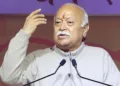
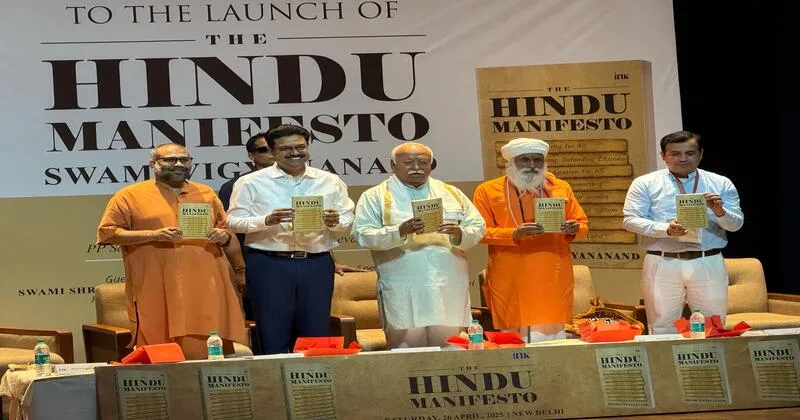
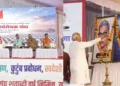
RSS Sarsanghchalak Dr Mohan Bhagwat at the book launch of 'The Hindu Manifesto', a new book by Swami Vigyananand, Joint General Secretary of the Vishva Hindu Parishad (VHP) and initiator of the World Hindu Congress

RSS Sarsanghchalak Dr Mohan Bhagwat at the book launch of 'The Hindu Manifesto', a new book by Swami Vigyananand, Joint General Secretary of the Vishva Hindu Parishad (VHP) and initiator of the World Hindu Congress

FacebookTwitterWhatsAppTelegramEmail

“Non-violence is our basic nature and values. But some people are wilful. I mentioned about Ravan in Mumbai, because Ravan had everything, yet his mind was against non-violence. Bhagwan Ram killed Ravan for his own welfare — it was not an act of violence, but of true non-violence. Non-violence is our dharma. We never cause any harm to our neighbours, but if someone do not follow their dharma and turns evil, then it becomes the duty of the king to protect his public, the king must perform his duty. Gita also teaches about non-violence. It says Arjun should fight and kill the Kauravas because, at that time, this was the only way for their welfare,” said RSS Sarsanghchalak Dr Mohan Bhagwat at the book launch of ‘The Hindu Manifesto’, a new book by Swami Vigyananand, Joint General Secretary of the Vishva Hindu Parishad (VHP) and initiator of the World Hindu Congress, on April 26 at the PM Museum in New Delhi.

He further said, “Even Ravan was killed because he refused to change his mind. Bhgawan Ram killed him only when he did not change”.  Emphasising the tradition of Shastrarth (debate), Dr Bhagwat said, “We have a tradition of Shastrarth, where a proposal is put forth, and everyone expresses their views on it. There are both the initial argument (Purva Paksh) and the counter-argument (Uttar Paksh). The word ‘Manifesto’ is a bit confusing, political parties also release a manifesto during elections, but this Hindu Manifesto is not like that. When discussions are held on such books, a consensus will emerge that will be in harmony with the present times.”

Dr Mohan Bhagwat further reflected on the failure of purely materialistic development models that have led to dissatisfaction and environmental degradation worldwide. He highlighted Bharat’s civilisational path as the “third path” — a harmonious balance between material and spiritual well-being. However, before inspiring the world, Hindus must first embody the principles outlined in Swamiji’s book, which are rooted in the eternal wisdom of the shastras. Historically, Bharat’s influence was widespread without conquest, but complacency and narrow-mindedness led to the neglect of true Dharmic values.

“Hindu saints gathered at Udupi recently reaffirmed that any form of discrimination has no religious sanction in our scriptures”, he said. He aslo acknowledged the need to correct historical deviations. Dr Bhagwat said that the book seeks to reignite debate and bring the authentic Hindu worldview back into consciousness — a worldview that holds no ill will, even towards adversaries. True Dharma emphasises righteous action, societal prosperity, and adherence to the four purusharthas without rejecting worldly responsibilities.

Dr Bhagwat stressed that Dharma is deeper than religious rituals; it embodies universal truths and spiritual wisdom (adhyatmikta). He positioned ‘The Hindu Manifesto’ as an essential reference for Hindus, urging scholars, researchers, and common people alike to engage with it, fostering a contemporary and vibrant understanding of traditional knowledge.

Speaking at the event, Swami Vigyananand explained that the book captures the essence of ancient wisdom, reinterpreted for contemporary times. He emphasized that Hindu thought has always addressed the needs of the present while being firmly rooted in timeless principles distilled into powerful Sutras by Rishis.
The 8 foundational sutras of The Hindu Manifesto emphasise prosperity for all, national security, quality education, responsible democracy, respect for women, social harmony, sacredness of nature, and respect for one’s heritage.

Expounding on these sutras, Swami Vigyananand said that unlike Western capitalism or socialism, Hindu tradition proposes a balanced economic model that values wealth creation alongside fair distribution. True Dharma includes the responsibility to destroy enemies without misplaced mercy, something we forgot in the past with disastrous consequences. The importance of quality education was stressed, recognising the destruction of Bharat’s indigenous education system under colonial rule. Rooted in a republican spirit, Hindu civilization advocates for responsible governance with public participation and rejects the mentality of passive acceptance of rulers.

The second half of the book lays the foundations for a civilizational renaissance, talking about safety, dignity, and respect for women, inspired by figures like Draupadi; a non-discriminatory society based on Dharma, with the correct understanding of Varna and Jati; environmental stewardship, reflecting deep-rooted reverence for nature; and respect for the sacred geography and cultural unity of Bharat.

Prof Yogesh Singh, Vice Chancellor of Delhi University, noted that true education is a blend of knowledge and wisdom, emphasizing the need for a strong treasury and defense for a resilient state. Swami Krishnashah Vidyarthi, Mahant of Rashtriya Valmiki Mandir, said that this book promises to be transformative as it contains the essence of our Dharmic thought.

Also Read: From Pahalgam to Murshidabad: Can India’s pluralism survive the Jihadist onslaught

The book ‘The Hindu Manifesto’ offers a transformative framework for prosperity, governance and justice in modern times, rooted in the principles of Dharma and the timeless wisdom of ancient Hindu texts such as the Vedas, Ramayana, Mahabharata, Arthashastra, and Shukranitisar. Swami Vigyananand has crafted The Hindu Manifesto as a blueprint for civilisational renaissance, based on eight guiding principles, or Sutras, that emphasise prosperity for all, national security, quality education, responsible democracy, respect for women, soctal harmony, sacredness of nature, and respect for one’s heritage.

The book presents a Dharma-centred model to foster a just, prosperous, and harmonious future for the world. It advocates for responsible democracy, drawing inspiration from Ram Rajya, where sovernance is rooted in justice and public welfare. It also redefines social structures, dispelling misconceptions about Varna and Jati and advocating for a non-discriminatory society.

‘The Hindu Manifesto’ maintains that a nation’s strength and longevity depend on two fundamental aspects: a solid foundational framework that ensures stability and progress, and a civilisational framework that nurtures values, identity and sustainability. Together, these aspects form the core philosophy of this book, with each of the eight Sutras representing a crucial pillar of a thriving society.

By blending ancient wisdom with contemporary Ideas, the book guides us to realign society with enduring civilisational values and power Bharat’s rise in the changing world order. A two-minute silence was also observed at the book launch to honour the innocent lives lost in the Pahalgam terrorist attack.
Topics: The Hindu ManifestoPahalgam Terrorist attackJoint General Secretary of the Vishva Hindu Parishad (VHP)RSSRSS Sarsanghchalak Dr Mohan BhagwatSwami Vigyananand
ShareTweetSendShareSend
✮ Subscribe Organiser YouTube Channel. ✮
✮ Join Organiser's WhatsApp channel for Nationalist views beyond the news. ✮
Previous News

From Pahalgam to Murshidabad: Can India’s pluralism survive the Jihadist onslaught

Next News

Modi’s Strategic Offensive: Exposing Congress’s hypocrisy on Waqf, reservations, and governance

Related News

Amid rising global conflicts and uncertainty, the idea of ‘Swa’ offers Bharat a foundation for self-reliance, resilience, and civilisational confidence

The Geopolitics of Selfhood: Why the idea of ‘Swa’ is emerging as Bharat’s strategic compass in a turbulent world

PM Narendra Modi disguised as a Sardar during 1975 Emergency (This is an AI generated image)

Emergency 1975: How young Narendra Modi worked underground to support families of jailed satyagrahis

Fifty years after the Emergency, India reflects on a defining test of democracy, freedom and citizen resilience

The Emergency at Fifty: Democracy’s darkest hour, India’s finest test

RSS struggle to defend the Constitution during the Emergency

Samvidhan Hatya Diwas: Revisiting RSS’s role in defending India’s Constitution & democratic freedoms during 1975-77

Sunil Ambekar (Akhil Bharatiya Prachar Pramukh Rashtriya Swayamsevak Sangh addressing the gathering in Patna

The Emergency taught us that a vigilant society is essential to protect democracy: Sunil Ambekar ji

Nagpur | Acceptance of Bharatiya civilisational values is steadily increasing worldwide: Shanta Kumari

Load More

Latest News

Muharram Procession Targeted? Pune businessman Faiyaz Premji held with thousands of poison capsules

Muharram mass poisoning plot in Mumbai foiled; Faiyaz Nisar arrested with 14,900 rat poison capsules

Suicide bomber detonates bomb at Rangers HQ in Karachi; At least 9 people reportedly killed

Karachi Blasts: Jamaat Ul Ahrar – splinter group of TTP claims responsibility; 9 killed including 6 Sindh Rangers

A representative image generated using AI

Exclusive | ‘He is only a Muslim’: Inside Madras HC judgment striking down Backward Class Muslim status for converts

St Peter & Paul Sea Foods Exports

Tiruvallur Ammonia Gas Leak: Death toll rises to 15; BJP questions delay in action, seeks Rs 25 lakh compensation

The Dark Days of Emergency: How despotic rule censored iconic ‘Sholay’ climax to serve political power

ISRO successfully tests next-gen semi-cryogenic rocket engine; Key milestone as India moves closer to Gaganyan mission

Europe Boils: Heatwave kills 100+ sparking public health emergency; Exposes the dark side of western model of growth

ANCHOR was released during the 3rd BRICS Neuroscience Symposium 2026

IIT Madras unveil ‘ANCHOR,’ the world’s most detailed 3D atlas of human brainstem

MC Sreedhara Varma Raja, hereditary trustee of Shree Tirumandhamkunnu Bhagavati Temple in Perinthalmanna, Malappuram

Keralam: Hereditary trustee takes over Tirumandhamkunnu temple after Devaswom board defies HC verdict

Karnataka sprinter Unnathi Aiyappa

Karnataka sprinter Unnathi Aiyappa eyes Asian Games medal after qualifying in 200m

Load More
  • Privacy
  • Terms
  • Cookie Policy
  • Refund and Cancellation
  • Delivery and Shipping

© Bharat Prakashan (Delhi) Limited.
Tech-enabled by Ananthapuri Technologies

  • Home
  • Search Organiser
  • Bharat
    • Assam
    • Bihar
    • Chhattisgarh
    • Jharkhand
    • Maharashtra
    • View All States
  • World
    • Asia
    • Africa
    • North America
    • South America
    • Europe
    • Australia
  • Editorial
  • Operation Sindoor
  • Opinion
  • Analysis
  • Defence
  • Culture
  • Sports
  • Business
  • RSS @ 100
  • Entertainment
  • More ..
    • Sci & Tech
    • Vocal4Local
    • Special Report
    • Education
    • Employment
    • Books
    • Interviews
    • Travel
    • Health
    • Politics
    • Law
    • Economy
    • Obituary
  • Subscribe Magazine
  • Read Ecopy
  • Advertise
  • Circulation
  • Careers
  • About Us
  • Contact Us
  • Policies & Terms
    • Privacy Policy
    • Cookie Policy
    • Refund and Cancellation
    • Terms of Use

© Bharat Prakashan (Delhi) Limited.
Tech-enabled by Ananthapuri Technologies