Pass Politics, Fail Democracy: Tamil Nadu’s campus autocracy
June 6, 2026
  • Read Ecopy
  • Circulation
  • Advertise
  • Careers
  • About Us
  • Contact Us
Android AppiPhone AppArattai
Organiser
  • ‌
  • Bharat
    • Assam
    • Bihar
    • Chhattisgarh
    • Jharkhand
    • Maharashtra
    • View All States
  • World
    • Asia
    • Europe
    • North America
    • South America
    • Africa
    • Australia
  • Editorial
  • International
  • Opinion
  • RSS @ 100
  • More
    • Op Sindoor
    • Analysis
    • Sports
    • Defence
    • Politics
    • Business
    • Economy
    • Culture
    • Special Report
    • Sci & Tech
    • Entertainment
    • G20
    • Azadi Ka Amrit Mahotsav
    • Vocal4Local
    • Web Stories
    • Education
    • Employment
    • Books
    • Interviews
    • Travel
    • Law
    • Health
    • Obituary
  • Subscribe
    • Subscribe Print Edition
    • Subscribe Ecopy
    • Read Ecopy
  • ‌
  • Bharat
    • Assam
    • Bihar
    • Chhattisgarh
    • Jharkhand
    • Maharashtra
    • View All States
  • World
    • Asia
    • Europe
    • North America
    • South America
    • Africa
    • Australia
  • Editorial
  • International
  • Opinion
  • RSS @ 100
  • More
    • Op Sindoor
    • Analysis
    • Sports
    • Defence
    • Politics
    • Business
    • Economy
    • Culture
    • Special Report
    • Sci & Tech
    • Entertainment
    • G20
    • Azadi Ka Amrit Mahotsav
    • Vocal4Local
    • Web Stories
    • Education
    • Employment
    • Books
    • Interviews
    • Travel
    • Law
    • Health
    • Obituary
  • Subscribe
    • Subscribe Print Edition
    • Subscribe Ecopy
    • Read Ecopy
Organiser
  • Home
  • Bharat
  • World
  • Operation Sindoor
  • Editorial
  • Analysis
  • Opinion
  • Culture
  • Defence
  • International Edition
  • RSS @ 100
  • Magazine
  • Read Ecopy
Home Bharat

Pass Politics, Fail Democracy: Tamil Nadu’s campus autocracy

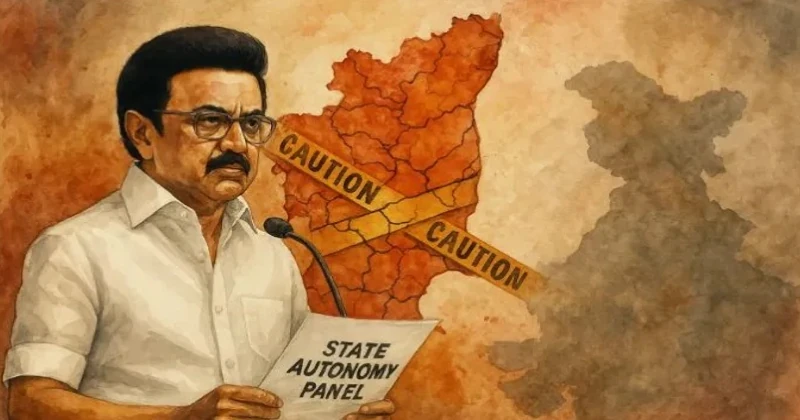
Tamil Nadu’s campuses, once the birthplace of political voices, are now turning into echo chambers of state control. As CM Stalin eyes total control over universities, student democracy in the state faces a slow, deliberate demise

Karthik H PKarthik H P
Apr 20, 2025, 08:00 pm IST
in Bharat, Tamil Nadu
Follow on Google News
(Image Source: OpIndia)

(Image Source: OpIndia)

FacebookTwitterWhatsAppTelegramEmail

While Bharat takes immense pride in being the world’s largest democracy, Tamil Nadu’s campuses have long functioned as controlled labs of silence, not platforms of freedom. In this southern state that boasts a supposedly progressive ethos, campus democracy is less of a living principle and more of a taxidermied trophy mounted on the wall of Dravidian hypocrisy.

“The latest chapter in this political farce is Chief Minister M. K. Stalin eyeing the role of Chancellor for all state universities. Because nothing says ‘academic freedom’ like having the ruling party’s patriarch sitting atop every university’s decision-making ladder.”

Who asked for this ‘next level’ democracy? – The Supreme Court Ruling

The Supreme Court, in State of Tamil Nadu vs. Governor of Tamil Nadu (W.P. (C) No. 1239 of 2023), ruled that the Governor cannot withhold assent once a Bill is re-passed by the State Assembly. A win for constitutional clarity, yes, but let’s not pop the champagne yet. Because while the Court held the Governor accountable, it accidentally lifted the veil on a more sinister

Reality: the Dravidian model’s slow suffocation of academic autonomy.

Tamil Nadu had passed 12 Bills, 10 of which concerned university governance, essentially moving the power to appoint Vice-Chancellors from the Governor to the elected government. The Governor stalled, and the State cried foul. However, when you examine the motive behind these bills, what emerges is not decentralisation but a carefully coded power grab.

If it’s governance, it’s Stalin ka parivaar. If it’s education, it’s also Stalin ka parivaar!

The DMK dressed it up as state autonomy. In reality, it’s party centralisation. If passed, the CM becomes the ultimate academic boss, M K Stalin, the new Chancellor of all universities. Not metaphorically. Literally.

We’re now staring down a system where one political party (and, more importantly, one family) gets to handpick who runs the intellectual life of the state. Forget checks and balances. This is checks cancelled, balances deleted.

DMK ensures delay of justice: Anna University and the Anatomy of Abuse

If you think this is hyperbole, look at the Gnanasekaran case. A DMK loyalist and known history-sheeter accused of sexually harassing a student inside Anna University. Police delays. Political silence. Institutional apathy.

Now imagine such figures being protected not just unofficially but structurally because their political patrons are also their academic bosses. That’s not just corruption of governance; it’s the poisoning of education itself.

It’s enough if the CM knows-public doesn’t need to!

Here’s what real campus democracy looks like:

-Independent student unions
-Transparent appointments
-Space for dissent
-Safety and justice for victims
-Decisions made through dialogue, not decree

Guess what the DMK government offers? None of the above. Instead, it hands universities over to the Chief Minister’s office, fully wrapped in a gift ribbon labelled “reform.”

TN Student Politics, RIP

Irony is bleeding in black ink: the DMK, a party once born from campus agitation, has become the very machinery that crushes student expression. Decades ago, leaders like K. Anbazhagan & Duraimurugan emerged from student activism. Today, Udhayanidhi Stalin ascends not through debate halls but through bloodlines.

No student unions. No campus elections. No dissent. No debate. Just state-sponsored sedation. The Dravidian model of higher education seems to believe that silent students make obedient citizens and, perhaps, more pliable voters.

In contrast, JNU and DU produce real national leaders. Like Arun Jaitley, Ravi Shankar Prasad, and Venkaiah Naidu, to name a few. Student activism in Telangana played a crucial role in the statehood movement. Even in Bihar, student leaders shape political discourse.

Tamil Nadu? Nothing. A self-induced coma. Not cultural. Not accidental. Politically engineered.

Is it a people’s party or a monarchy’s party?– A Legacy of Control

In public speeches, the DMK thumps its chest for federalism. But in private, it architects a fortress of control. The shift from Governor to CM is not about justice or efficiency but, it’s about empire-building. The empire of one man, one party, one family, one voice.

Let’s be clear: the Supreme Court did what it had to. But courts can’t revive student unions. Courts can’t run university elections. Courts can’t teach courage.

That job? It’s ours. The nationalists. The thinkers. The doers. The youth.

“Campus-um Kedaichudhu, Kalvi-um Kettudhu!” (Campus got hijacked, education got ruined!)

Campus democracy in Tamil Nadu is not dying of natural causes. It’s being euthanised needle by needle by a political culture that thrives on control and fears dissent. If we don’t act now, we’re not just losing student voices, we’re losing the very soul of our future leadership.

This isn’t just about who appoints Vice-Chancellors. It’s about who gets to ask questions in the first place. And if students can’t ask questions, then we’re not running universities. We’re running training camps for silence.



Topics: DMKABVPMk StalinDravidian ModelTamilnaduCampus DemocracyAcademic FreedomUniversity Autonomy
ShareTweetSendShareSend
✮ Subscribe Organiser YouTube Channel. ✮
✮ Join Organiser's WhatsApp channel for Nationalist views beyond the news. ✮
Previous News

“A deliberate political design behind the chaos in West Bengal”: Jagdambika Pal, Chairperson of JPC on Waqf

Next News

How Congress sidelined Sardar Patel’s legacy for Nehru

Related News

MK Stalin with Sonai Gandhi; MK Stalin with Rahul Gandhi (File Photos) (Left to Right)

Tamil Nadu: DMK says no to INDIA Alliance meet in Delhi, blames Congress for political backstabbing

Representative Image

From DMK to TVK Government: Did crimes against women and children end in Tamil Nadu?

ABVP National General Secretary Dr. Virendra Singh Solanki addresses the press after the NEC meeting, discussing resolutions passed, campaigns, and a nationwide call to action

Odisha: ABVP National Executive Adopts key resolutions on jihadi exploitation, conversions and urban Maoism networks

ABVP delegates deliberating during the last day of the National Executive Council (NEC) meeting in Bhubaneswar.

ABVP’s NEC Meeting Ends: 4 resolutions on educational reforms, women’s safety, urban Maoism & global scenario passed

National Executive Council Meeting of the ABVP in Bhubaneswar

ABVP National Executive Council Meeting: ABVP calls for industry-academia partnership to boost research ecosystem

ABVP’s National Executive Council Meeting began in Bhubaneswar with Prof. Raghuraj Kishore Tiwari, Dr Virendra Singh Solanki and Shri Ashish Chauhan inaugurating the event

ABVP National Executive Council Meet: “Three-language policy to strengthen Indian languages,” says Dr Virendra Singh

Load More

Latest News

A series of high-level engagements signals New Delhi's growing focus on building interoperable security networks across the Indo-Pacific

India strengthens Indo-Pacific security architecture with new defence and maritime partnerships

Prime Minister Narendra Modi

“Makes every Indian proud”: PM Modi hails India’s 7.7 per cent GDP growth in FY 2025-26

Once known for maoist violence, Minpa now leads healthcare revolution with telemedicine services in Sukma

From Maoist Stronghold to Healthcare Hub: How Chhattisgarh’s Minpa is transforming through telemedicine & development

Dr Surendra Jain, Joint General secretary, VHP

VHP Demands Audit of Waqf Properties Amid Encroachment Claims: “Land should go to rightful owner,” says Surendra Jain

A Special NIA Court has framed charges against banned PFI and 20 office bearers, including E. Abubakar and O.M.A. Salam, under UAPA and IPC

PFI Terror Case: Special NIA court charges Abubakar, Salam & others for alleged conspiracy to wage war against India

Prime Minister Narendra Modi with women during an event (Old image used for representative purposes)

The Nari Shakti Decade: How 12 years of policy reforms under Modi govt transformed lives of women in Bharat

Ritabrata Banerjee, expelled by Mamata Banerjee from TMC, has been appointed as the Leader of the Opposition in Bengal assembly.

TMC House Divided: Mamata’s party battles Itself as LoP row exposes deepening cracks after BJP’s big blow

Lucknow’s UP 112 Headquarters hosts West Bengal team for policing innovation study

UP 112 Model: West Bengal police visits Lucknow to replicate Yogi’s emergency response model

Representative Image

Pakistan: POJK to go for polls on July 27 under shadow of JAAC agitation

Saokat Molla with Mamata Banerjee

West Bengal: NIA foils escape bid, tracks former TMC MLA Saokat Molla through third-party mobile network

Load More
  • Privacy
  • Terms
  • Cookie Policy
  • Refund and Cancellation
  • Delivery and Shipping

© Bharat Prakashan (Delhi) Limited.
Tech-enabled by Ananthapuri Technologies

  • Home
  • Search Organiser
  • Bharat
    • Assam
    • Bihar
    • Chhattisgarh
    • Jharkhand
    • Maharashtra
    • View All States
  • World
    • Asia
    • Africa
    • North America
    • South America
    • Europe
    • Australia
  • Editorial
  • Operation Sindoor
  • Opinion
  • Analysis
  • Defence
  • Culture
  • Sports
  • Business
  • RSS @ 100
  • Entertainment
  • More ..
    • Sci & Tech
    • Vocal4Local
    • Special Report
    • Education
    • Employment
    • Books
    • Interviews
    • Travel
    • Health
    • Politics
    • Law
    • Economy
    • Obituary
  • Subscribe Magazine
  • Read Ecopy
  • Advertise
  • Circulation
  • Careers
  • About Us
  • Contact Us
  • Policies & Terms
    • Privacy Policy
    • Cookie Policy
    • Refund and Cancellation
    • Terms of Use

© Bharat Prakashan (Delhi) Limited.
Tech-enabled by Ananthapuri Technologies