India has stepped up its defence diplomacy across the Indo-Pacific, advancing maritime security cooperation, defence industrial collaboration, information-sharing mechanisms and military interoperability with a range of strategic partners, led by Australia, while also deepening engagement with Singapore, New Zealand, the European Union, Sweden and the Netherlands.
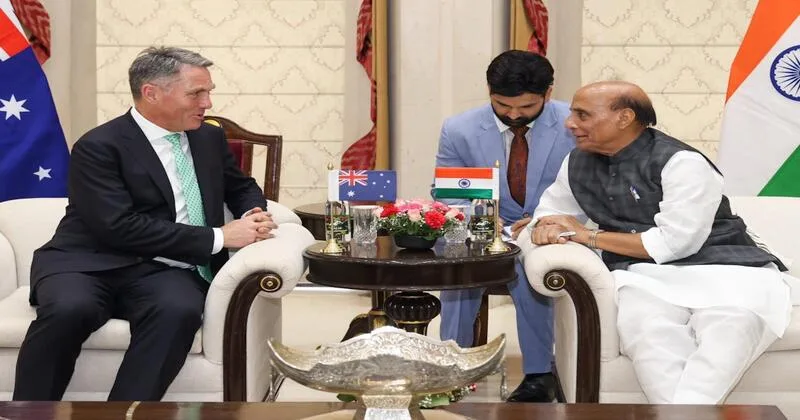
The momentum was visible during a series of high-level defence interactions held in New Delhi and on the sidelines of the Shangri-La Dialogue in Singapore, underscoring New Delhi’s growing focus on strengthening partnerships that contribute to a secure, stable and rules-based Indo-Pacific. At the centre of these developments was the second India-Australia Defence Ministers’ Dialogue in New Delhi, where Defence Minister Rajnath Singh and Australian Deputy Prime Minister and Defence Minister Richard Marles reviewed the expanding strategic partnership and outlined a broad roadmap for future cooperation across maritime, military and defence-industrial domains.
Maritime security cooperation moves into new phase
A key outcome of the India-Australia dialogue was the decision to advance collaborative maritime domain awareness activities through maritime patrol aircraft and explore new opportunities for enhancing undersea domain awareness. The agreement reflects the increasing importance both countries attach to monitoring activities across the Indian Ocean and wider Indo-Pacific, where maritime security challenges continue to evolve. The two sides also encouraged greater cooperation between the Indian Coast Guard and Australia’s Maritime Border Command, signalling an effort to broaden operational engagement beyond conventional military structures. The ministers reaffirmed their shared commitment to a free, open, peaceful, stable and prosperous Indo-Pacific and stressed the importance of freedom of navigation, overflight rights and unimpeded lawful trade. Both countries reiterated support for international maritime norms under the 1982 United Nations Convention on the Law of the Sea (UNCLOS).
India and Australia are also preparing to jointly host a Search and Rescue (SAR) and tabletop exercise later this month at the Maritime Rescue Coordination Centre in Chennai. The exercise will be conducted under the framework of the Indian Ocean Rim Association (IORA), where both countries serve as co-leads of the Working Group on Maritime Safety and Security. The planned exercise is expected to strengthen regional coordination mechanisms and improve preparedness for maritime emergencies across the Indian Ocean Region.
Military interoperability and operational integration deepen
The defence dialogue also focused heavily on enhancing interoperability between the armed forces of the two countries. Building upon the 2020 Mutual Logistics Support Arrangement, both ministers agreed to explore mechanisms that would improve procedural interoperability during exercises and operations. They also decided to continue aircraft deployments from each other’s territories, a step aimed at increasing operational familiarity and strengthening military coordination.
The two countries outlined an ambitious schedule of military engagements in the coming years. Australia welcomed India’s enhanced participation in Exercise Talisman Sabre 2027, while India welcomed Australian participation in Exercise Milan 2026. New Delhi will also participate in Australia’s Exercise Kakadu and both sides are preparing to operationalise the bilateral air-to-air refuelling arrangement during Exercise Pitch Black.
Military cooperation is simultaneously expanding into new operational areas. The latest edition of Exercise ‘Austrahind’ has evolved to focus on amphibious combat and littoral manoeuvres, reflecting the growing importance of coastal and maritime operations in regional security planning. Australia welcomed India’s participation in Operation Render Safe 2026, while India accepted Australia’s invitation to participate in submarine rescue exercise Black Carillon, further widening the scope of bilateral military engagement.
The ministers also looked ahead to the inaugural Joint Staff Talks scheduled later this year and encouraged officials to finalise arrangements for the deployment of an Indian visiting instructor at the Australian Defence College during 2028-29, a move intended to strengthen professional military exchanges and strategic alignment.
Defence industry partnership gains momentum
Beyond operational cooperation, India and Australia are now moving towards deeper defence-industrial collaboration. Both ministers announced the commencement of work on a Memorandum of Understanding concerning the provision of defence articles and defence services, which will serve as the next major step in expanding defence industry ties.
The move follows Australia’s first defence trade mission to India and the Australia-India Defence Industry Roundtable held in October 2025, events that highlighted growing interest among defence manufacturers and policymakers in expanding bilateral industrial cooperation.
The two sides agreed to continue engagement through the Joint Working Group on Defence Industry, Research and Materiel while exploring additional opportunities for collaboration.
Emerging technologies have become an important pillar of the relationship. India and Australia are examining possibilities for defence science and technology cooperation in areas such as sensor technologies and other advanced systems. Australia also invited India to participate in the 2026 Australian Defence Science, Technology and Research Summit, signalling an effort to institutionalise collaboration in future-oriented defence capabilities.
Quad maritime initiatives receive fresh push
The growing strategic convergence among India, Australia, Japan and the United States also featured prominently during the discussions. The ministers reaffirmed their commitment to strengthening maritime domain awareness and improving interoperability among Quad partners. They expressed strong support for the Quad Indo-Pacific Maritime Surveillance Collaboration initiative, which will initially focus on the Indian Ocean Region through expert exchanges and tabletop exercises.
Australia welcomed India’s operationalisation of the Indian Ocean component of the Quad Indo-Pacific Partnership for Maritime Domain Awareness through the Information Fusion Centre–Indian Ocean Region in Gurugram. Both countries also agreed to work towards developing a Common Operational Picture across the Indo-Pacific by building on existing maritime domain awareness initiatives. Such efforts are intended to improve information-sharing and create a more coordinated understanding of maritime developments across one of the world’s most strategically important regions.
The emphasis on surveillance collaboration, information fusion and maritime awareness reflects a broader shift towards networked security partnerships that seek to improve collective responses to emerging challenges in the Indo-Pacific.
Defence diplomacy expands across the Indo-Pacific
Parallel to the India-Australia engagement, Defence Secretary Rajesh Kumar Singh held an extensive series of bilateral meetings during the Shangri-La Dialogue in Singapore, highlighting India’s wider diplomatic outreach across the Indo-Pacific and Europe. His discussions with defence ministers from Singapore and New Zealand focused on strengthening bilateral defence ties, enhancing maritime cooperation, advancing information-sharing arrangements and reaffirming a shared commitment to a secure, stable and inclusive Indo-Pacific.
During the Singapore visit, Rajesh Kumar Singh also met Singapore President Tharman Shanmugaratnam, where discussions centred on strengthening strategic relations and expanding cooperation in areas of mutual interest.
India’s defence engagement with Europe also witnessed notable progress. Talks with Sweden’s State Secretary for Defence, Peter Sandwall, focused on expanding defence cooperation and exploring collaboration in defence technology and innovation.
Separate discussions were held with Netherlands Chief of Defence Onno Eichelsheim on military exchange programmes and joint training initiatives. Rajesh Kumar Singh also met Netherlands Defence Minister Dilan Yesilgoz-Zegerius to discuss military cooperation and defence-industrial collaboration, reflecting the growing strategic engagement between the two countries.
The Defence Secretary further interacted with Belen Martinez Carbonell and Enrico Barduani, with discussions focused on advancing strategic dialogue between India and the European Union and exploring avenues for deeper defence cooperation. He also held talks with Australian Defence Secretary Meghan Quinn, where both sides reviewed progress under the India-Australia Comprehensive Strategic Partnership, discussed upcoming high-level engagements and examined further opportunities to strengthen defence cooperation.
Taken together, the engagements in New Delhi and Singapore point to an increasingly proactive Indian defence diplomacy that is simultaneously strengthening maritime security partnerships, expanding defence-industrial cooperation and building interoperable military networks across the Indo-Pacific. As regional security dynamics continue to evolve, New Delhi’s latest initiatives indicate a sustained effort to deepen strategic partnerships while reinforcing its role as a key security stakeholder in the wider Indo-Pacific region.