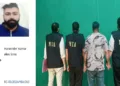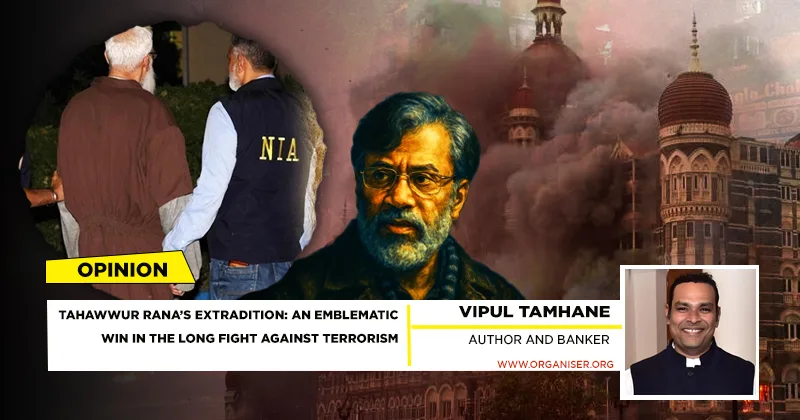
Pakistan’s ‘Thousand Year War’ with India which was actually a political rhetoric by Zulfikar Ali Bhutto, had taken some turns in history which proved to be shame for Pakistan, a numerous times at the hands of Indians. In the same string, in a recent turn of events with profound geopolitical implications, the Indians have achieved yet another victory, as United States has extradited Captain Tahawwur Rana, a Pakistani-origin Canadian citizen and ex-army doctor, to India for his suspected role in the deadly 2008 Mumbai terror attacks. The extradition, facilitated after a long drawn-out legal process and a final order by the U.S. Supreme Court, is a huge diplomatic win for India and a critical milestone in the global fight against terrorism.
Rana’s extradition, some 16 years on from the heinous attacks which killed 166 individuals is a symbolic and strategic benchmark. The assault, dubbed around the world as “26/11,” was perpetrated by agents of the Pakistan-based militant organization Lashkar-e-Taiba (LeT), and involved a highly complicated infrastructure of facilitators and planners based across frontiers.
Rana, now in Indian custody and shortly to be produced before a National Investigation Agency (NIA) court, was arrested in the U.S. in 2009 and convicted in 2011 of a different plot to commit terrorism against a Danish newspaper. His link to 26/11, however, has always been large. Indian officials claim Rana played a key role in facilitating his boyhood friend from the Cadet College Hasanabdal days and co-conspirator, Daood Gilani also known by his alias ‘David Coleman Headley’, in the procurement of travel documents and establishing a legitimate business cover in India as an immigration consulting outfit. The cover enabled Headley to make close observations of the 26/11 targets, the Taj Mahal Palace Hotel and Chabad House, without provoking suspicions.
Rana’s role as a Deep-State operative was exposed, as a prime facilitator of the attacks which been established through Gilani’s confessions, what makes his extradition particularly significant is the potential intelligence he may hold. Investigators hope Rana could expose deeper ties between Pakistan’s military intelligence service, the Inter-Services Intelligence (ISI), and terrorist organizations like Lashkar-e-Taiba. India has always claimed that the 2008 Mumbai attacks were not just the product of lone wolf actors but were organized with the backing of elements in the Pakistani state.
Rana’s background lends credence to this perspective. Post regiment from the Pakistani Army as an officer, Rana moved to Canadian and assumed naturalised citizenship, to used his global mobility to operate beyond borders. His dual nationality and genuine business fronts furthered him in utilizing sleeper cells; with Headley he was able to operate with virtual impunity, until the attacks made the world wake up and take notice.
After his conviction in the U.S., Rana was faced with extradition proceedings brought by India. He sought to prevent his removal, citing that as a Muslim of Pakistani descent, he could not be assured of safety in India. The U.S. Supreme Court rejected this on the basis that it accepted India’s case and emphasized international cooperation for fighting terrorism; seeking closure for 6 victims from the same attack, who were U.S. citizens. Following the September 11 attack, UN Security Council Resolution 1373 (2001) came into effect, which emphasized more cooperation in extradition and the law of Aut Dedere Aut Judicare (Extradite or Prosecute), trials of cases of terrorism, to which U.S. is the primary ratifying party.
His appeal as well raised eyebrows, given the judicial treatment by India of Ajmal Amir Kasab, the sole 26/11 perpetrator caught alive. Kasab was tried to his full extent, represented, and appealed before finally being hanged. The bar set little scope for Rana’s case to hold ground.
India has legally won by bringing Rana to justice, sending a message of resolve to the world. For years, the victim families of 26/11, Indian people, and international observers have cried out for accountability from the Pakistan. The extradition of Rana indicates that world powers want to act on strong evidence and join hands with India in an international league for justice.
The timing of the extradition of Rana, after Prime Minister Narendra Modi spoke with U.S. President Donald Trump, reflects the increasing India-U.S. convergence against terror. Whereas Washington has been criticized in the past for its pick-and-choose attitude towards terror threats worldwide, particularly considering its refusal to extradite David Headley due to a plea bargain arrangement, this action serves to correct some of the imbalance.
Critics have maintained that Headley’s plea bargain, which secured him life imprisonment in return for testimony and immunity from extradition, is a diplomatic failure. Some retired Indian officials have even posited that Headley was a double agent, perhaps beyond the radar of U.S. intelligence agencies. If this were the case, it would add a sinister twist to the story, suggesting foreknowledge or passive collusion.
In light of Rana’s background as a deep state asset, someone reportedly sent out to subvert Indian security interests while working in civilian cover; his worth to Pakistan’s intelligence community is now largely exhausted. The person who suggested ‘Nishan-e-Haider’ the highest gallantry award given by Pakistan Army to the 26/11 terrorists, as quoted in the FBI report, his transfer to India, thus, was not only legally tenable but diplomatically convenient to the U.S. and symbolically necessary for India.
What’s in store is that, the Indian intelligence bureaus and the NIA are getting set for a rigorous interrogation session. They want not just to get information regarding the planning and conduct of 26/11 but also determine the remaining sleeper cells, logistics networks, and impending dangers. Rana’s information could bring forth recruitment habits, cross-border funding, and international terrorist hideouts sponsored by states.
Yet, notwithstanding Rana’s extradition, there is a great deal more at stake. Some of the important masterminds such as LeT founder Hafiz Saeed and 26/11 alleged operational commander Zaki-ur-Rehman Lakhvi roam free in Pakistan, despite condemnation from around the world and a price on their heads. New Delhi has called for their extradition all along, but Islamabad’s denial is representative of a pattern of state-abetted terror.
Punishing these men will take more than diplomatic pressure. It will take concerted international pressure, including from friends like the U.S., to make Pakistan comply. In the meantime, symbolic wins like Rana’s extradition will be both a victory and a reminder of work still to be done.
The international struggle against terrorism cannot be discriminatory. If terrorism has to be vanquished, political expediency must be abandoned by all countries and principles of justice enforced uniformly. Rana’s extradition is progress, but the Headley deal is still a stain. If the United States really wants to lead the war on terror globally, its policy and practice have to match its words. In the same way, Pakistan needs to face international repercussions if it keeps harboring and hosting those who carried out mass killings.
So far, India has taken a definitive leap toward accountability to the 26/11 victims. The global audience waits in suspense. Will this turning point give way to actual accountability, or disappear in the knotted skein of global diplomacy, is a determination that will map the contours of future South Asia and international counter-terror agendas.
As the plane bearing Tahawwur Rana touched Indian ground on the 9th April, 2025, the message was clear: India will not rest until each hand behind the 26/11 horror is brought to book. Rana’s extradition is not the end but a new beginning in a long search for truth, justice, and the destruction of terror networks based on ideology and power politics.
Given the serious terrorism charges Tahawwur Rana faces in India and his status as a naturalized Canadian citizen, in-spite Ottawa’s inaction, it is reasonable to expect that the Canadian government would have revoked his passport following his arrest in the United States, especially under the provisions of Canada’s Citizenship Act (R.S.C., 1985, c. C-29), which allows for revocation in cases involving in terrorism and/or national or international threat. Widely regarded as a terrorist operative for Pakistani deep-state, Rana is considered strategically expendable. Despite commendable diplomatic wrangling by the Indian external affairs and the judiciary, his extradition to India, therefore, serves as an optic diplomatic gesture, particularly for the U.S. President Donald Trump, reinforcing an image of strong counter-terrorism cooperation with India. But genuine diplomatic achievement in the war against terrorism would be more aptly illustrated by the extradition of David Coleman Headley from America, also, by forcing Pakistan, through relentless international pressure, to extradite Saeed and Lakhvi. These villains were key players in the planning of the 2008 Mumbai attacks. Ensuring their prosecution in Indian courts would be a much more significant and effective milestone in international efforts to combat terrorism and bring its masterminds to justice.
The road ahead is long, but for now, justice has taken a meaningful step forward.