Bharat has long embraced a scientifically and astronomically grounded approach to marking the New Year which is aligned with seasonal transitions and celestial events. However, the widely accepted practice of beginning the year in January follows the Gregorian calendar, introduced by Pope Gregory XIII in 1582 as a modification of the Julian calendar. This choice does not correspond to any specific astronomical occurrence, making it more of a convention than a scientific marker of time. Many Bharatiya New Year festivals, such as Gudi Padwa, Ugadi, Baisakhi, Bihu, etc., are celebrated near the vernal equinox, which takes place around March 20–22. This alignment reflects Bharat’s rich astronomical knowledge tradition, ensuring that the New Year coincides with important seasonal shifts that influence agriculture, climate, and daily life. The vernal equinox is a key astronomical event which occurs when the Sun crosses the celestial equator, balancing day and night almost equally. This event brings spring into the Northern Hemisphere, ushering warmer temperatures and extended daylight, symbolising renewal and new beginnings. By aligning New Year celebrations with vernal equinox, the Bharatiya Calendar System captures the essence of equilibrium and nature’s awakening, showcasing a deep understanding of Earth’s axial tilt and orbital dynamics.
Furthermore, this period coincides with the harvest season for Rabi crops across various regions in Bharat. The culmination of the agricultural cycle provides a logical and practical basis for marking the beginning of a new year, as communities celebrate the fruits of their labour and prepare for the upcoming planting season. This alignment between celestial events and occupational practices underscores a holistic approach to timekeeping, where calendars are crafted not only to track astronomical phenomena but also to harmonize with the rhythms of human life, promoting sustainability and environmental awareness.
The origins of Bharatiya calendars date back to the Vedic period (1500–600 BCE), where early texts such as the Rig Veda mention solstices, equinoxes, and seasonal shifts. These observations formed the foundation for a timekeeping system that evolved through the Gupta period (4th–6th centuries CE), Bharat’s golden age of science. During this era, luminaries like Āryabhaṭa (476–550 CE) revolutionised astronomy with his compilation Aryabhatiya, in which he proposed that the Earth rotates on its axis and calculated its circumference with remarkable accuracy (approximately 39,968 kilometers which was remarkably accurate, differing by only about 0.2 per cent from the modern value of approximately 40,075 kilometers at the equator).
Varāhamihira (505–587 CE) further refined astronomical calculations in his Pancha-Siddhantika, a synthesis of five major astronomical traditions identified as the Surya Siddhanta, Romaka Siddhanta, Paulisa Siddhanta, Vasishtha Siddhanta, and Paitamaha Siddhanta. Each of these systems offered distinct approaches to computing planetary positions, eclipses, and other astronomical events. By the 12th century, Bhāskara II (1114–1185 CE) had developed intricate algorithms for planetary motion in his Siddhanta Shiromani, which anticipated many modern trigonometric methods. These works solidified the Indian calendar as a scientifically rigorous system deeply embedded in empirical observation and mathematical sophistication.
Regional Dynamism in the Indian Calendar System
The Bharatiya calendar’s flexibility and resilence is evident in its regional variants. In the North India, the purnimanta system, which begins months at the full moon, predominates, while in the South India, the amanta system, starting at the new moon, is more common. These lunar influences are integrated into the broader luni-solar calendars, such as the Vikram Samvat (57 BCE) and Shaka Samvat (78 CE), widely followed in northern and central regions like Uttar Pradesh, Madhya Pradesh, Gujarat, and Maharashtra. Unlike the Gregorian calendar, which relies on a fixed solar year of 365 days, adjusted with a leap day every four years to match the Earth’s actual revolution time of 365.2425 days, the Indian luni-solar system adopts a more dynamic approach. A purely lunar year of 354 days falls short of the solar year by about 11 days, so the Indian calendar introduces an intercalary month, known as Adhik Maas, roughly every 2.7 years. This adjustment ensures that festivals and significant dates remain aligned with the seasons, preventing the drifting seen in purely lunar calendars like the Islamic Hijri calendar, where sacred dates shift across seasons over time. By incorporating Adhik Maas, the Bharatiya system maintains a harmonious link between human activities, seasonal cycles, and the cosmic order, showcasing an advanced understanding of astronomical rhythms that surpasses the Gregorian calendar’s rigid framework.
The origins of Hindu calendar date back to the Vedic period. Solstices, equinoxes and seasonal shifts have been mentioned in Rig Veda
In addition to luni-solar systems, distinct solar calendars thrive in southern and eastern India, particularly in regions such as Tamil Nadu (Tamil calendar), Kerala (Malayalam calendar), West Bengal (Bengali calendar), and Odisha (Odia calendar). These calendars are anchored to the Earth’s orbit around the Sun, dividing the year into 12 months based on the Sun’s transit through specific zodiac signs, or rashis. Each month begins when the Sun enters a new rashi, aligning the calendar with observable solar phenomena and seasonal shifts. This solar emphasis supports agricultural planning and ensures that regional occupations stay in tune with local climatic conditions, highlighting the practical utility of these systems. The coexistence of varied calendrical approaches underscore India’s sophisticated approach to accommodating the subcontinent’s vast geographical diversity and rich cultural landscape, offering a flexible and adaptive framework for organising time.
While the lunar aspect of timekeeping governs tithis, the solar aspect is defined by Sankrānti, the transition of the Sun from one zodiac sign (rashi) to another. Unlike Western calendars that arbitrarily divide months into 30 or 31 days, the Hindu solar calendar accounts for the Earth’s elliptical orbit and its varying speed around the Sun. This results in solar months that fluctuate between approximately 29.26 and 31.80 days. Such a method provides a far more precise representation of seasonal changes, crucial for agricultural and ritualistic purposes.
The Hindu calendar’s brilliance shines through its Panchānga meaning “five limbs” or five dimensions of time. It is a five-part system comprising tithi (lunar day), vara (weekday), nakshatra (lunar mansion), yoga (auspicious period), and karana (half-tithi). This multidimensionality offers a richer temporal framework than most calendars.
All five fundamental elements are derived from precise astronomical calculations:
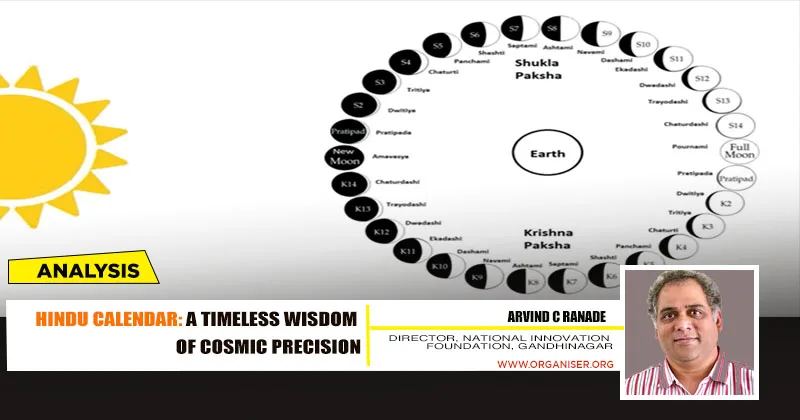
- Tithi (Lunar Day): A tithi is a fundamental unit of time in the Hindu luni-solar calendar, representing the Moon’s phase. It is defined as the duration required for the angular separation between the Moon and the Sun to increase by 12 degrees. As the Moon orbits the Earth, its position relative to the Sun shifts continuously; each time this angle grows by 12 degrees, a new tithi begins. Since a full lunar cycle spans 360 degrees, dividing it into 12-degree increments results in 30 tithis per lunar month. Unlike the solar day, which is consistently 24 hours, a tithi varies in length, typically ranging from 21.5 to 26 hours, due to the Moon’s fluctuating orbital speed caused by its elliptical orbit. Consequently, the number of tithis in a month does not always align perfectly with the 30 or 31 solar days of a calendar month, highlighting the dynamic, astronomy-driven nature of this timekeeping system.
- Nakshatra (Lunar Mansion): In the Hindu calendar system, the Nakshatra framework meticulously charts the Moon’s journey across the sky by dividing the ecliptic, the apparent path of the Sun around Earth, into 27 equal segments, each spanning 13 degrees and 20 minutes. These segments, known as nakshatras, are tied to specific stars or constellations and collectively form a detailed celestial map. The 27 nakshatras, Ashwini, Bharani, Krittika, Rohini, Mrigashira, Ardra, Punarvasu, Pushya, Ashlesha, Magha, Purva Phalguni, Uttara Phalguni, Hasta, Chitra, Swati, Vishakha, Anuradha, Jyeshtha, Mula, Purva Ashadha, Uttara Ashadha, Shravana, Dhanishta, Shatabhisha, Purva Bhadrapada, Uttara Bhadrapada, and Revati, reflect the Moon’s sidereal period of approximately 27.3 days, during which it spends roughly one day in each nakshatra before moving to the next. Occasionally, a 28th nakshatra, Abhijit, is recognised in specific contexts, but the standard system comprises 27
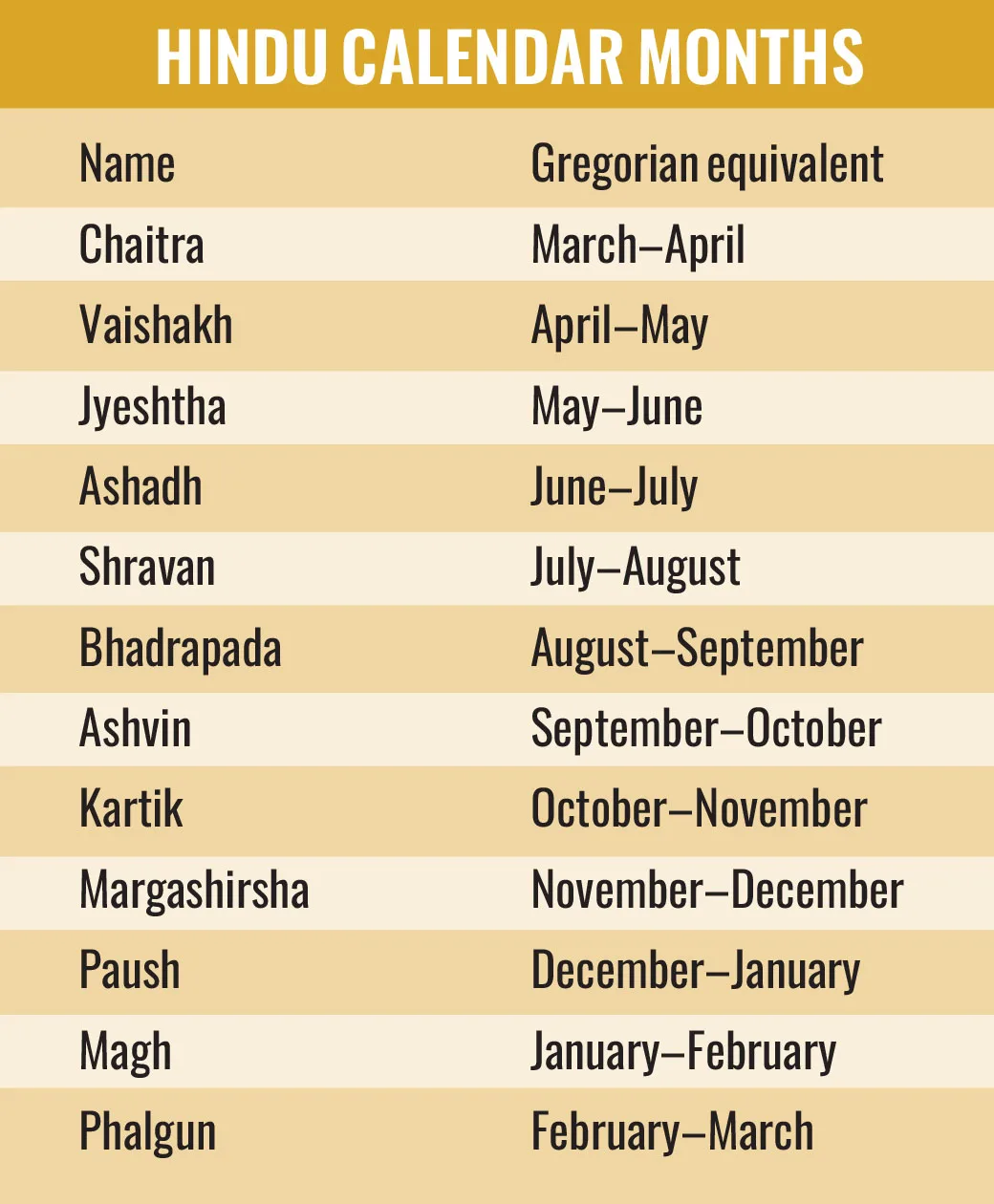
The Hindu calendar is lunisolar, balancing lunar months with the solar year. Each lunar month, lasting about 29.5 days (the synodic period from one new moon to the next), features a full moon roughly midway through, marking the peak of the waxing phase (Shukla Paksha). The month is named after the nakshatra in which the Moon resides during the full moon, reducing the 27 nakshatras to 12 namely Chaitra, Vaishakha, Jyeshtha, Ashadha, Shravana, Bhadrapada, Ashwin, Kartika, Margashirsha, Pausha, Magha, and Phalguna.
- Vāra (Weekday): The Hindu calendar follows a seven-day week wherein each day is intricately linked to a celestial body that defines its name and significance. Ravivar (Sunday) aligns with Surya (the Sun), Somvar (Monday) with Chandra (the Moon), Mangalvar (Tuesday) with Mangal (Mars), Budhvar (Wednesday) with Budh (Mercury), Guruvar (Thursday) with Guru (Jupiter), Shukravar (Friday) with Shukra (Venus), and Shanivar (Saturday) with Shani (Saturn), weaving together astronomical precision and cultural resonance in a system deeply rooted in the cosmos.
- Yoga (Luni-Solar Angle Calculation): Yoga is calculated using the sum of the longitudes of the Sun and the Moon, divided into 27 parts. From a scientific standpoint, the calculation of Yoga is based on astronomical observations and mathematical divisions of the ecliptic. While the astrological interpretations of these Yogas are not scientifically validated, the underlying astronomical calculations are grounded in the movements of celestial bodies.
- Karana (Half Tithi): A karana is half of a tithi (lunar day), lasting approximately 6 hours or the time it takes for the angular distance between the Sun and Moon to increase by 6 degrees. There are 11 karanas in total, which repeat cyclically to account for 60 half-tithis in a lunar month. This is used as calculational units in the Hindu Panchang system.
This fivefold structure, far more intricate than the Gregorian day-year focus, reflects a holistic scientific vision of time as interwoven with cosmic patterns. The Hindu calendar’s scientific rigour rests on a robust mathematical foundation. Ancient Bharatiya astronomers employed spherical trigonometry and iterative algorithms—centuries before their Western adoption—to compute celestial positions. Āryabhaṭa’s sine tables, for instance, predate European developments by over a millennium, while Bhāskara II’s differential calculus-like methods in Lilavati anticipated Newton. Venkatesh Ketkar predicted the existence of Pluto in 1911, well before Clyde Tombaugh’s official discovery of Pluto in 1930
The Surya Siddhanta provides equations for eclipses, planetary conjunctions, and sunrise times, incorporating corrections for parallax and retrograde motion. Modern analysis confirms these calculations’ precision; the text’s eclipse predictions align within minutes of NASA’s data for historical events. Meanwhile, Lagadha’s Jyotisha Vedanga (circa 1400 BCE) introduced early algebraic techniques to synchronise lunar and solar cycles, a feat later refined by Siddhanta scholars like Munjala (10th century CE), who tackled longitudinal discrepancies.

Despite the visionary efforts of the Calendar Reform Committee and the scientific rigor behind the Indian National Calendar, its intended role in unifying and modernising Bharat’s timekeeping remains an unfulfilled dream. Introduced in 1957 as a symbol of post-independence self-reliance, it was meant to reflect the rhythms of Bharat’s seasons, agricultural cycles, and astronomical traditions. Yet, 67 years later, it lingers in the shadows, relegated to a mere footnote in official documents while the Gregorian calendar, an artifact of colonial rule with its arbitrary month lengths and imperial legacy, continues to dictate the calendar system of India. Dr. Meghnad Saha, who chaired Calendar Reform Committee culturally resonant calendar, one that would integrate seamlessly into education, administration, and governance. But the weight of history, global standardisation, and administrative inertia have led to keeping this vision from taking root. The calendar that was meant to guide farmers through their sowing seasons, align taxation with harvest cycles, and offer students a clearer understanding of time and astronomy now stands largely forgotten—its logic ignored, its potential untapped.
Chaitra Pratipada, the first day (Pratipada) of the Shukla Paksha in the month of Chaitra, marks the Hindu New Year in many regions. In the Gregorian calendar, this falls on March 30, 2025. In the Indian calendar system, it signifies the start of Vikram Samvat 2082, a lunisolar calendar running 56–57 years ahead of the Gregorian due to its epoch in 57 BCE. At the same time, the Shaka Samvat transitions to year 1947 from 1946, aligning with India’s official national calendar, which begins on Chaitra 1.
The onset of Hindu Varsha Pratipada is an opportunity to reflect on the nation’s rich astronomical heritage. In an era of atomic clocks and digital timekeeping, Bharat’s traditional Panchāng serve as a reminder that time is not merely a sequence of measured intervals but an intricate dialogue between the cosmos and the natural world.