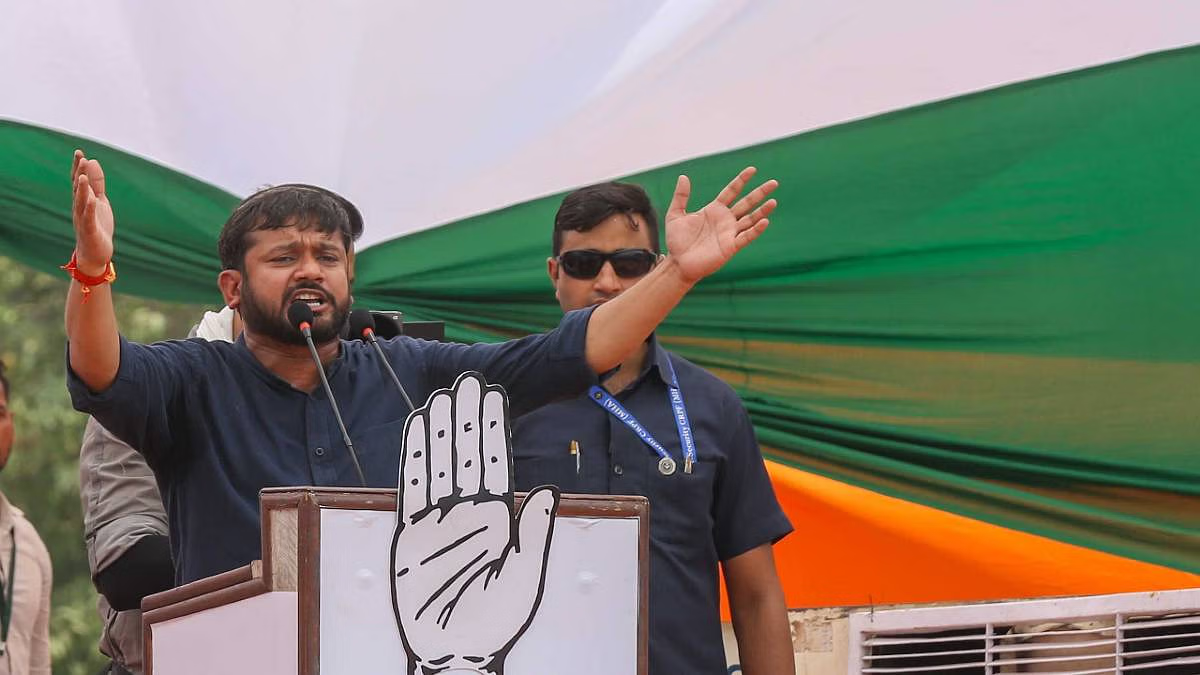
Kanhaiya Kumar, once a known figure in student activism and a staunch advocate of Communist ideology, has now aligned himself with the Congress party. However, despite this change in political affiliation, his stance on development remains largely unchanged, marked by skepticism and resistance, a characteristic trait of leftist leaders when it comes to large-scale infrastructure projects. His recent comments on Bihar’s development, particularly his criticism of the Bharatmala Project’s road construction, reflect not just his ideological stubbornness but also a fundamental misunderstanding of how economic growth takes shape.
Instead of recognising the crucial role that improved road connectivity plays in attracting industries and boosting economic activity, Kumar has chosen to portray the initiative as a ploy against Bihar. His assertion that these roads are being built to exploit the state’s water resources is not only far-fetched but completely disconnected from economic reasoning. This raises a critical question: Is his opposition driven by a concern for Bihar’s future, or is it yet another attempt to stay in the political spotlight by resisting progress for the sake of resistance?
The bizarre theory on roads and water looting
Kanhaiya Kumar has put forward a strange and unfounded theory regarding the Bharatmala Project, a national initiative to improve road connectivity across India. According to him, the construction of roads in Bihar is a covert strategy to “loot” the state’s water resources. He questioned why industries had not previously come to Bihar and why only small-scale investments are being made now. His conclusion? Roads are unnecessary and part of a grand conspiracy against the state.
While absurdity has no defined limits, there comes a point where it is better to remain silent than to propagate baseless theories. Kanhaiya Kumar, however, refuses to acknowledge such a limit. He went so far as to name a few businessmen, accusing them of conspiring against Bihar. His argument that Bihar has abundant water and that roads are being built to exploit it is not only flawed but completely disconnected from reality.
Reality of Bihar’s water crisis
If we look at actual data, Bihar’s water situation is not as simplistic as Kumar portrays it. According to a 2023 report by the Ministry of Jal Shakti, Bihar has already extracted 44 per cent of its groundwater resources. This is despite the fact that the state does not have a strong industrial base. For comparison, Gujarat, which is heavily industrialised, has exploited 51 per cent of its groundwater resources. Meanwhile, states like Haryana, Punjab, and Rajasthan have crossed the 100 per cent depletion mark.
Given these statistics, it is illogical to suggest that Bihar is being specifically targeted for water exploitation. If resource extraction were truly the motive behind infrastructure projects, the government would prioritise regions with higher water availability and industrial output. Kanhaiya Kumar’s theory lacks both factual grounding and economic reasoning.
Leftist habit of opposing development
For decades, leftist leaders in India have consistently opposed large-scale development projects, branding them as capitalist exploitation. Kanhaiya Kumar is merely following in this tradition by criticising the Bharatmala Project. His question—why are roads being built in Bihar when industries have not yet arrived?—demonstrates his lack of understanding of economic growth.
Infrastructure development, particularly roads, is a prerequisite for industrial expansion. No industry can thrive without proper transportation networks to facilitate the movement of goods, raw materials, and labor. Economic zones and industrial hubs do not emerge in isolation; they require foundational elements such as road connectivity, reliable electricity, and law and order. Kanhaiya Kumar’s assertion that industries should have come before roads is fundamentally illogical.
Who ruined Bihar’s industrial prospects?
If Kumar is genuinely interested in understanding why Bihar has lagged in industrial development, he should direct his questions towards the parties that ruled the state for most of the post-independence period, the Congress and Lalu Prasad Yadav’s Rashtriya Janata Dal (RJD). Between 1950 and 2005, these parties controlled Bihar’s governance, and their policies systematically destroyed the state’s industrial potential.
One of the most detrimental policies was the Freight Equalisation Policy introduced by the Congress government. This policy ensured that the cost of transporting minerals from mineral-rich Bihar and Jharkhand to other parts of the country remained the same, regardless of distance. As a result, industries that could have been established in Bihar were instead set up in coastal states, where transport costs were lower. Experts estimate that this policy alone cost Bihar nearly Rs 10 lakh crore in lost economic opportunities. Even though the policy was scrapped in 1990, the damage had already been done.
Bihar’s economic decline is evident in statistical data. In 1960-61, Bihar contributed 7.8 per cent to India’s GDP. Today, its share has dropped to just 2.8 per cent. Even if we include Jharkhand, the combined GDP contribution stands at only 4.3 per cent. This steady decline can be directly attributed to poor governance and misguided economic policies under Congress rule.
Role of RJD and Congress in Bihar’s economic downfall
Instead of questioning the necessity of roads, Kanhaiya Kumar should confront his own party, Congress, about the policies that crippled Bihar’s economy. Post-independence, no new industries were developed in the state, and the few that existed were left to decay. The RJD government, under Lalu Prasad Yadav, worsened the situation by fostering an environment of lawlessness, extortion, and kidnappings. This further discouraged industrial investment, sealing Bihar’s fate as an economically stagnant region.
Given that Congress and RJD have been long-time allies, both parties share the responsibility for Bihar’s industrial backwardness. If Kumar wants to demand accountability, he need not look beyond his own political circle.
NDA’s contribution to Bihar’s infrastructure
The NDA government under Nitish Kumar may not have been able to attract major industries to Bihar, but it has made significant strides in improving the state’s infrastructure. Basic amenities like roads, electricity, and water supply, which were once considered luxuries in Bihar, have now become widely accessible. The state had been so deeply mired in lawlessness under previous governments that even achieving these fundamental improvements was a monumental task.
Kumar’s complaint that only small investments are coming into Bihar also lacks economic logic. Large-scale investments do not occur overnight; economic growth is a gradual process. Small businesses and startups often pave the way for larger industries to follow. His real frustration seems to be that development is taking place despite his ideological opposition to it.
Kanhaiya Kumar’s political relevance
Kanhaiya Kumar’s opposition to infrastructure development is not rooted in genuine concern for Bihar’s future. His statements reflect his struggle for political relevance. There was a time when leftist leaders gained traction by inciting workers against industrialists. However, Bihar’s electorate has repeatedly rejected Kumar’s brand of politics. His rhetoric, which may resonate within university circles, does not translate into electoral success.
Instead of opposing much-needed infrastructure projects, he should focus on advocating for policies that attract investment, improve governance, and enhance educational opportunities in Bihar. His baseless conspiracy theories serve only to hinder progress and distract from the real issues affecting the state.
Bihar needs roads, industries, and better governance. Baseless opposition to critical infrastructure projects like the Bharatmala Project only hampers the state’s progress. Kanhaiya Kumar’s arguments reflect a lack of economic understanding and a desperate attempt to remain politically relevant. If he truly cares about Bihar’s development, he should work towards policies that encourage industrial growth rather than opposing the very foundation of economic progress. Bihar has suffered enough due to decades of misgovernance; what it needs now is progress, not political theatrics.