“The colours of Holi are not just shades of spring, but the echoes of Radha’s love for Krishna, the triumph of devotion over tyranny, and the eternal dance of creation and renewal.”
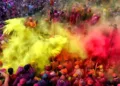
Holi, the festival of colours, devotion, and the victory of dharma is celebrated on Phalguna Purnima as per the Hindu calendar. This year, in Vikram Samvat 2081, Holika Dahan falls on March 13, 2025, followed by Rangwali Holi on March 14. More than just a festival, Holi is a civilisational marker, a reaffirmation of cultural resilience, and a celebration of dharma prevailing over adharma. Rooted in the Vedas, Puranas, and Itihasas, it embodies the triumph of light over darkness, unity over division, and spiritual renewal over stagnation.
The fire of Holika Dahan, symbolising the burning of arrogance and evil, traces its origins to Bhakta Prahlad’s unwavering faith in Vishnu against his father Hiranyakashipu’s oppression. Holika, who believed herself invincible, was reduced to ashes, proving that misused power and injustice will always meet their downfall. This fire has continued to burn through the ages, a testament to the eternal battle between dharma and tyranny.
But Holi is more than just an ancient myth—it is also a festival of divine love, immortalised in the tales of Radha and Krishna. As Krishna, dark-skinned and mischievous, lamented his complexion, Yashoda playfully suggested he also coloured Radha’s face. Thus began a tradition that transcended mere playfulness—it became a symbol of love beyond superficial differences, a divine union that knew no boundaries. Even today, Vrindavan, Barsana, and Nandgaon burst into vibrant celebrations, where Ras-Lila recreates the eternal love of Radha and Krishna, and the Lathmar Holi of Barsana revives the playful defiance of the Gopis against Krishna and his companions.
The Ramayana also weaves Holi into its grand narrative. As Bhagwan Rama and Sita returned to Ayodhya after years of exile and their victory over Ravana, the people welcomed them with colours, music, and festivities. It was not just a homecoming; it was a celebration of righteousness, of dharma restored, and of the joy that follows struggle and sacrifice. Thus, Holi became a festival that celebrates not just love, but justice—not just playfulness, but victory.
Yet, Holi is not merely a festival of gods and legends—it is also a symbol of Bharat’s cultural defiance and resilience. Under oppressive foreign rulers, it remained an assertion of identity, a silent yet powerful reminder that no external force could erase Bharat’s traditions. During the Mughal era, when restrictions were imposed on Hindu festivities, Holi became an act of rebellion—a festival that could not be suppressed despite bans and decrees. Even during the most oppressive periods, Holi continued to be celebrated in defiance, proving that cultural spirit cannot be extinguished by imperial decree.
During British rule, Holi again emerged as a force of unity and national resurgence. The British, fearing the power of mass Hindu gatherings, attempted to curb Holi celebrations, yet it persisted, bringing together people across regions, castes, and social barriers. Revolutionaries like Bal Gangadhar Tilak recognised the potential of such festivals in uniting the masses, and Holi became a rallying point for nationalistic fervour, a celebration of collective strength against colonial rule. The colours of Holi thus became more than a festival—they became an expression of defiance of Bharat’s refusal to surrender its cultural identity to foreign rule.
Holi’s spirit extends beyond Hinduism, finding resonance in Sikhism, Jainism, and Buddhism. Guru Gobind Singh Ji transformed Holi into Hola Mohalla, a festival where Khalsa warriors display their martial prowess, reinforcing the idea that celebration and resistance go hand in hand. In Jainism, Holi represents the burning away of karma, a moment of inner purification, mirroring Holika Dahan’s symbolism of the destruction of impurities. In Buddhism, particularly in Nepal and Ladakh, Holi has been adapted as a festival of spring’s arrival, celebrating renewal and harmony.
From the grand Lathmar Holi of Barsana, where women playfully challenge men in a reenactment of Radha and Krishna’s divine love, to the Phoolon Ki Holi of Vrindavan, where flowers replace colours in an offering of devotion, each region of Bharat adds its own unique touch to the celebration. The Hola Mohalla of Punjab blends festivity with valour, as Sikh warriors display their martial skills, while Shantiniketan’s Basanta Utsav in Bengal merges colours with art, music, and poetry, reflecting the intellectual and creative soul of the land. In the royal courts of Rajasthan, Holi is played with grandeur, elephants adorned in bright hues, and folk dancers moving to the beats of traditional instruments, while in the tribal heartlands, Indigenous communities celebrate it in harmony with nature, using organic colours and age-old rituals.
Holi is not bound by geography or social divides—it is a festival of oneness, where the rich and the poor, the king and the commoner, and the devotee and the warrior all become one in the embrace of colour. In that moment, all distinctions melt away, replaced by a sense of belonging, shared laughter, forgetting grievances, and renewing bonds. It is Bharat’s message to the world—unity in diversity, celebration in togetherness, and love beyond all barriers.
History has preserved Holi’s grandeur through literature and poetry. Bhai Nand Lal, a poet in Guru Gobind Singh Ji’s court, described Holi as a festival where saffron-scented waters and rose fragrances filled the air, dissolving differences and uniting people. The Sanskrit play Ratnavali, attributed to King Harsha, also paints Holi as a joyous, unifying festival, proving its deep-rooted presence in Bharat’s history.
Holi is not just about colours, festivities, and rituals—it is the heartbeat of Bharat’s civilisational essence. It is a testament to the timeless struggle between truth and deception, between love and separation, between resistance and submission. It reminds us that every tyrant will fall like Hiranyakashipu, every Holika will burn, and every Prahlad will rise victorious. It is the festival where devotion meets defiance, where history meets myth, and where Bharat renews itself, year after year, in an unbroken continuity that no force can erase.