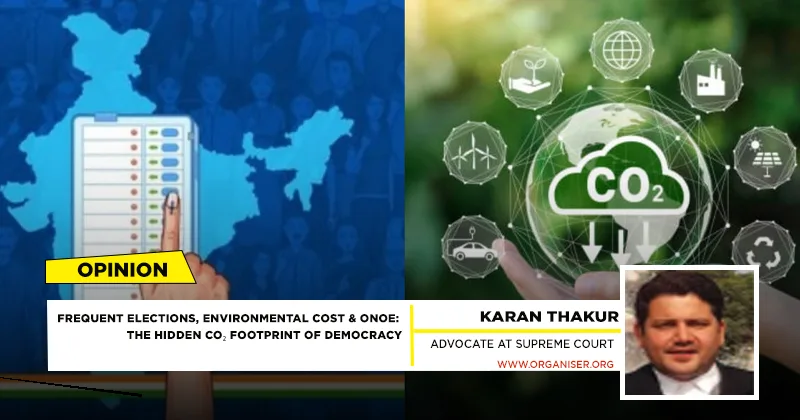
Frequent Elections, Environmental Cost & ONOE: The hidden CO₂ footprint of democracy
June 25, 2026
  • Read Ecopy
  • Circulation
  • Advertise
  • Careers
  • About Us
  • Contact Us
Android AppiPhone AppArattai
Organiser
  • ‌
  • Bharat
    • Assam
    • Bihar
    • Chhattisgarh
    • Jharkhand
    • Maharashtra
    • View All States
  • World
    • Asia
    • Europe
    • North America
    • South America
    • Africa
    • Australia
  • Editorial
  • International
  • Opinion
  • RSS @ 100
  • More
    • Op Sindoor
    • Analysis
    • Sports
    • Defence
    • Politics
    • Business
    • Economy
    • Culture
    • Special Report
    • Sci & Tech
    • Entertainment
    • G20
    • Azadi Ka Amrit Mahotsav
    • Vocal4Local
    • Web Stories
    • Education
    • Employment
    • Books
    • Interviews
    • Travel
    • Law
    • Health
    • Obituary
  • Subscribe
    • Subscribe Print Edition
    • Subscribe Ecopy
    • Read Ecopy
  • ‌
  • Bharat
    • Assam
    • Bihar
    • Chhattisgarh
    • Jharkhand
    • Maharashtra
    • View All States
  • World
    • Asia
    • Europe
    • North America
    • South America
    • Africa
    • Australia
  • Editorial
  • International
  • Opinion
  • RSS @ 100
  • More
    • Op Sindoor
    • Analysis
    • Sports
    • Defence
    • Politics
    • Business
    • Economy
    • Culture
    • Special Report
    • Sci & Tech
    • Entertainment
    • G20
    • Azadi Ka Amrit Mahotsav
    • Vocal4Local
    • Web Stories
    • Education
    • Employment
    • Books
    • Interviews
    • Travel
    • Law
    • Health
    • Obituary
  • Subscribe
    • Subscribe Print Edition
    • Subscribe Ecopy
    • Read Ecopy
Organiser
  • Home
  • Bharat
  • World
  • Operation Sindoor
  • Editorial
  • Analysis
  • Opinion
  • Culture
  • Defence
  • International Edition
  • RSS @ 100
  • Magazine
  • Read Ecopy
Home Bharat

Frequent Elections, Environmental Cost & ONOE: The hidden CO₂ footprint of democracy

The frequent election cycles in India contribute significantly to environmental degradation, from CO₂ emissions to waste generation. The One Nation, One Election (ONOE) proposal offers a sustainable solution to reduce the environmental footprint of democracy while maintaining its integrity

Adv Karan ThakurAdv Karan Thakur
Mar 14, 2025, 12:00 pm IST
in Bharat, Opinion
Follow on Google News
FacebookTwitterWhatsAppTelegramEmail

“The greatest threat to our planet is the belief that someone else will save it.”

As an Advocate and a responsible citizen of this nation, the idea of One Nation, One Election (ONOE) came to my mind while witnessing the frequent election cycles and their massive environmental and economic impact. Every year, we see tons of paper wasted, millions travelling for campaigns and voting, and a continuous burden on governance due to the never-ending election mode. It made me think—can we balance democracy with sustainability? ONOE is not just about efficiency; it is about reducing the carbon footprint of our electoral process and ensuring that our democracy evolves in a way that is both governance-friendly and environmentally responsible.

India, the world’s largest democracy, also bears one of the highest environmental costs of conducting frequent elections. With elections happening almost every year in some parts of the country, the burden on natural resources, carbon emissions, and public expenditure has reached an alarming level. While the democratic process is essential, the repeated cycle of elections contributes significantly to climate change through excessive paper consumption, energy use, extensive travel, and electronic waste. It is time to assess the environmental footprint of our electoral process and explore how One Nation, One Election (ONOE) can serve as a sustainable alternative.

Every election cycle in India generates an estimated 1–2 million metric tons of CO₂ emissions, equivalent to burning 1 billion litres of petrol or driving 5 billion kilometres in a car. A significant portion of this comes from producing and distributing campaign materials such as posters, banners, and pamphlets, leading to large-scale deforestation. Despite the increasing shift to digital campaigns, printed materials still dominate election propaganda. The extensive travel undertaken by political leaders, security personnel, election officials, and voters also adds a substantial amount of greenhouse gas emissions. Political rallies, often attended by thousands, require massive logistical arrangements, including transportation, temporary electricity setups, and other resources that contribute to an unnecessary carbon burden.

Another overlooked factor is the electronic waste generated by EVMs (Electronic Voting Machines) and VVPATs (Voter Verified Paper Audit Trail systems). While these machines reduce paper ballots, their manufacturing, maintenance, and disposal contribute significantly to environmental degradation. Additionally, the energy required to operate polling stations, counting centres, and associated infrastructure is immense, further adding to the carbon footprint of the electoral process.

The Case for ONOE: A Sustainable Electoral Reform

The One Nation, One Election policy, which proposes holding Lok Sabha and State Assembly elections simultaneously once every five years, offers a revolutionary solution to mitigate these environmental costs. By reducing the frequency of elections, ONOE could cut down CO₂ emissions by nearly 50 per cent, leading to lower deforestation, reduced travel-related pollution, and less electronic waste. A synchronised electoral cycle would also bring economic benefits, as conducting elections is a resource-intensive process that diverts government machinery and public funds away from essential governance.

A unified election system would result in a drastic reduction in campaign materials, as political parties would need to print and distribute promotional content only once in five years instead of multiple times for different state elections. It would also streamline voter participation, reducing the number of trips voters take to polling booths, thereby minimising fuel consumption and overall carbon emissions. Furthermore, security and administrative costs would be significantly lower, as the deployment of forces and election staff would be required only once per electoral cycle, leading to a more efficient, cost-effective, and environmentally responsible election process.

A Call for Sustainable Electoral Practices

While the debate over ONOE continues, it is imperative to recognise that the environmental impact of frequent elections is not just a logistical issue but a climate crisis concern. If democratic nations aim to lead by example in sustainability, electoral reforms that focus on reducing carbon emissions, minimising waste, and adopting eco-friendly practices must become a priority. The transition to paperless elections, digital campaigns, and energy-efficient polling infrastructure should also be part of a long-term strategy to make democracy environmentally sustainable.

India, as a global leader, must ensure that its democratic process does not come at the cost of its natural resources. Implementing ONOE would be a step toward a more stable governance model, allowing elected governments to focus on long-term policy-making rather than being in a perpetual election mode. More importantly, it would significantly lower the environmental burden caused by our current electoral practices. As we move forward, the question is no longer about whether ONOE is possible but whether we can afford to ignore its environmental necessity any longer. The time has come to balance democracy with climate responsibility, ensuring that our future elections are not just fair and free but also sustainable and carbon-conscious.

 

Topics: CO2 FootprintSustainable DemocracyPaper WasteEco Friendly Governanceclimate changeOne Nation One Electionenvironmental impactElections 2025
ShareTweetSendShareSend
✮ Subscribe Organiser YouTube Channel. ✮
✮ Join Organiser's WhatsApp channel for Nationalist views beyond the news. ✮
Previous News

Holi celebrations in the Indian Army: Why this festival is so special 

Next News

Holi: A reflection of Hindu consolidation

Related News

One Nation One Election is the need of the hour

End the perpetual campaign: Why One nation, One election is the need of the hour

Representative Image

Climate Intelligence: Indian AI-led path to net-zero resilience

Bomb cyclone to hit the east coast of America reflecting the reality of climate change

Bomb cyclone to batter the US; A reflection of climate change reality that Donald Trump rejects

Karnataka: Illegal use of 267 acres of forest land for Yettinahole project exposes governance & environmental failures

A representative image

‘One Nation, One Election’ gets constitutional green signal from law commission

Economist and Sixteenth Finance Commission Chairman Arvind Panagariya

‘One Nation, One Election’ will boost growth, cut fiscal waste: Finance Commission Chairman Arvind Panagariya to JPC

Load More

Latest News

RSS struggle to defend the Constitution during the Emergency

Samvidhan Hatya Diwas: Revisiting RSS’s role in defending India’s Constitution & democratic freedoms during 1975-77

Fresh plea in Odisha High Court seeks CBI probe into Swami Laxmanananda murder case amid missing Naidu Commission report

Swami Laxmanananda Murder Case: Fresh plea in Odisha HC cites missing Naidu Commission report, seeks CBI inquiry

For the first time, NCERT adds Emergency to class 9 curriculum, highlights suspension of rights and democratic struggles

NCERT includes Emergency chapter in class 9 textbook, describes 1975-77 period as a major challenge to Indian democracy

Delhi HC adjourns Jawad Siddiqui’s plea seeking 6-week interim bail

Al-Falah Trust Case: ED opposes interim bail for chairman Jawad Ahmad, cites risk of concealing Rs 493 cr proceeds

Twin earthquakes devastate Venezuela

Venezuela Earthquake 2026: Powerful 7.5 & 7.2 magnitude tremors leave the country in ruins; State of emergency declared

Pakistan’s Defence Minister, Khawaja Muhammad Asif

Pakistan Defence Minister Khwaja Asif sparks fury in POJK, labels Mirpuris &  Rawalakot residents ‘Non-Kashmiris’

Sunil Ambekar (Akhil Bharatiya Prachar Pramukh Rashtriya Swayamsevak Sangh addressing the gathering in Patna

The Emergency taught us that a vigilant society is essential to protect democracy: Sunil Ambekar ji

Punjab Moga Massacre 1989: When Khalistani terrorists turned an RSS shakha into a killing field

From sovereign satellite networks to human spaceflight, India is building the foundations of a globally competitive space power

India eyes a $45 billion space economy by 2033: AnanthSat-1’s 2029 launch heralds the private satellite age

Emergency and RSS- The resistance years: Sangh, society and restoration of democracy

Load More
  • Privacy
  • Terms
  • Cookie Policy
  • Refund and Cancellation
  • Delivery and Shipping

© Bharat Prakashan (Delhi) Limited.
Tech-enabled by Ananthapuri Technologies

  • Home
  • Search Organiser
  • Bharat
    • Assam
    • Bihar
    • Chhattisgarh
    • Jharkhand
    • Maharashtra
    • View All States
  • World
    • Asia
    • Africa
    • North America
    • South America
    • Europe
    • Australia
  • Editorial
  • Operation Sindoor
  • Opinion
  • Analysis
  • Defence
  • Culture
  • Sports
  • Business
  • RSS @ 100
  • Entertainment
  • More ..
    • Sci & Tech
    • Vocal4Local
    • Special Report
    • Education
    • Employment
    • Books
    • Interviews
    • Travel
    • Health
    • Politics
    • Law
    • Economy
    • Obituary
  • Subscribe Magazine
  • Read Ecopy
  • Advertise
  • Circulation
  • Careers
  • About Us
  • Contact Us
  • Policies & Terms
    • Privacy Policy
    • Cookie Policy
    • Refund and Cancellation
    • Terms of Use

© Bharat Prakashan (Delhi) Limited.
Tech-enabled by Ananthapuri Technologies