“The greatest threat to our planet is the belief that someone else will save it.”
As an Advocate and a responsible citizen of this nation, the idea of One Nation, One Election (ONOE) came to my mind while witnessing the frequent election cycles and their massive environmental and economic impact. Every year, we see tons of paper wasted, millions travelling for campaigns and voting, and a continuous burden on governance due to the never-ending election mode. It made me think—can we balance democracy with sustainability? ONOE is not just about efficiency; it is about reducing the carbon footprint of our electoral process and ensuring that our democracy evolves in a way that is both governance-friendly and environmentally responsible.
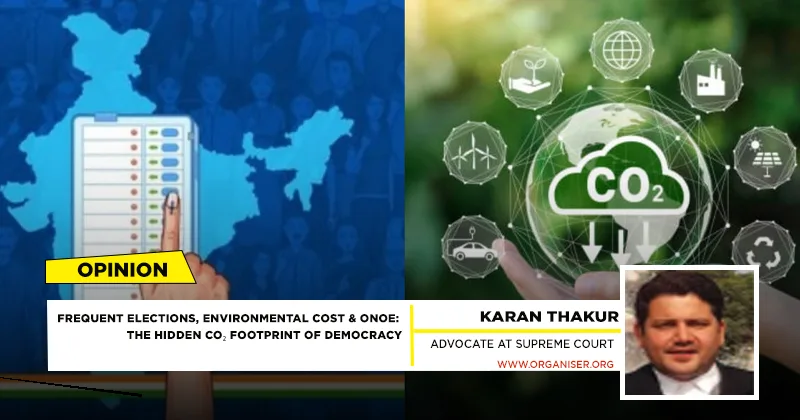
India, the world’s largest democracy, also bears one of the highest environmental costs of conducting frequent elections. With elections happening almost every year in some parts of the country, the burden on natural resources, carbon emissions, and public expenditure has reached an alarming level. While the democratic process is essential, the repeated cycle of elections contributes significantly to climate change through excessive paper consumption, energy use, extensive travel, and electronic waste. It is time to assess the environmental footprint of our electoral process and explore how One Nation, One Election (ONOE) can serve as a sustainable alternative.
Every election cycle in India generates an estimated 1–2 million metric tons of CO₂ emissions, equivalent to burning 1 billion litres of petrol or driving 5 billion kilometres in a car. A significant portion of this comes from producing and distributing campaign materials such as posters, banners, and pamphlets, leading to large-scale deforestation. Despite the increasing shift to digital campaigns, printed materials still dominate election propaganda. The extensive travel undertaken by political leaders, security personnel, election officials, and voters also adds a substantial amount of greenhouse gas emissions. Political rallies, often attended by thousands, require massive logistical arrangements, including transportation, temporary electricity setups, and other resources that contribute to an unnecessary carbon burden.
Another overlooked factor is the electronic waste generated by EVMs (Electronic Voting Machines) and VVPATs (Voter Verified Paper Audit Trail systems). While these machines reduce paper ballots, their manufacturing, maintenance, and disposal contribute significantly to environmental degradation. Additionally, the energy required to operate polling stations, counting centres, and associated infrastructure is immense, further adding to the carbon footprint of the electoral process.
The Case for ONOE: A Sustainable Electoral Reform
The One Nation, One Election policy, which proposes holding Lok Sabha and State Assembly elections simultaneously once every five years, offers a revolutionary solution to mitigate these environmental costs. By reducing the frequency of elections, ONOE could cut down CO₂ emissions by nearly 50 per cent, leading to lower deforestation, reduced travel-related pollution, and less electronic waste. A synchronised electoral cycle would also bring economic benefits, as conducting elections is a resource-intensive process that diverts government machinery and public funds away from essential governance.
A unified election system would result in a drastic reduction in campaign materials, as political parties would need to print and distribute promotional content only once in five years instead of multiple times for different state elections. It would also streamline voter participation, reducing the number of trips voters take to polling booths, thereby minimising fuel consumption and overall carbon emissions. Furthermore, security and administrative costs would be significantly lower, as the deployment of forces and election staff would be required only once per electoral cycle, leading to a more efficient, cost-effective, and environmentally responsible election process.
A Call for Sustainable Electoral Practices
While the debate over ONOE continues, it is imperative to recognise that the environmental impact of frequent elections is not just a logistical issue but a climate crisis concern. If democratic nations aim to lead by example in sustainability, electoral reforms that focus on reducing carbon emissions, minimising waste, and adopting eco-friendly practices must become a priority. The transition to paperless elections, digital campaigns, and energy-efficient polling infrastructure should also be part of a long-term strategy to make democracy environmentally sustainable.
India, as a global leader, must ensure that its democratic process does not come at the cost of its natural resources. Implementing ONOE would be a step toward a more stable governance model, allowing elected governments to focus on long-term policy-making rather than being in a perpetual election mode. More importantly, it would significantly lower the environmental burden caused by our current electoral practices. As we move forward, the question is no longer about whether ONOE is possible but whether we can afford to ignore its environmental necessity any longer. The time has come to balance democracy with climate responsibility, ensuring that our future elections are not just fair and free but also sustainable and carbon-conscious.