

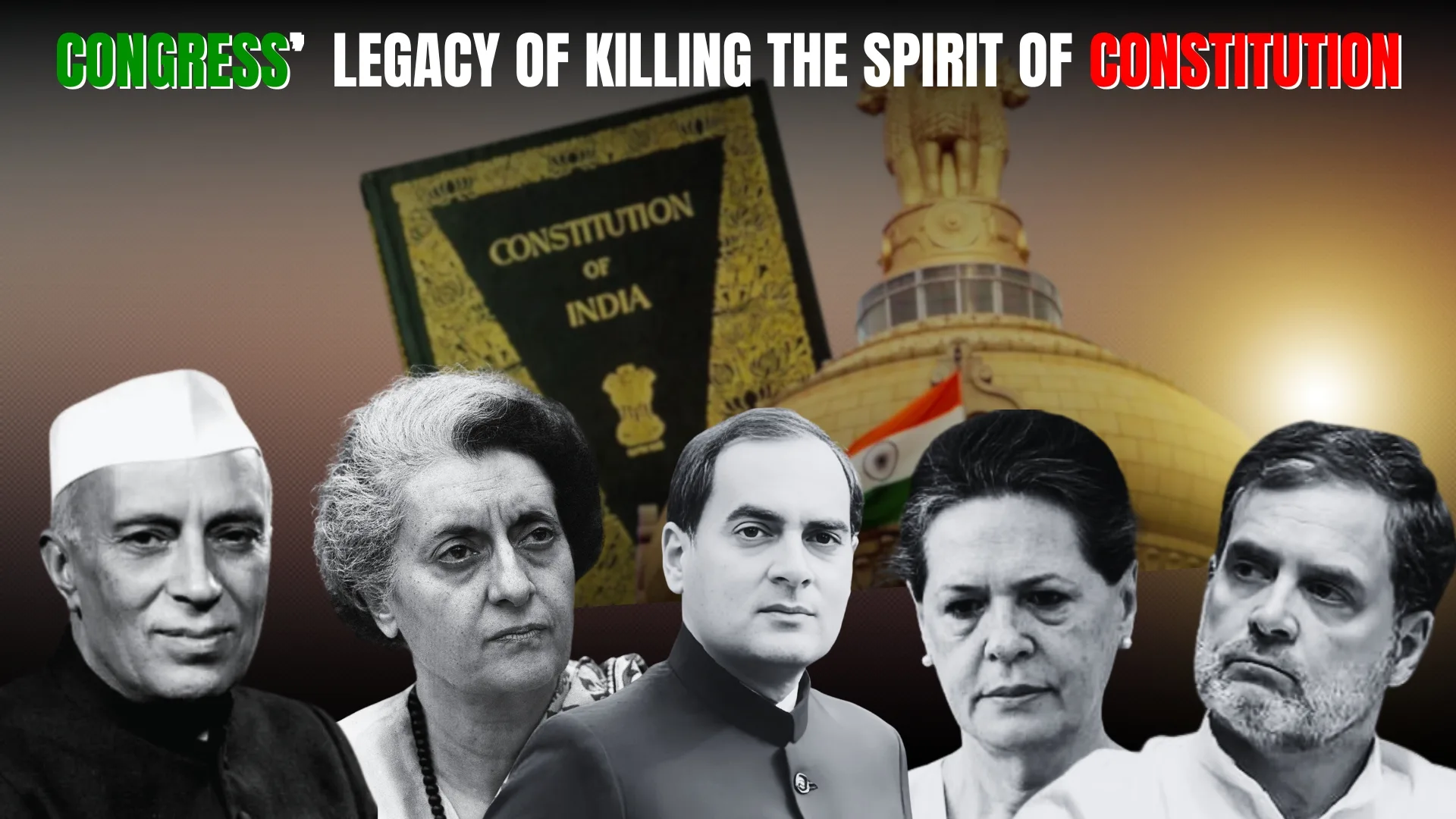
The parliamentary debate on the Constitution turned out to be yet another occasion for an intense diatribe between the ruling BJP and the Opposition. Congress thought it could trap the BJP on the issue of the Constitution, as it had attempted during the 2024 Lok Sabha polls by propagating the narrative that the BJP would change the Constitution if it returned to power. However, the debate backfired on Congress, as the BJP reminded the nation of the Congress’ repeated assaults on the Constitution to protect their family and vote bank.
India boasts the largest Constitution in the world, crafted with the intent to heal the deep-seated wounds of centuries of oppression and subjugation and to empower its citizens as stakeholders in the nation’s progress.
However, the lofty ideals enshrined in the Constitution were soon subjected to political manoeuvring, particularly by the very leaders who had drafted and adopted it.
Now, it’s time to look at the 55 years of Congress’ rule when it played with the Constitution 77 times for its political gain. The first one was by Nehru, the so-called messiah of democracy. Below are the times when Congress played with the Constitution for dynastic dominance and vote-bank politics.
First Amendment: Nehru’s Attack on Freedom of Speech
Our Constitution came into force in 1950, and the First Amendment was passed in 1951 by Prime Minister Nehru. It is rather ironic that today, the Congress party and the entire Left-wing ecosystem accuse the BJP of curbing Freedom of Speech, when, in the first Amendment, PM Nehru expanded the scope of “reasonable restrictions” on the Freedom of Speech and Expression guaranteed as a Fundamental Right in Article 19(1)(a) of the Constitution.
The Battle in the Court: Organiser and Cross Roads
In the year 1950, 22 communist prisoners were killed and 107 were injured when they were shot by the Madras police in Salem Central Jail. Romesh Thapar, a young communist journalist, condemned this barbaric act in his magazine Cross Roads. The government of Madras banned the circulation of Cross Roads under the Madras Maintenance of Public Order Act. Jawaharlal Nehru was concerned about his image and wrote a letter to Sardar Patel saying, ‘We are losing the support of the public, and a feeling is rising against the police, as existed under the British regime.’
At the same time, Organiser, under the editorship of K R Malkani, wrote a series of articles criticizing the policies of Nehru and Liaqat Ali Khan for their ineffective handling of the refugee crisis in Bengal and their apathy towards the Hindus of the nation. Nehru shifted the blame on the journalists for “running down his reputation with a campaign based on ‘malicious misrepresentation of facts’ and outright fabrications”. He was particularly critical of the Hindu Mahasabha and the RSS, subjecting the editors and printers of Organiser to the ‘pre-censorship’ order under the East Punjab Public Safety Act, to force them to submit all their content for prior approval from the Government.
The editor of Organiser, K R Malkani, and the printer of Organiser, Brij Bhushan filed a petition in the Supreme Court. Thus, two cases for freedom of the press were being discussed in the court simultaneously, Brij Bhushan vs. The State of Delhi and Romesh Thappar vs. The State of Madras. These cases attracted a lot of public attention, and the government of India received criticism from all quarters. Eventually, on May 26 1950, the verdict for both cases was pronounced, quashing the restrictions as void and pointing out that the government had misinterpreted and misused the constitutional provision of Article 19(2), providing reasonable restrictions to the right to freedom.
The legal defeat of the Indian Government became the starting point for the ruling regime to arm-twist the Constitution to suit their agenda. The Constitution was put into action just fourteen months ago under the same regime and was now being amended because it was seen as an ‘obstacle’.
Under the guise of making reforms feasible, the proposed Amendment tried to curb the freedom of the press in India by implementing what Nehru called “reasonable restrictions” on freedom.
The proposed Amendment introduced new clauses for curbing the freedom of the press, including public order, the interests of the security of the state, and the relations with foreign countries under Article 19 (2). Nehru faced a hard time debating with Shyama Prasad Mukherjee as he bashed Nehru for diluting the Constitution into a “scrap of paper”.
Despite the severe criticism from all quarters and the press coverage of the same, Nehru succeeded in implementing his proposed Amendment on June 18 1951, largely because of the dominance of Congress leaders in the parliament.
Emergency was Darkest Chapter
This was not the end of constitutional changes. The darkest chapter in the political history of independent India came during the Internal Emergency imposed by Prime Minister Indira Gandhi when Opposition leaders were jailed, and the infamous 42nd Amendment was enacted.
The 42nd Amendment stands out for its far-reaching effects and is often referred to as the “mini Constitution.” This Amendment, among other things, added the words “secular” and “socialist” to the Preamble of the Constitution. These terms had been explicitly debated and rejected by several founding members, including Dr BR Ambedkar, who opposed the inclusion of “socialist” because he believed that adding would be “destroying democracy altogether.”
Notably, the 42nd Amendment was enacted during the internal Emergency when Opposition leaders were imprisoned. If one is truly searching for dictatorship in Indian politics, this is where his quest ends.
Rajiv Gandhi succumbs to pressure of Muslim hardliners
Another member of the Nehru-Gandhi family, former PM Rajiv Gandhi, In 1986, set a dangerous precedent of catapulting to Muslim hardliners. The Mohd. Ahmad Khan vs. Shah Bano Begum & Others case and the subsequent legislation passed by the Rajiv Gandhi government is often remembered as a pivotal moment in India’s political history.
It all started when Shah Bano, the 62-year-old Muslim woman, filed a petition in court in April 1978 demanding maintenance from her divorced husband, Mohammed Ahmad Khan, a renowned lawyer in Indore. Shah Bano’s husband Khan divorced her by uttering triple talaq later in November stating he was not obliged to pay her any maintenance as she is not his wife under Islamic law.
The two were married in 1932 and had five children — three sons and two daughters. Shah Bano’s husband had forced her to move out of the residence three years before, after living with Khan and his second wife.
Shah Bano, who went to court against her husband, filed a claim for maintenance for herself and her five children under Section 123 of the Code of Criminal Procedure, 1973. In August 1979, Shah Bano won the maintenance case in the local court, which ordered Khan to provide her with the maintenance of Rs 25 per month. However, Khan contested the claim on the grounds that the Muslim Personal Law in India required the husband to only provide maintenance for the iddat period after divorce.
Years later, Shah Bano filed another plea seeking revised maintenance in the Madhya Pradesh High Court. In April 1985, in a historic judgment, the Supreme Court ruled in favour of Shah Bano and upheld the decision by the High Court, stating that she was entitled to be paid for maintenance by her husband.
As the Supreme Court upheld the right to alimony in the case, the judgement ignited a political controversy regarding the claim of judicial overreach in cases that are attached to Muslim personal law.
The historic judgement, which had laid the ground for Muslim women’s fight for equal rights in matters of marriage and divorce in regular courts, did not go well within the Muslim community.
The Muslim hardliners and clerics pushed the then Rajiv Gandhi government, elected in 1984, to pass the Muslim Women (Protection on Divorce Act), 1986. This law overturned the Supreme Court’s verdict in the Shah Bano case. The 1986 Muslim Women (Protection on Rights of Divorce) Act diluted the Supreme Court judgment and allowed maintenance to a divorced woman only during the period of iddat, or till 90 days after the divorce.
Sonia Gandhi’s insult to PM Chair
Former Media Advisor to Prime Minister Manmohan Singh, Sanjay Baru, in his book The Accidental Prime Minister, stated that while Manmohan Singh held the office of Prime Minister, he wielded little real power. He had minimal control over his cabinet members, lacked authority in key appointments, and Congress President Sonia Gandhi often made decisions on files that ultimately bore his signature.
Baru asserted that Sonia Gandhi was the de facto authority. Sonia Gandhi was allegedly referred to as the Super PM, exerting an upper hand over the Prime Minister. She maintained this control through bureaucrat Pulok Chatterjee, who was appointed to a key position in the Prime Minister’s Office at her behest. Such influence undermined the authority of the Prime Minister, constituting a clear insult to the sanctity of a constitutional post.
Rahul Gandhi tore Ordinance in House in 2013
The next generation of Congress, Rahul Gandhi, also insulted the Constitution in 2013 as he tore up an ordinance regarding the disqualification of convicted lawmakers. Notably, he was not the person being elected to a position of power and was given precedence over Prime Minister Manmohan Singh through the National Advisory Council, which is an insult to the Constitutional post of The Prime Minister of India.
This ordinance had been approved by the cabinet led by Prime Minister Manmohan Singh, and Rahul Gandhi’s actions are an example of disrespect towards the constitutional process and the authority of the then Prime Minister.
Congress’ hypocrisy on minority rights and reservations
The Congress party’s disregard for the Constitution continues as in Karnataka, Congress promised reservations for Muslims and pledged to safeguard Muslim Personal Laws. This stands in stark contrast to the Places of Worship Act (1991), which effectively deprived Hindus of reclaiming temples converted into mosques before 1947. Congress also passed the Waqf Act, granting Muslim bodies significant power to claim land, furthering their appeasement politics.
This historical account highlights Congress’ repeated attempts to manipulate the Constitution for its political agenda, from Nehru to Rahul Gandhi. Their track record is a stark reminder of their disregard for constitutional ideals in favour of dynastic dominance and vote-bank politics.