
The Indian Parliament, once revered as a bastion of intellectual rigour and democratic deliberation, has experienced a marked decline in its standards over the past several decades. Historically, this institution epitomised the aspirations of the Indian republic, providing a platform for nuanced ideological discourse, informed policy critique, and collaborative governance. However, it increasingly resembles a theatre for performative grandstanding, partisan disruptions, and rhetorical excesses. Priyanka Gandhi’s maiden parliamentary speech exemplifies this troubling trend. Instead of contributing substantively to the discourse, her address highlighted the superficiality and sensationalism that have come to dominate parliamentary proceedings.
Intellectual and moral gravitas of its early leaders. Figures such as Shyama Prasad Mukherjee, Sardar Patel, Ram Manohar Lohia and Atal Bihari Vajpayee set benchmarks for parliamentary debate characterised by erudition, ideological clarity, and principled dissent. These debates often transcended party lines, reflecting a shared commitment to addressing the complexities of governance and nation-building.
In stark contrast, contemporary parliamentary sessions are often marred by cacophonous disruptions, partisan sloganeering, and performative theatrics. The prioritisation of optics over substance has diluted the quality of debate and eroded public trust in the institution’s capacity to address pressing national issues. This systemic decline reflects a broader malaise in India’s political culture, where the allure of populist soundbites often outweighs the imperative for thoughtful policymaking.
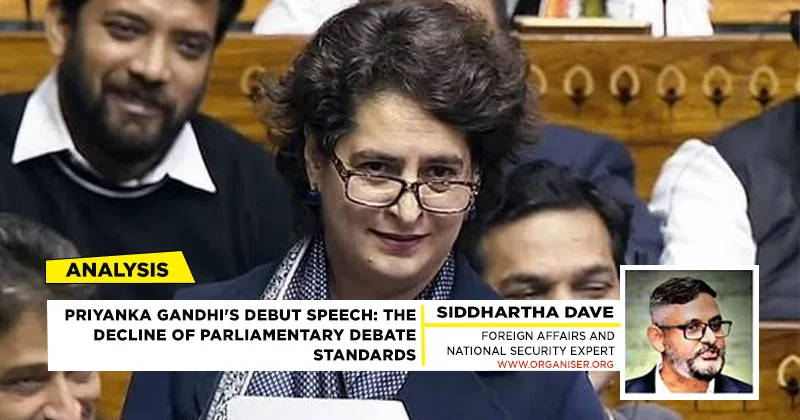
Priyanka Gandhi’s debut speech underscores this degeneration. Her address, anticipated as a significant contribution to parliamentary discourse, instead relied heavily on emotive rhetoric and generalisations, lacking the analytical depth or constructive proposals essential for meaningful debate.
Priyanka Gandhi’s Speech: A Missed Opportunity
As a prominent figure within the Congress party and a scion of India’s most politically influential family, Priyanka Gandhi Vadra’s entry into the parliamentary arena carried substantial expectations. Her debut address was an opportunity to articulate a cogent critique of government policies and present an alternative vision for the nation. Unfortunately, the speech fell short of these expectations, characterised instead by rhetorical flourishes and vague assertions.
Repeated invocations of “Bharat Mata” and anecdotal references to the struggles of the underprivileged, while emotionally charged, lacked credibility when juxtaposed with the Congress party’s historical inadequacies on these same issues. Rather than anchoring her arguments in empirical evidence or proposing actionable policy solutions, Mrs Vadra resorted to superficial critiques that offered little substantive engagement with the issues. Her approach, seemingly tailored to generate media headlines and social media traction, failed to rise to the level of intellectual contribution expected in Parliament.
Moreover, her privileged background and limited grassroots engagement undermined her attempt to position herself as an empathetic advocate for marginalised communities. This disconnect between rhetoric and reality weakened her message and reinforced perceptions of superficiality in her political persona.
Broader Implications for Parliamentary Debates
Priyanka Gandhi Vadra’s speech is a microcosm of the larger systemic issues afflicting parliamentary discourse in India. Increasingly, debates have shifted from substantive engagement with pressing national challenges—such as economic inequality, healthcare, education, and defence—to partisan squabbles and theatrical displays. This trend has diminished the institution’s capacity to fulfil its constitutional mandate as a forum for accountability and policymaking.
The deliberate sidelining of complex policy discussions in favour of sensationalism erodes the institution’s credibility and weakens its ability to address the diverse needs of the nation. Critical policy areas such as fiscal management, technological innovation, and environmental sustainability receive inadequate attention in a landscape dominated by rhetorical excesses. This devaluation of parliamentary proceedings is a procedural failure and a profound disservice to the democratic ethos.
In such an environment, leaders like Priyanka Gandhi Vadra, who possess the platform and visibility to elevate the quality of discourse, bear a heightened responsibility to transcend partisan theatrics. However, her debut speech perpetuated the patterns of performative dissent that have become entrenched in contemporary parliamentary culture.
The Role of Political Leadership in Addressing the Decline
The decline in parliamentary standards is symptomatic of a broader crisis in political leadership. Across party lines, leaders have contributed to fostering a culture where disruptions, inflammatory rhetoric, and personality-driven politics take precedence over meaningful policy engagement.
The Congress party’s role in this decline warrants particular scrutiny. Once considered the architect of India’s democratic institutions, the party now grapples with a diminished capacity for effective opposition. Instead of leveraging its historical legacy to advocate for substantive reforms, Congress has often resorted to performative opposition, prioritising optics over outcomes. Priyanka Gandhi Vadra’s speech epitomised this approach, showcasing an overreliance on emotive appeals at the expense of analytical rigour.
Contextualising Priyanka Gandhi Vadra’s Speech
While Priyanka Gandhi Vadra’s debut speech may be an isolated instance, it is emblematic of a deeper crisis within India’s parliamentary system. Her reliance on rhetoric over reason reflects a broader trend of superficial engagement that transcends party lines. For Parliament to reclaim its stature as a temple of democracy, leaders must prioritise substantive engagement and address the real issues facing citizens.
The Congress party, as a custodian of India’s democratic legacy, bears a unique responsibility in this regard. Its leaders, including Priyanka Gandhi, must commit to elevating the quality of parliamentary debates and articulating a coherent vision for national development. By doing so, they can not only restore the party’s credibility but also strengthen the democratic fabric of the country.
Priyanka Gandhi’s debut parliamentary speech represents a missed opportunity to contribute meaningfully to India’s democratic discourse. Rather than seizing the moment to elevate the quality of debate, her address exemplified the sensationalism and superficiality that increasingly characterise parliamentary proceedings. For the Indian Parliament to regain its relevance and respect, it must reject these trends and reembrace its foundational principles of intellectual rigour and democratic accountability.
The path to reform demands a collective effort by political leaders, parties, and citizens. As voters, we must insist on better representation, holding our representatives accountable for their words and actions. Political parties must invest in nurturing leaders prioritising governance and the national interest over partisan gains. Only through such measures can Parliament fulfil its constitutional role and restore public faith in India’s democratic institutions.