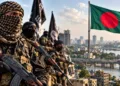
On the occasion of Vijay Divas, my homage and salutations to the Fallen Heroes and Bravehearts of the 1971 Bangladesh Liberation War. In the annals of the military history of the sub-continent in the last 60 years, India’s war against Pakistan to liberate Bangladesh on December 16 1971, remains an unparalleled victory in the famous 14 days of war. India and Bangladesh jointly celebrate the combined victory of the Indian Armed Forces and Mukti Bahini of Bangladesh on December 16 as Vijay Divas. The ouster of the Sheikh Hasina regime in Bangladesh on August 5 this year, the interim government of Muhammad Yunus in Bangladesh is unlikely to celebrate this historic day because they are even obliterating the memory of their founding father, Bangabandhu Sheikh Mujibur Rahman. The Jehadis in Bangladesh are increasingly getting radicalised, and there have been continuous attempts to undermine the role of India in the liberation of Bangladesh in December 1971. Therefore, the first lesson is not to allow a country that was born with the sacrifice of Indian soldiers to be not allowed to drift into the folds of our inimical forces. The deep state wants India to be confronted again on two active fronts in the west and east.
While the 1971 war officially commenced on December 3, 1971, when Pakistan Air Force bombed our border towns in Punjab and Rajasthan, the war was fought on two fronts in the west, with West Pakistan and with East Pakistan in the east. There is no other example in contemporary history where a nation such as West Pakistan and East Pakistan was separated in two parts, 2200 km apart, and India sandwiched d between two Muslim-majority territories. East Pakistan was ruled ruthlessly by the West Pakistan-dominated Army, and overall security was the responsibility of Pakistan Eastern Command, with its headquarters at Dacca. The representation of Bengali officers in East Pakistan was less than 5 per cent, mostly in technical and administrative positions. Therefore, the complete command & control structure lay in the hands of the officer cadre drawn from discriminatory West Pakistan. We should also remember that the armed forces should have equitable representation from all corners of India. Towards this end, the Agnipath Scheme provides an equal opportunity to recruit Agniveers from all parts of the country.
In 1971, the Indian armed forces were not very modern. The military hardware was largely of Russian origin but slightly outdated. The Pakistan side had fairly more modern weapons and equipment, mostly of American origin. A classic example is India’s Vijayant tanks, which are taking on Pakistan’s more modern Patton tanks. The lesson that emerges is that while the weapon is essential, the motivated soldier behind the weapon wins the battles. The soldiers’ morale and motivation are paramount for a nation’s security. There have been many attempts to undermine a soldier’s status over time, many times unintentionally. Since the uniformed fraternity does not protest and remains committed to maintaining the territorial integrity of the nation, at times the bureaucracy neglects the interests of the armed forces. A grateful nation must hold its armed forces in the highest esteem, status and substance.
The 1971 war also brought the Indian Army, Indian Navy and Indian Air Force together to fight a war over two fronts, with their combined strength and synergy. The military campaign is an example of the armed forces exercising Operational Athe rt in the most professional for military dents. Operational Art combines strategy and tactics to achieve a strategic military goal. Operational Art allows the subordinate military commanders to fight the battles towards a common objective and is greatly influenced by the military acumen of the ground-level commanders. For a professional armed forces like ours, it is imperative to have the best and most competent military leadership at the tactical level and the higher echelons of strategic leadership.
This war also gave a new identity and recognition to the Indian Air Force and Indian Navy. So far, the Indian Army had the lead role right from the 1947 war against Pakistan. In the 1971 war, the Indian Air Force and Indian Navy played a critical role, though it was the Indian Army which had to fight through a well-entrenched Pakistan Army, both in the west and the east. The victory in the 1971 war is a tribute and homage to about 3900 Indian soldiers making the supreme sacrifice, and another 9851 were wounded, more than overall 95 per cent casualties being from the Indian Army. Ideally, all three services should have strengthened their jointness and synergy post the war, but unfortunately, it did not happen. Only in the last decade has India taken up the issue of integration between the three wings of the armed forces more seriously.
With the creation of the appointment of Chief of Defence Staff (CDS), effective January 1, 2020, under the Modi 2.0 government, the Indian Armed Forces officially began to look at the formal integration of three forces into Theatre Commands. Theatre Commands are planned to be integrated military establishments that combine the three armed forces wings organised to train in peace and fight together in war. For an aspirational nation with the ambition of becoming a developed nation by 2047, Theatre Commands with the ability to maintain the nation’s territorial integrity are the most important military reform needed now. Theatre Commands also empower the Indian armed forces to be a global player where military intervention is needed to secure the national interests. The military leadership should also overcome the turf war to protect the service’s specific interests and combine them towards greater cooperation and synergy.
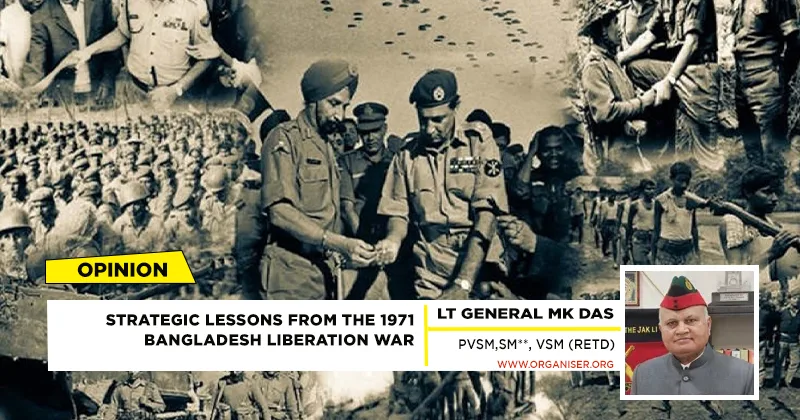
Around 93,00 Pakistani soldiers surrendered to the Indian Army and Mukti Bahini on December 16 1971. The iconic photograph of Lt General AAK Niazi, Commander Eastern Command Pakistan, signing the instrument of surrender in the presence of Lt General JS Aurora, General Officer Commanding in Chief, Indian and Bangladesh Forces, adorns every military establishment in India. While the current dispensation in Bangladesh may live in denial mode about the sterling contribution of India to liberate it from tyranny and genocide, I am told that Pakistani officers and men swear to take revenge on India for their embarrassing defeat in the 1971 war. India does not need any further testimony. But at the strategic level, we as a nation should be prepared to deal with the new dispensation in Bangladesh, in the worst-case scenario.
At the diplomatic level, India did not leverage the outstanding military victory to settle all pending military and strategic issues with Pakistan, including a final settlement of the vexed Kashmir issue. This moment of victory was an excellent opportunity to put Pakistan in its place. Instead, the Shimla Agreement of July 2 1972, gave away a tremendous advantage, including releasing 93,000 Prisoners of War. Thus, the concluding lesson in this piece is to seek the opinion of military leadership before signing any agreement with an adversary. Most importantly, India and its political leadership should fully comprehend the strategic culture in all its dimensions and be on the same page for safeguarding the national interest. The latest developments in Bangladesh, particularly the atrocities against the Hindu minority, are a cause of serious concern, and we must deal with the new challenges with complete determination and unity of purpose. This is another interpretation of ‘Ek Hain to Safe Hain’.