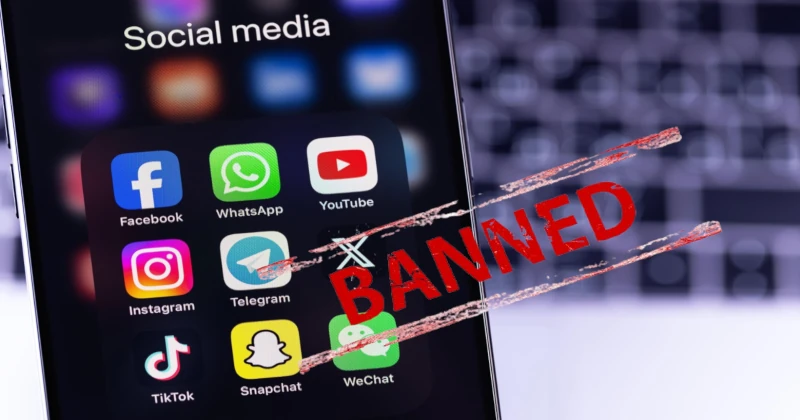
Australia has enacted one of the most stringent social media regulations to date, banning children under the age of 16 from accessing platforms like Facebook, Instagram, and TikTok. The Social Media Minimum Age Bill, imposes hefty fines of up to A$49.5 million ($32 million) on tech giants that fail to comply.
The bill, which will begin implementation in January 2025 and take full effect by late 2025, has sparked intense debate, winning praise from child safety advocates while drawing criticism from digital rights groups, privacy advocates, and portions of the tech industry.
Core Provisions of the Bill
- Age Restriction: Prohibits access to all social media platforms for users under 16 years old.
- Enforcement Mechanism: Platforms must implement robust age-verification systems to prevent underage logins.
- Fines: Non-compliance could result in penalties of up to A$49.5 million per violation.
- Exemptions: Platforms like YouTube, widely used in educational contexts, are excluded from the ban.
- Implementation Timeline: The government will test enforcement methods throughout 2024, with full implementation slated for late 2025.
How will it be enforced?
As Australia gears up to implement its landmark legislation banning social media for children under 16, attention has turned to the mechanisms that will enforce the law. A trial of age-verification methods, starting in January 2025, will explore several approaches to ensure compliance while safeguarding user privacy and avoiding scalability issues.
The government and industry experts are considering three primary methods:
1. Biometric Age Estimation
Users will upload a video selfie, which will be analysed for age-related features using AI technology. The system estimates the user’s age without storing personal data, as the biometric information is deleted post-analysis.
2. Document-Based Verification
This method involves users submitting official documents like a passport or birth certificate to a third-party service. The service anonymises the data and generates a verification token, confirming the user’s eligibility without revealing their identity.
3. Age Inference via Data Cross-Checking
Platforms may also use data cross-checking techniques to verify age. This involves analysing a user’s account activity, such as email registration dates, and comparing it with existing account information to deduce age.
The trial will include rigorous testing to address potential vulnerabilities. This includes evaluating the robustness of these systems against workarounds such as appearance-altering filters, fake documents, or fraudulent account activities. Participants in the trial will actively attempt to bypass the verification systems to highlight weaknesses.
Solutions that fail to prevent scalable circumvention attempts will be rejected, ensuring that the final implementation is both secure and effective.
The trial results will guide lawmakers and social media companies in implementing the ban. The Age Check Certification Scheme, a UK-based consultancy, is overseeing the process and will provide detailed recommendations to the Australian government by mid-2025.
Tony Allen, CEO of the certification scheme, emphasised the importance of a balanced approach:
“While no single method is perfect, our goal is to develop multiple solutions that are accurate, privacy-preserving, and user-friendly. This will set a high benchmark for age verification globally.”
The debate over safety vs. freedom
The legislation has been championed by parents, mental health advocates, and government officials who cite growing concerns about the impact of social media on young people’s mental health. Testimonies from families affected by cyberbullying and self-harm, including heartbreaking cases presented during a 2024 parliamentary inquiry, fueled the push for action.
Parental Advocacy:
Ali Halkic, whose 17-year-old son died by suicide following social media bullying, described the ban as a critical measure. “This gives control back to parents and protects young kids from the toxic influences online.”
Government Leadership:
Prime Minister Anthony Albanese called the law “a necessary intervention to protect our children and provide them with a healthier upbringing.”
Medical Backing:
The move aligns with warnings from health experts, including U.S. Surgeon General Vivek Murthy, who has likened social media’s influence on youth mental health to a public health crisis.
Despite strong public support—77 per cent of Australians back the measure—critics argue the bill is overly broad and fails to consider its potential downsides.
Youth and Digital Advocacy Groups:
Advocates warn the ban could isolate vulnerable groups, such as LGBTQIA teens and migrant children, from critical online support networks.
Enie Lam, a 16-year-old Sydney student, said, “Social media has its problems, but banning it entirely might push kids toward more dangerous, hidden parts of the internet.”
Privacy Concerns:
The Australian Human Rights Commission criticised the bill for potentially infringing on young people’s rights and paving the way for state surveillance through increased data collection.
In response, lawmakers amended the bill to prohibit mandatory uploads of identification documents, requiring platforms to offer alternative verification methods.
Tech Industry Pushback:
Sunita Bose, Managing Director of the Digital Industry Group (DIGI), called the law “premature,” noting the lack of clear guidance on enforcement mechanisms. Meta, owner of Facebook and Instagram, condemned the bill as “inconsistent and ineffective,” accusing lawmakers of ignoring input from over 100 child safety and mental health groups.
Australia’s ban sets a new benchmark for countries grappling with social media regulation. While France and some U.S. states have introduced partial restrictions requiring parental consent for minors, Australia’s outright prohibition is unprecedented.
The move has drawn criticism from international stakeholders, including tech mogul Elon Musk, who labeled it a “backdoor to control internet access.” Meanwhile, some experts fear the law could escalate tensions between Australia and U.S.-based tech giants, already strained by Australia’s earlier mandate requiring social media platforms to pay for news content and combat online scams.
Industry Reaction
The tech sector has voiced significant concerns, questioning the feasibility of enforcing such a ban and warning of unintended consequences. Companies like Meta and TikTok have argued that implementing robust age-verification systems within the proposed timeline is unrealistic. They had lobbied for a delay in the legislation until after the trials.
“This is cart before horse,” said Sunita Bose, highlighting the lack of clarity around compliance requirements.
Critics, including young Australian entrepreneurs, argued that the ban could stifle creativity. “Social media has allowed teenagers to explore their passions and even launch careers. This ban risks taking that away,” said Leonardo Puglisi, a 16-year-old journalist and founder of 6 News Australia.
The law has ignited a fierce debate about the balance between protecting children and preserving digital freedoms. While some see it as a long-overdue safeguard, others worry about overreach and unintended social consequences.
For Parents: The ban is a victory, giving them greater control over their children’s exposure to harmful online content.
For Teens: The law could push them toward unsupervised, potentially more dangerous online spaces.
For the Global Community: Australia’s decision is being closely watched, as other nations may adopt similar measures or face resistance from tech companies and advocacy groups.
Australia’s initiative comes as governments worldwide grapple with the challenges of regulating social media for young users. The move is being closely observed by countries facing similar concerns about the mental health impacts of social media and the misuse of personal data.
Although some European nations and US states have introduced age restrictions, enforcement has been hindered by concerns over privacy and free speech. Australia’s approach could provide a model for overcoming these obstacles, potentially setting a new standard for protecting children in the digital age.