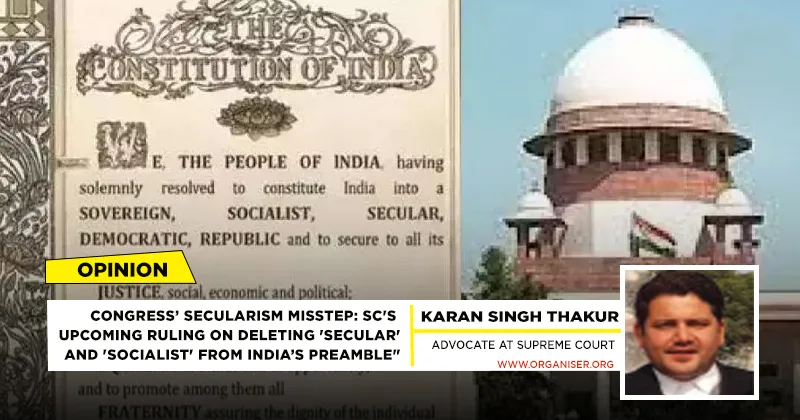
Congress’ Secularism Misstep: SC's upcoming ruling on deleting 'secular' and 'socialist' from India’s Preamble"
June 16, 2026
  • Read Ecopy
  • Circulation
  • Advertise
  • Careers
  • About Us
  • Contact Us
Android AppiPhone AppArattai
Organiser
  • ‌
  • Bharat
    • Assam
    • Bihar
    • Chhattisgarh
    • Jharkhand
    • Maharashtra
    • View All States
  • World
    • Asia
    • Europe
    • North America
    • South America
    • Africa
    • Australia
  • Editorial
  • International
  • Opinion
  • RSS @ 100
  • More
    • Op Sindoor
    • Analysis
    • Sports
    • Defence
    • Politics
    • Business
    • Economy
    • Culture
    • Special Report
    • Sci & Tech
    • Entertainment
    • G20
    • Azadi Ka Amrit Mahotsav
    • Vocal4Local
    • Web Stories
    • Education
    • Employment
    • Books
    • Interviews
    • Travel
    • Law
    • Health
    • Obituary
  • Subscribe
    • Subscribe Print Edition
    • Subscribe Ecopy
    • Read Ecopy
  • ‌
  • Bharat
    • Assam
    • Bihar
    • Chhattisgarh
    • Jharkhand
    • Maharashtra
    • View All States
  • World
    • Asia
    • Europe
    • North America
    • South America
    • Africa
    • Australia
  • Editorial
  • International
  • Opinion
  • RSS @ 100
  • More
    • Op Sindoor
    • Analysis
    • Sports
    • Defence
    • Politics
    • Business
    • Economy
    • Culture
    • Special Report
    • Sci & Tech
    • Entertainment
    • G20
    • Azadi Ka Amrit Mahotsav
    • Vocal4Local
    • Web Stories
    • Education
    • Employment
    • Books
    • Interviews
    • Travel
    • Law
    • Health
    • Obituary
  • Subscribe
    • Subscribe Print Edition
    • Subscribe Ecopy
    • Read Ecopy
Organiser
  • Home
  • Bharat
  • World
  • Operation Sindoor
  • Editorial
  • Analysis
  • Opinion
  • Culture
  • Defence
  • International Edition
  • RSS @ 100
  • Magazine
  • Read Ecopy
Home Bharat

Congress’ Secularism Misstep: SC’s upcoming ruling on deleting ‘secular’ and ‘socialist’ from India’s Preamble”

The Supreme Court is set to deliver a crucial ruling on pleas seeking the removal of the words "secular" and "socialist" from India’s Preamble. These terms, introduced through the 42nd Amendment during the Emergency, have sparked debates over their constitutional validity and alignment with India’s foundational principles

Adv Karan ThakurAdv Karan Thakur
Nov 22, 2024, 08:00 pm IST
in Bharat, Opinion, Law
Follow on Google News
FacebookTwitterWhatsAppTelegramEmail

The Supreme Court of India has reserved its judgment on the contentious issue of the inclusion of the words “secular” and “socialist” in the Preamble of the Constitution. The debate stems from their addition during the Emergency under the 42nd Constitutional Amendment in 1976. Critics argue these terms were introduced without adequate public consultation, reflecting the political climate of the time. Proponents, however, view them as an affirmation of India’s existing constitutional values. The judgment, set to be pronounced on November 25, 2024, is expected to address their compatibility with the Constitution’s original framework.

Justice Sanjiv Khanna, leading the bench, noted the distinctiveness of Indian secularism, which emphasizes coexistence and tolerance. The Court also considered whether these additions aligned with the foundational principles of equality, liberty, and fraternity. Public debates on this issue have intensified, with legal experts and political commentators weighing in on its implications for governance and constitutional integrity.

India’s secularism, distinct from the Western model, is deeply intertwined with its civilizational ethos. Unlike the strict separation of religion and state seen in Western secularism, Indian secularism embodies Sarva Dharma Sambhava—equal respect for all religions. This principle is not an imported ideology but a reflection of India’s millennia-old traditions, where diverse faiths have coexisted harmoniously, forming the foundation of its pluralistic society.

The ongoing debate over the inclusion of “secular” and “socialist” in the Preamble through the 42nd Amendment brings into focus these enduring values. As the Supreme Court deliberates on their constitutional validity, it confronts questions about whether these terms align with India’s indigenous understanding of secularism or represent a politically motivated imposition from an era of turbulence.

Secularism: An Ancient Bharatiya Tradition

Indian secularism is rooted in cultural and historical practices that prioritise inclusivity and mutual respect among faiths. Long before the formal adoption of the Constitution, Indian society thrived on the principles of pluralism. Unlike Western secularism, which seeks to isolate religion from public life, India’s model integrates spirituality into societal and state structures without promoting or privileging any specific religion. This balance allows religious freedom while fostering unity in diversity.

Secularism in its true sense has always been part of Indian heritage, requiring no validation through Western terminologies or political amendments. For centuries, the Indian state and society upheld values of tolerance and coexistence, even in the face of external challenges. From this view, the addition of “secular” in the Preamble during the Emergency in 1976 was redundant and politically driven, rather than an authentic enhancement of India’s constitutional identity.

The Judiciary’s Role in Shaping Secularism

The judiciary has played a pivotal role in defining secularism within India’s constitutional framework. Landmark cases like Kesavananda Bharati v. State of Kerala (1973) established the basic structure doctrine, ensuring that fundamental principles like secularism cannot be altered through amendments. Similarly, in S.R. Bommai v. Union of India (1994), the Supreme Court underscored that secularism is central to governance, mandating the state to uphold equality and neutrality toward all religions.

As the Supreme Court revisits the inclusion of “secular” and “socialist” in the Preamble, it must decide whether these additions uphold the Constitution’s original spirit or distort it. Justice Sanjiv Khanna, leading the current bench, emphasized that Indian secularism is not about religious uniformity but about coexistence and tolerance, ensuring that all citizens enjoy equal rights regardless of their faith.

The 42nd Amendment: Enhancing or Deviating?

The 42nd Constitutional Amendment, introduced during the Emergency in 1976, added the terms “secular” and “socialist” to the Preamble. Critics argue that this amendment, enacted without extensive debate or public consultation, was more reflective of the political climate of the time than the framers’ intent. They contend that India’s secular ethos was already enshrined in its Constitution through provisions ensuring equality, religious freedom, and non-discrimination.

The Petitioner in the case, argued that the retrospective addition of these terms undermines the sanctity of the Constitution. He proposed bifurcating the Preamble into its original text and subsequent amendments to maintain historical authenticity. On the other hand, the judiciary has suggested that these terms merely codify existing principles inherent in the Constitution, aligning with its broader goals of equality and fraternity.

Implications for India’s Democratic Identity

The Supreme Court’s verdict on this case will have profound implications for India’s political and constitutional trajectory. Upholding the inclusion of “secular” and “socialist” would reinforce their significance as guiding principles for governance. Conversely, ruling against their inclusion could redefine the limits of constitutional amendments, prioritising fidelity to the original text.

Beyond the legal ramifications, this case touches on the philosophical core of India’s democracy. It compels the nation to reflect on its identity as a secular state—one that celebrates diversity not through uniformity but by embracing its differences.

The Bharatiya Model of Secularism

Indian secularism is not a borrowed concept but a testament to the country’s civilizational wisdom. It transcends the Western notion of rigid boundaries between religion and state, embodying a holistic approach that respects spiritual diversity while ensuring governance remains impartial. This model has allowed India to flourish as a vibrant democracy, where unity is achieved not by erasing differences but by celebrating them.

As the nation awaits the Supreme Court’s verdict, it is clear that the decision will go beyond the immediate question of the Preamble’s wording. It will reaffirm India’s commitment to its pluralistic identity and the values that have sustained its democracy for centuries. At its heart, this case is not just about constitutional semantics but about defining the soul of a nation rooted in harmony, tolerance, and inclusivity.


Topics: SocialismPreambleSupreme CourtSecularismJustice Sanjiv Khanna
Share1TweetSendShareSend
✮ Subscribe Organiser YouTube Channel. ✮
✮ Join Organiser's WhatsApp channel for Nationalist views beyond the news. ✮
Previous News

Manipur: “We support agitation against killing of innocents, but some looted houses on the name of protest,” says CM

Next News

Chhattisgarh: CM Vishnu Deo Sai, deputy CMs commends security forces for eliminating 10 Maoists in Sukma district

Related News

The AMU Judgment: Why the Supreme Court must revisit Article 30

Tamil Nadu Assembly (File Photo)

Tamil Nadu speaker drops action against 21 rebel AIADMK MLAs after EPS withdrawal, targets 4 who joined TVK

Supreme Court remarks have revived the UAPA bail debate, with supporters citing national security concerns

UAPA Bail Debate: Striking a delicate balance between individual liberty and national security

Supreme Court invokes Article 142, issues strict timelines to curb delay in High Court judgments

Supreme Court invokes Article 142, orders strict timelines for High Court judgments to end delays in justice delivery

SIR and Article 324: Supreme Court strengthens the constitutional spine of Indian Democracy; Reaffirms ECI’s authority

Andhra Pradesh cancels Pastor Anand’s SC certificate following Apex Court’s verdict on SC/ST Act on Christian converts

Load More

Latest News

Islamists who raped the Hindu woman in Nagpur arrested

Jihadi Mindset Surfaces in Nagpur: Ayyaz Taj, Hazrat Maulana from MP & Amin Shaikh, raped Hindu woman

UPSC Prelims 2026 result declared

UPSC CSE Prelims Result 2026 Declared: 13,343 candidates qualify for mains exam; Download result PDF here

VHP International Working President Alok Kumar addressing the media

Shree Ram Janmaboomi Teerth Kshetra takes responsibility for every rupee, will fully cooperate with SIT: Alok Kumar

India-Slovakia heralds new era of partnership: Seal MoUs in defence, digital tech, counter-terrorism & labour mobility

Telangana: LRPF Seeks NHRC Probe into Agape Over HIV Orphans’ Privacy, Child Safety and Regulatory Concerns

US protests against India’s FCRA amendments; Transparency norms rattle foreign funded missionary networks

PoJK Protests: 2 JAAC activists killed, 8 injured in Rawalakot; Pakistani security forces crackdown on civilians

Singapen Special Task Force (SSTF) unit in Tamil Nadu

Singapen, all-women police unit, force launched by TVK, but crimes against women remain a growing concern in Tamil Nadu

The National Democratic Alliance (NDA) on June 10 passed a resolution marking 12 years of the Narendra Modi-led Government, describing it as a defining phase of "people-centric development, participative democracy and performance-oriented governance"

12 years of Modi government:  Restoration of self-belief

More than a cultural gathering, the event reflected a collective resolve to protect indigenous traditions, strengthen community bonds and celebrate Bharat's enduring unity in diversity.

Janajati Samagam 2026: The indigenous quest to protect culture, tradition and the soul of Bharat

Load More
  • Privacy
  • Terms
  • Cookie Policy
  • Refund and Cancellation
  • Delivery and Shipping

© Bharat Prakashan (Delhi) Limited.
Tech-enabled by Ananthapuri Technologies

  • Home
  • Search Organiser
  • Bharat
    • Assam
    • Bihar
    • Chhattisgarh
    • Jharkhand
    • Maharashtra
    • View All States
  • World
    • Asia
    • Africa
    • North America
    • South America
    • Europe
    • Australia
  • Editorial
  • Operation Sindoor
  • Opinion
  • Analysis
  • Defence
  • Culture
  • Sports
  • Business
  • RSS @ 100
  • Entertainment
  • More ..
    • Sci & Tech
    • Vocal4Local
    • Special Report
    • Education
    • Employment
    • Books
    • Interviews
    • Travel
    • Health
    • Politics
    • Law
    • Economy
    • Obituary
  • Subscribe Magazine
  • Read Ecopy
  • Advertise
  • Circulation
  • Careers
  • About Us
  • Contact Us
  • Policies & Terms
    • Privacy Policy
    • Cookie Policy
    • Refund and Cancellation
    • Terms of Use

© Bharat Prakashan (Delhi) Limited.
Tech-enabled by Ananthapuri Technologies