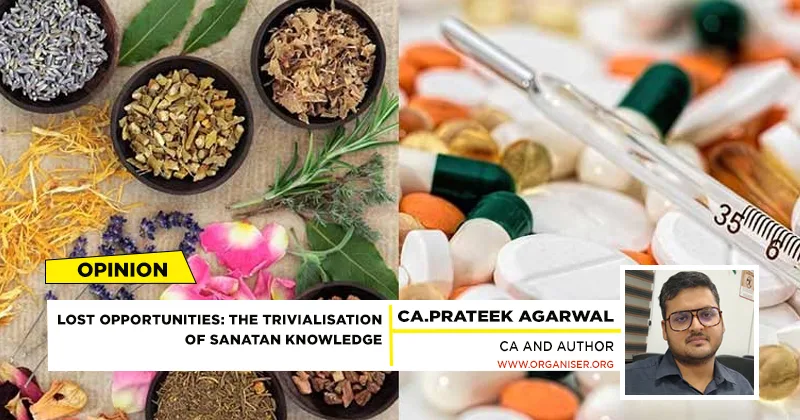
Lost Opportunities: The trivialisation of Sanatan knowledge
June 5, 2026
  • Read Ecopy
  • Circulation
  • Advertise
  • Careers
  • About Us
  • Contact Us
Android AppiPhone AppArattai
Organiser
  • ‌
  • Bharat
    • Assam
    • Bihar
    • Chhattisgarh
    • Jharkhand
    • Maharashtra
    • View All States
  • World
    • Asia
    • Europe
    • North America
    • South America
    • Africa
    • Australia
  • Editorial
  • International
  • Opinion
  • RSS @ 100
  • More
    • Op Sindoor
    • Analysis
    • Sports
    • Defence
    • Politics
    • Business
    • Economy
    • Culture
    • Special Report
    • Sci & Tech
    • Entertainment
    • G20
    • Azadi Ka Amrit Mahotsav
    • Vocal4Local
    • Web Stories
    • Education
    • Employment
    • Books
    • Interviews
    • Travel
    • Law
    • Health
    • Obituary
  • Subscribe
    • Subscribe Print Edition
    • Subscribe Ecopy
    • Read Ecopy
  • ‌
  • Bharat
    • Assam
    • Bihar
    • Chhattisgarh
    • Jharkhand
    • Maharashtra
    • View All States
  • World
    • Asia
    • Europe
    • North America
    • South America
    • Africa
    • Australia
  • Editorial
  • International
  • Opinion
  • RSS @ 100
  • More
    • Op Sindoor
    • Analysis
    • Sports
    • Defence
    • Politics
    • Business
    • Economy
    • Culture
    • Special Report
    • Sci & Tech
    • Entertainment
    • G20
    • Azadi Ka Amrit Mahotsav
    • Vocal4Local
    • Web Stories
    • Education
    • Employment
    • Books
    • Interviews
    • Travel
    • Law
    • Health
    • Obituary
  • Subscribe
    • Subscribe Print Edition
    • Subscribe Ecopy
    • Read Ecopy
Organiser
  • Home
  • Bharat
  • World
  • Operation Sindoor
  • Editorial
  • Analysis
  • Opinion
  • Culture
  • Defence
  • International Edition
  • RSS @ 100
  • Magazine
  • Read Ecopy
Home Bharat

Lost Opportunities: The trivialisation of Sanatan knowledge

In an era increasingly focused on modernity, the profound heritage of Sanatan knowledge, particularly Ayurveda, remains largely overlooked. Despite its potential, Ayurveda constitutes only 2 per cent of the 1.6 trillion dollar global pharmaceutical market, underscoring a missed economic opportunity. This trivialisation not only disregards valuable wisdom but also limits India's ability to leverage its rich traditional practices for global benefit

CA PRATEEK AGARWALCA PRATEEK AGARWAL
Oct 20, 2024, 06:00 pm IST
in Bharat, World, Opinion, Health
Follow on Google News
FacebookTwitterWhatsAppTelegramEmail

In a world increasingly focused on modernity, the rich heritage of Sanatan knowledge—including systems like Ayurveda—has often been overlooked. With the global pharmaceutical market valued at a staggering 1.6 trillion dollars, it’s disheartening to note that the Ayurvedic market constitutes only 2 per cent of this total, despite Ayurveda being one of the world’s oldest and most comprehensive systems of medicine. This disparity highlights a broader issue: the trivialisation of Sanatan traditions and the economic opportunities that have been missed as a result.

A Rich Heritage Ignored

Sanatan knowledge encompasses not just Ayurveda but also various traditional practices in agriculture, education, and sustainable living, offering immense potential. Ancient texts such as the Charaka Samhita, Sushruta Samhita, and Ashtanga Hridaya provide a wealth of information, detailing over 700 herbs and more than 6,000 formulations for various health conditions. The Madhav Nidan, a classic from around 800 AD, offers insights into over 5,000 signs and symptoms, further emphasising the depth and complexity of this traditional knowledge.

Despite this rich heritage, these systems have often been marginalised in favour of Western medical paradigms. Since India’s independence, there has been a persistent failure to acknowledge the significance of traditional knowledge systems. The post-colonial leadership seemed more inclined to adopt modern medical practices, often dismissing indigenous methods as archaic or irrelevant. This choice has not only sidelined valuable wisdom but also resulted in significant economic losses for the country.

If India had invested in the research and development of Ayurveda after independence, it could have secured a major share of medicinal patents and a substantial portion of the global medicinal market, which is currently dominated by the USA (44 per cent), followed by China and the EU.

Recognition and Progress

In a pivotal move, the Indian Government first recognised the vast potential of traditional medicine in November 2014, transforming the erstwhile department into a dedicated ministry: the Ministry of AYUSH (Ayurveda, Yoga, Naturopathy, Unani, Siddha, and Homeopathy). This change allowed for a separate budget for research, pulling these traditional practices out of the shadows of modern medicine.

Since then, the Ministry of AYUSH has signed 24 country-to-country memoranda of understanding (MoUs) for cooperation in the field of traditional medicine and homoeopathy with nations like China, Germany, Japan, Iran, Brazil, Bangladesh, and Malaysia. Additionally, 43 MoUs for collaborative research and academic collaboration have been signed with foreign institutes and universities, paving the way for greater integration of traditional knowledge into global practices.

Notably, in 2022, KAL obtained its first patent from the US and met California’s Prop 65 standards, one of the most stringent requirements for drugs, for its herbal drug targeting Type-2 diabetes, obesity, and lipid profile management. Furthermore, in 2024, Indian patents for an Ayurvedic formulation developed by BHU, Varanasi, that demonstrates 95 per cent efficacy against the SARA virus were granted.

The Patent Landscape

The landscape of patent filings reflects a renewed interest in Ayurveda. From independence until March 31, 2013, a total of 609 patents were filed by Indian entities in the field of Ayurveda, with only 119 granted. In stark contrast, during just three years of the Modi Government (2019-2021), 761 patents were filed, with 86 granted. This significant increase underscores the untapped potential of traditional knowledge systems in the modern marketplace.

Broader Opportunities

The missed opportunities in Ayurveda are just the tip of the iceberg. Numerous traditional knowledge systems remain underexplored, offering great economic value not only to India but to the world. Areas such as organic agriculture, the use of natural fertilisers, the benefits of millets, ancient educational models (Nalanda, Takshashila, Vikramashila), indigenous liquors like Mahua, metallurgy (like the Iron Pillar from Chandragupta’s era), sustainable architecture, wellness health, and beauty care are all ripe for exploration and innovation.

A Call for Change

The reasons for this oversight are complex. One might point to the legacy of leaders like the Nehru family, who shaped the vision of post-independence India with a socialist mindset that often overlooked ancient Indian principles. The influence of Thomas Babington Macaulay’s education policy in 1835, which prioritised Western education over indigenous systems, created a divide that continues to affect perceptions of traditional knowledge. Macaulay’s in some sense succeeded in creating a class which are Indian in blood and colour, but English in taste, in opinions, in morals, and in intellect”.

As we move forward, there is a pressing need for a drastic change in mindset across the political landscape. Recognising and valuing the Traditional Knowledge System of Sanatan, free from the constraints of minority appeasement and pseudo-secularism, is essential. Acknowledging the financial forces of the Western world should not deter India from reclaiming its heritage and capitalising on the wealth of knowledge it possesses.

The trivialisation of Sanatan knowledge systems represents not just a cultural oversight but also a significant economic opportunity that has been squandered. By recognising and investing in these traditions, India can not only reclaim its heritage but also position itself as a leader in the global wellness economy. The path forward lies in acknowledging the value of this knowledge, investing in its potential, and ensuring that it plays a pivotal role in shaping a sustainable and prosperous future for all.


 

Topics: AyurvedaSanatan traditionSanatana knowledge
ShareTweetSendShareSend
✮ Subscribe Organiser YouTube Channel. ✮
✮ Join Organiser's WhatsApp channel for Nationalist views beyond the news. ✮
Previous News

Delhi CRPF school blast ahead of Deepawali: Multi-Agency probe initiated; Crude bomb use under investigation

Next News

AAP Exposed: Bans firecrackers for Deepawali, but workers celebrate with them after leaders released from jail 

Related News

UP CM Yogi Adityanath chaired a high-level AYUSH Department review in Lucknow

Uttar Pradesh’s AYUSH Push: Yogi govt unveils mega plan to make UP global hub for wellness and healing

Representative Image

How Namami Gange is reviving India’s lost botanical inheritance

Fathers of Science (Image Source: X0

From Aryabhata to Charaka: 36 visionary sants who shaped the foundations of modern science and knowledge

Brahmi: An Indian ancient cognitive science rooted in ayurveda and validated by modern research

Finance Minister Nirmala Sitharaman in parliament presenting Budget 2026

Budget 2026 pushes AYUSH: Five regional medical hubs, three new all India Institutes of Ayurveda announced

Yogi Adityanath government is set to transform AYUSH centres across Uttar Pradesh into advanced research hubs

Uttar Pradesh to transform AYUSH centres into research hubs to tackle critical and lifestyle diseases

Load More

Latest News

Union Home Minister Amit Shah addressing BSF personnel at the Lankamura Border Outpost along the India-Bangladesh border in West Tripura district on June 5, 2026

Amit Shah at Bangladesh Border: “India will have an impregnable security grid soon”

India slams Pakistan’s bid to hold elections in Gilgit-Baltistan, demands end to illegal occupation

Maharashtra government approves central wage structure for Pune Metro Contract Workers; Major victory for BMS

India seals robust 7.7% GDP Growth in FY26: Reflects economic resilience amid West Asia crisis & other global headwinds

A representative image

After TCS, Corporate Jihad allegations reach SBI: Married Hindu employee conversion claims trigger FIR in Mumbai

MEA spokesperson Randhir Jaiswal highlights India's resolve to deport illegal Bangladeshi migrants via bilateral mechanisms

India reiterates strong resolve to deport illegal Bangladeshis; Flags delay of bilateral procedures from Dhaka

Kerala HC rejects CMRL appeal, clears way for ED probe against Pinarayi Vijayan’s daughter in money laundering case

Uttar Pradesh leads in Bharat's green transformation

World Environment Day 2026: On his birthday, Yogi Adityanath’s green vision powers Uttar Pradesh’s transformation

As Khalistani networks seek new platforms beyond the West, Azerbaijan has emerged as a key venue for conferences, campaigns and narratives aligned with the Pakistan-Turkey axis against India.

Khalistan’s New Grazing Ground: Azerbaijan emerges as new hub for Turkey-Pakistan backed anti-India networks

Kochi IPL Mystery: Why Did Sunanda Pushkar Surrender Stake Amid Benami Claims Tied to Shashi Tharoor, Sonia Gandhi?

Kochi IPL Mystery: Why Did Sunanda Pushkar Surrender Stake Amid Benami Claims Tied to Shashi Tharoor, Sonia Gandhi?

Load More
  • Privacy
  • Terms
  • Cookie Policy
  • Refund and Cancellation
  • Delivery and Shipping

© Bharat Prakashan (Delhi) Limited.
Tech-enabled by Ananthapuri Technologies

  • Home
  • Search Organiser
  • Bharat
    • Assam
    • Bihar
    • Chhattisgarh
    • Jharkhand
    • Maharashtra
    • View All States
  • World
    • Asia
    • Africa
    • North America
    • South America
    • Europe
    • Australia
  • Editorial
  • Operation Sindoor
  • Opinion
  • Analysis
  • Defence
  • Culture
  • Sports
  • Business
  • RSS @ 100
  • Entertainment
  • More ..
    • Sci & Tech
    • Vocal4Local
    • Special Report
    • Education
    • Employment
    • Books
    • Interviews
    • Travel
    • Health
    • Politics
    • Law
    • Economy
    • Obituary
  • Subscribe Magazine
  • Read Ecopy
  • Advertise
  • Circulation
  • Careers
  • About Us
  • Contact Us
  • Policies & Terms
    • Privacy Policy
    • Cookie Policy
    • Refund and Cancellation
    • Terms of Use

© Bharat Prakashan (Delhi) Limited.
Tech-enabled by Ananthapuri Technologies