
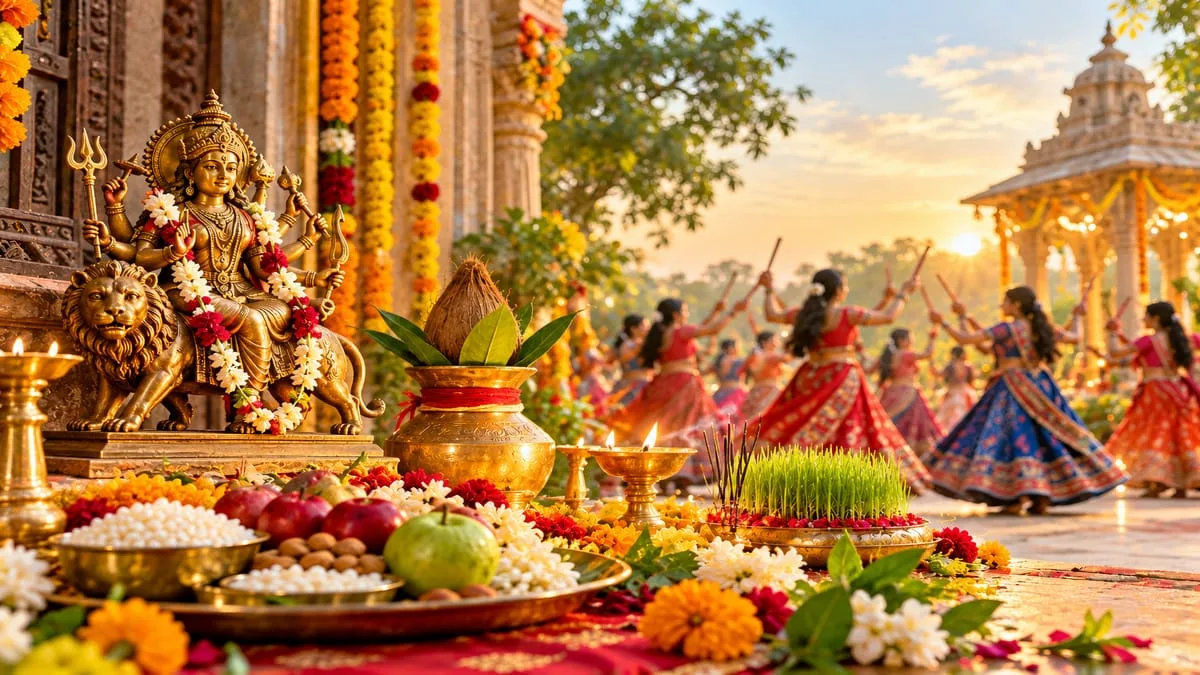
From seasonal rhythms and mindful nourishment to daily routines and community celebrations, Navratri offers a timeless perspective on living in harmony with nature.
“Dadi, why do we light diyas, prepare special food and gather for bhajans during Navratri? And why does the festival fall around the same time every year? Is it simply a tradition we follow because our parents and grandparents did?”
The questions came from a curious young granddaughter as she watched her grandmother arrange flowers before the morning prayers.
Dadi smiled. “Perhaps we have become so accustomed to following our traditions that we have forgotten to ask what they mean. There is a story behind these nine nights, one that goes beyond the rituals we see.”
Across India and far beyond its borders, Navratri is celebrated with extraordinary fervour and devotion. Temples resound with chants, homes glow with the light of diyas, communities come alive with Garba and Dandiya, and families gather to worship the many forms of the Divine ‘Devi Ma’. For some, it is a time of fasting and prayer; for others, a celebration of music, dance, food and togetherness.
At its heart lies the worship of Shakti, the divine feminine power. Yet, the festival also offers an opportunity to explore India’s rich traditions through another lens: the wisdom of Ayurveda, with its emphasis on seasonal living, appropriate nourishment and the everyday habits that sustain well-being.
Could these nine nights hold lessons that are as relevant to the younger generation today as they were to our ancestors?
Navratri and the rhythms of nature
“Let us begin with the calendar,” Dadi might have said. “Our festivals are connected to the rhythms of nature in more ways than we sometimes realise.”
The two widely observed Navratri festivals, Chaitra Navratri in spring and Sharad Navratri in autumn, are celebrated according to the Hindu lunisolar calendar. Both fall around seasonal transitions, making their timing an interesting starting point for exploring Ayurveda’s understanding of the relationship between human life and the natural world.
Ayurveda, India’s traditional system of health and healing, recognises that changing seasons call for adjustments in diet and lifestyle. This principle is known as Ritucharya, or the seasonal regimen.
Classical Ayurvedic texts describe six seasons, each associated with particular environmental conditions and traditional recommendations for food and daily activities. The underlying principle is simple: our habits should respond to the world around us. What may suit us during the heat of summer may not be equally appropriate during the rains or cooler months.
Sharad Ritu, broadly corresponding to autumn, follows the rainy season in the traditional Ayurvedic calendar. Chaitra Navratri, meanwhile, falls around the transition into spring, when Ayurveda also recommends seasonal adjustments.
This does not mean that Navratri was designed as a medical regimen or that observing the festival automatically improves health. Its religious significance stands on its own. Rather, the coincidence of these observances with seasonal transitions offers a meaningful opportunity to revisit a principle deeply rooted in Indian thought: well-being is influenced by our relationship with our surroundings.
In an age of air-conditioned offices, irregular meals, late-night screen time and sedentary routines, this principle deserves renewed attention. Seasonal awareness need not be complicated. It can begin with paying attention to local weather, eating suitable foods, maintaining regular routines and adapting activity to our individual needs.
The wisdom of eating with awareness
“Then, Dadi, is that why we eat differently during Navratri?” the granddaughter asked. “In part, perhaps,” came the reply. “But food has always meant more than filling the stomach. It is also about how we nourish ourselves.”
In Ayurveda, Ahara, or food and nourishment, is regarded as one of the important foundations of health. Food suitability is considered in relation to the individual, digestive capacity, preparation, quantity and season.
During Navratri, dietary practices vary across regions and families. Some devotees observe a complete or partial fast; others consume fruits, milk, nuts or preparations made with ingredients such as sabudana, kuttu and singhara. These practices carry religious and cultural significance and should not be reduced to their nutritional properties alone.
Nevertheless, they offer an opportunity to reflect on the quality of our everyday food choices. Do we eat at regular times? Are our meals appropriate to our needs? Do we pay attention to hunger and fullness? How often do we rely on heavily processed foods or meals rich in sugar and excess fat?
One important distinction deserves emphasis: fasting does not automatically mean eating lightly or healthfully. A diet dominated by fried fasting foods, sweets or excessive portions may still be nutritionally unbalanced.
Ayurveda’s broader emphasis on appropriate nourishment encourages moderation rather than extremes. The aim is to nourish the body in a manner suited to individual needs, not to burden it through excess or deprive it unnecessarily.
Fasting, moreover, is not suitable for everyone. People with diabetes, those taking glucose-lowering medicines, pregnant individuals, frail older adults and people with certain medical conditions may need to avoid fasting or seek individualised medical advice before changing their eating patterns.
The deeper lesson is not that everyone must fast, but that food deserves greater awareness, moderation and respect.
Rituals that connect generations
Navratri is rich in rituals shaped by regional customs, family traditions and devotional beliefs. Lighting a lamp, establishing a kalash, offering flowers, reciting prayers and preparing prasad are expressions of devotion that connect generations.
In some households, barley seeds, known as jau, are sown at the beginning of the festival and their growth is observed over the nine days. Within these traditions, the sprouting seeds can evoke renewal, fertility and the relationship between human life and the natural world. Such practices should first be understood in their religious and cultural contexts. Their value does not depend on assigning a medical explanation to every ritual.
Yet traditions can carry layers of meaning beyond their visible form. A daily prayer creates a moment of pause. Preparing an offering can become an act of attention and care. Gathering as a family creates space for stories, memories and shared values.
This is particularly relevant today, when meals are hurried, conversations are interrupted by notifications, and families often struggle to find time together. Traditional observances can create occasions to slow down, reconnect and participate in a shared cultural experience.
The value lies not in claiming that every ritual has a measurable health benefit, but in recognising how meaningful participation can enrich our relationship with family, community and heritage.
Dinacharya: The health wisdom of everyday habits
Ayurveda’s wisdom extends beyond seasonal changes to the habits that shape everyday life. The concept of Dinacharya, or the daily regimen, emphasises the importance of regular routines, personal hygiene, physical activity and appropriate rest. Together with Ritucharya, it forms part of Ayurveda’s broader approach to maintaining health through daily conduct and lifestyle.
Consider how differently our days are organised today. Late nights, prolonged screen time, irregular meals and long hours of sitting have become commonplace. We often search for a single remedy for fatigue or poor health while overlooking the cumulative influence of our everyday habits.
The observances associated with Navratri offer a useful opportunity to reflect on this imbalance. Morning prayers can provide structure to the day, while evening gatherings and devotional singing create occasions to step away from routine demands and participate in something shared.
Garba and Dandiya offer another interesting connection. These dances are first and foremost expressions of devotion, cultural identity and collective celebration. They also involve physical movement, often sustained over an evening. They remind us that physical activity need not always be confined to a gym or treated as a separate obligation. Dancing, walking, yoga and other enjoyable forms of movement can all contribute to an active lifestyle, with the intensity adapted to individual ability and health.
Rest matters just as much. Late-night festivities need not become an excuse for chronic sleep deprivation. Balancing celebration with adequate sleep and recovery is a practical way to carry the spirit of mindful living into the festival.
The broader Ayurvedic concept of Swasthavritta, concerned with the maintenance of health, also encompasses appropriate conduct and the conditions that support well-being. This is consistent with the classical Ayurvedic understanding of Swasthya, or health, which considers the balance of bodily functions alongside the well-being of the mind, senses and self.
In other words, health is not merely about what we eat or how much we exercise. It also involves how we organise our lives, relate to others and nurture a sense of balance.
Navratri does not automatically confer these benefits, nor should its rituals be recast as medical interventions. Rather, the festival offers an occasion to revisit principles that remain relevant: regularity, moderation, movement, rest and conscious living.
Nine nights, a celebration of shakti
At the spiritual heart of Navratri is the worship of the Goddess in her many forms. The nine forms of Durga, collectively known as Navadurga, are associated with distinct narratives and qualities within Hindu religious traditions. Through stories of the Goddess overcoming forces of disorder, the festival affirms the triumph of good over evil and celebrates the power of the Divine Mother.
For contemporary readers, the symbolism can also prompt reflection on courage, discipline, compassion and resilience. These are modern reflections inspired by the tradition, not replacements for its religious meaning.
Here, an interesting dialogue emerges between India’s spiritual heritage and its health traditions. Ayurveda approaches health as more than the absence of physical illness, recognising the importance of bodily balance alongside the well-being of the mind and senses. The worship of Shakti, meanwhile, occupies its own profound place within Hindu religious thought.
These traditions should not be conflated. Worship of the Goddess is a religious practice; Ayurveda is a traditional system of health and healing. Yet both invite us to look beyond a narrow understanding of life and consider the relationship between our actions, our surroundings and our inner state.
Making tradition meaningful for the next generation
Perhaps the most important question is what remains when the nine nights are over. For younger generations, participation need not be limited to attending a puja because the family expects it or joining Garba and Dandiya because it is fashionable. Understanding the stories, symbolism and cultural significance behind these observances can make participation more meaningful.
The same applies to Ayurveda. Its principles need not remain confined to books or conversations among the older generation. Seasonal awareness can begin with simple choices: eating appropriate, freshly prepared meals; maintaining regular routines; getting adequate sleep; staying physically active; and being attentive to changing environmental conditions and personal needs.
These are not benefits exclusive to Navratri, nor are they guaranteed by observing the festival. They are everyday practices informed by the broader principle of living with greater awareness of our bodies and environment.
There is also a role for families in keeping traditional knowledge alive. Listening to grandparents explain a prayer, learning the story behind a ritual, helping prepare a traditional dish or joining a community celebration can turn inherited customs into living knowledge.
Tradition remains relevant not because every practice must remain unchanged, but because understanding its meaning allows each generation to engage with it thoughtfully.
Beyond the nine nights
As the granddaughter helped Dadi arrange the final flowers, her questions had not disappeared. They had simply changed. She was beginning to see Navratri not merely as a calendar of rituals, but as a window into a larger cultural world; one in which devotion, nature, nourishment, family and community occupy meaningful places.
That is perhaps the enduring value of India’s festivals. They preserve more than memories of the past; they create opportunities for each generation to rediscover the ideas and values that have shaped our civilisation.
Navratri does not need to be recast as a health programme to remain relevant to the modern world. Its spiritual significance stands on its own, while its seasonal timing offers a natural occasion to reflect on Ayurveda’s wisdom of adaptation. Its rituals, meanwhile, continue to connect families and communities through shared faith and cultural memory.
The nine nights may end, but the wisdom they invite us to explore can accompany us throughout the year. The true continuity of tradition lies not simply in repeating what we have inherited, but in understanding its meaning and carrying its enduring values into the way we live today.