
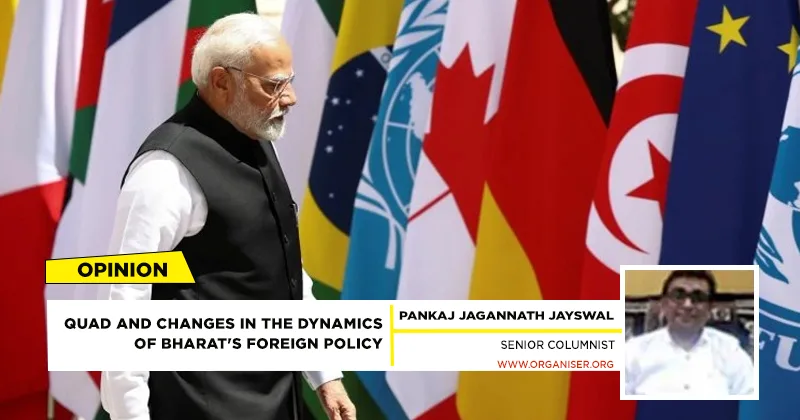
Bharat’s foreign policy remained weak for decades. It was primarily inspired by superpowers, Westerners, and the Islamic world. Even Pakistan benefited from the weak mindset and slave mentality. The mindset of giving in to international pressure was common, and surrendering national ideals to make the world community happy was part of foreign policy. We suffered economic losses on numerous fronts as a result of such strategy, including a loss of self-esteem, allowing China to grow exponentially in the global market, and increased unemployment. Prior to 2014, foreign direct investment (FDI) was not treated equally, benefiting both the multinational corporation (MNC) and the country of origin.
In contrast, FDI in other countries has traditionally been on a host country or equal footing basis. India clearly has weaker credibility on international platforms. Many problems made by or relating to India were not backed by many nations; instead, internal issues were highlighted with a falsified narrative at the UN Assembly and other platforms to degrade India’s image. The US Government’s interference in numerous internal concerns hampered international policy and economic decisions. There were many positive aspects in foreign policy before, but they were either unfavourable to us or were a squandered opportunity for balance.
We can clearly witness this poor treatment of India in numerous areas, particularly in the late availability of vaccines, late or no technology transfer, pushing India to take loans to purchase old technology and unreasonable loan conditions.
After 2014
However, the situation has changed since 2014, when the Government took a new approach to foreign policy, believing that every country, large or small, is significant and acting appropriately. The first step was to invite SAARC member countries to the swearing ceremony, followed by the Prime Minister’s first foreign visit to Nepal, rather than a wealthy and prosperous country. We can clearly see a shift in thinking and decisions in favour of a robust Bharat’s foreign policy.
Bharat’s self-sufficiency will be the key to exponential growth by leveraging local talent, skills, and expertise. The transformation in foreign policy, as emphasised by S Jaishankar, EAM, in Raisina discussion 2022, is self-reliance (Atmanirbhar Bharat), not just incompetence but also in mindset and acceptance of greater responsibility. It will require a narrative on “New India.” Getting the world right is one of three topics on which we must focus our attention. The second step is to implement the operational strategy while simultaneously establishing capacities and narratives for dealing with it.
The mindset of importing the majority of things from China has shifted as a result of a more balanced and “Bharat first” approach to dealing with the world without jeopardising the dealing country’s social, political, and economic interests.
PM Modi’s vision of ‘effective multilateralism,’ which recognises the realities of many nations’ emergence and acknowledges that many voices, not a few, should define the global agenda. This also challenges any power’s hegemony. Based on this concept, India began to establish connections with countries that were receiving less attention due to policy gridlock. In 2015, he was the first Prime Minister to visit Mongolia, and the comprehensive partnership was elevated to Strategic Partnership. Modi upgraded the partnership with Vietnam to a Comprehensive Strategic Partnership level in 2016. Modi made the first visit by an Indian Prime Minister to Israel in 2017, elevating the relationship to a strategic level. He became the first Prime Minister to visit Canada and the UAE since 1986 and, recently, Ukraine.
Investment and Security
The diverse diplomatic outreach in recent years was not about pomp and ceremony, but rather part of a well-planned strategy to integrate foreign policy with national progress and resurgence. Aside from enhancing India’s worldwide profile, this extensive diplomatic engagement resulted in foreign collaborations and financial backing for flagship national rejuvenation initiatives such as Make in India, Atmanirbhar Bharat, Skill India, Digital India, Namami Gange, and Start-up India. Increased involvement with India’s external partners has resulted in practical advantages for people through foreign investment and technological partnerships, which have led to the building factories and the creation job opportunities. The creation of green energy collaborations with countries such as the United States, France, and Denmark has paved the way for Indian inhabitants to live clean, low-carbon lives.
Modi’s foreign policy success is obvious in how he has dealt with the country’s archrivals, China and Pakistan. The Modi Government used surgical strikes to eliminate Pakistan’s nuclear threat and restore the country’s security interests. The Modi government’s foreign policy has served as a tool for India’s national security, whether it is combating the threat of terrorism emanating from Pakistan or, rescuing its diaspora trapped in a conflict zone, resisting Chinese aggression, or navigating a complex global crisis in the aftermath of Russia’s war in Ukraine.
India is currently accused of many things, but not of “strategic innocence.” It seeks significant power relationships, each with its own merits. It is unwilling to relinquish control over its relations with rivals. Delhi will neither allow Moscow to define India’s relations with the United States nor will Washington limit India’s involvement with Russia. It was not always the case. Previously, Delhi was frequently inclined to restrict its connections with the United States and Europe for fear of offending Moscow and Beijing’s sensibilities. This was done either for ideological reasons or to avoid unwanted effects in relations with Russia and China. The Modi government has moved beyond its defensive and servile posture. Putting national interests ahead of political correctness has resulted in huge strategic advantages for Delhi.
QUAD
India’s participation in the Quad provides a strategic platform for regional cooperation and counterbalancing China while allowing it to retain strategic autonomy. India can effectively navigate its geopolitical interests by prioritising issue-based alignment, strengthening domestic capabilities, and aggressively defining the Quad’s agenda. Diversified ties and selective cooperation will strengthen India’s sovereignty while benefiting from Quad initiatives.
Quad Investors Network (QUIN)
We support private-sector efforts such as the Quad Investors Network, which promotes investments in strategic technologies such as clean energy, semiconductors, essential minerals, and quantum. The QUIN is making a number of investments to strengthen supply chains, improve joint R&D, commercialise new innovations, and invest in our future workforce.
India’s participation in the Quad has had a significant impact on bilateral relations and strategic security talks. External Affairs Minister S Jaishankar stated that India’s participation demonstrates its commitment to a free and open Indo-Pacific, strategic autonomy, and strengthened partnerships with major democracies. The Quad has enhanced India’s strategic connections with the United States, Japan, and Australia, while also serving as a forum for addressing regional and global issues.
The shifting dynamics of the Quad and the larger Indo-Pacific region will continue to influence India’s participation in the conversation. As India navigates these complications, participation in the Quad will remain an important part of its foreign policy and national security framework. This “New Bharat” believes in equally adoring all nations, whether superpower, wealthy, or impoverished. The New Bharat, based on Sanatan Dharma ideals, will aim for harmony, peace, inclusive growth, and environmental protection. Bharat’s youth must believe in themselves by acquiring knowledge and expertise because a self-sufficient Bharat will have several opportunities to flourish in all sectors.