Andhra Pradesh: Archaeologists unearth 139,000-year-old tools that draw parallels to modern craftsmanship
December 13, 2025
  • Read Ecopy
  • Circulation
  • Advertise
  • Careers
  • About Us
  • Contact Us
Android AppiPhone AppArattai
Organiser
  • ‌
  • Bharat
    • Assam
    • Bihar
    • Chhattisgarh
    • Jharkhand
    • Maharashtra
    • View All States
  • World
    • Asia
    • Europe
    • North America
    • South America
    • Africa
    • Australia
  • Editorial
  • International
  • Opinion
  • RSS @ 100
  • More
    • Op Sindoor
    • Analysis
    • Sports
    • Defence
    • Politics
    • Business
    • Economy
    • Culture
    • Special Report
    • Sci & Tech
    • Entertainment
    • G20
    • Azadi Ka Amrit Mahotsav
    • Vocal4Local
    • Web Stories
    • Education
    • Employment
    • Books
    • Interviews
    • Travel
    • Law
    • Health
    • Obituary
  • Subscribe
    • Subscribe Print Edition
    • Subscribe Ecopy
    • Read Ecopy
  • ‌
  • Bharat
    • Assam
    • Bihar
    • Chhattisgarh
    • Jharkhand
    • Maharashtra
    • View All States
  • World
    • Asia
    • Europe
    • North America
    • South America
    • Africa
    • Australia
  • Editorial
  • International
  • Opinion
  • RSS @ 100
  • More
    • Op Sindoor
    • Analysis
    • Sports
    • Defence
    • Politics
    • Business
    • Economy
    • Culture
    • Special Report
    • Sci & Tech
    • Entertainment
    • G20
    • Azadi Ka Amrit Mahotsav
    • Vocal4Local
    • Web Stories
    • Education
    • Employment
    • Books
    • Interviews
    • Travel
    • Law
    • Health
    • Obituary
  • Subscribe
    • Subscribe Print Edition
    • Subscribe Ecopy
    • Read Ecopy
Organiser
  • Home
  • Bharat
  • World
  • Operation Sindoor
  • Editorial
  • Analysis
  • Opinion
  • Culture
  • Defence
  • International Edition
  • RSS @ 100
  • Magazine
  • Read Ecopy
Home Bharat

Andhra Pradesh: Archaeologists unearth 139,000-year-old tools that draw parallels to modern craftsmanship

A cache of stone tools found in Andhra Pradesh, dating back 139,000 years, shows surprising similarities to modern crafting techniques. These ancient artefacts display a level of sophistication previously attributed to later human ancestors. Despite their advanced design, the identity of their makers remains a mystery, challenging archaeologists and historians

WEBDESKWEBDESK
Sep 2, 2024, 07:30 pm IST
in Bharat, Andhra Pradesh, Culture
Follow on Google News
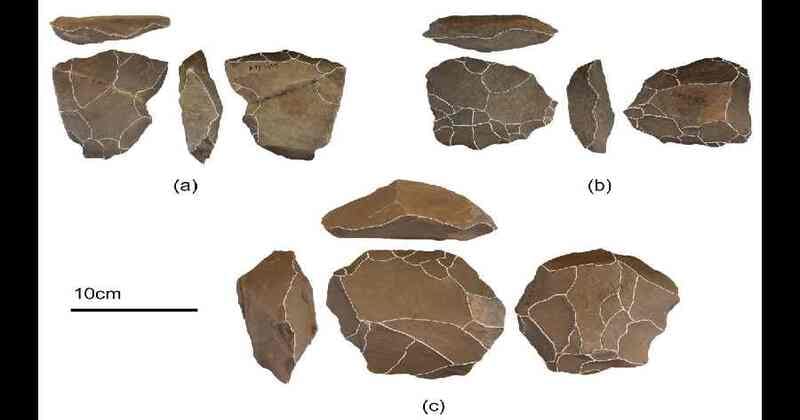
A sample of the tools from the Middle Stone Age site in Ratlepalle in Prakasam district of Andhra Pradesh

A sample of the tools from the Middle Stone Age site in Ratlepalle in Prakasam district of Andhra Pradesh

FacebookTwitterWhatsAppTelegramEmail

Archaeologists in Andhra Pradesh have unearthed stone tools that are 139,000 years old, challenging the long-standing notion that only modern humans were capable of producing such sophisticated implements. This find adds a new layer of mystery regarding the identity of the ancient toolmakers.

Excavations near the village of Retlapalle in Prakasam district have uncovered what are believed to be Middle Paleolithic stone tools. Archaeologists suggest that these tools support the theory that some extinct human ancestors were skilled in stone-making.

The collection of several hundred stones, shaped into oval, triangular, or pointed tools for use as blades, cutters, or scrapers, dates back to a period before Homo sapiens, or modern humans, migrated from Africa to South Asia.

Anil Devara, an assistant professor of archaeology at the Maharaja Sayajirao University, Baroda, who led the excavations, said, “The identity of the toolmakers in Retlapalle remains a mystery.”

The intrigue started to unfold almost twenty years ago when a different archaeological team found similar stone tools at Attirampakkam, a prehistoric site roughly 60 km west of Chennai. These tools were estimated to be between 372,000 and 170,000 years old.

Genetic evidence from over 25 years ago indicates that today’s global population descends from modern humans who migrated out of Africa between 60,000 and 70,000 years ago. However, an independent archaeological study conducted a decade ago at Jwalapuram in Andhra Pradesh uncovered stone tools dating back 77,000 years. This discovery has led some researchers to propose that the presence of Homo sapiens in India might extend as far back as 125,000 years. Researchers had earlier found even older stone tools in India.

Prehistorians Shanti Pappu and Kumar Akhilesh at the Sharma Centre for Heritage Education have discovered tools at Attirampakkam that are approximately 1.5 million years old. Additionally, a site in Karnataka has produced tools dating back around 1.2 million years. But researchers classify these older tools as “Acheulian” tools made by the extinct ancestral species called Homo erectus that once roamed across Africa and Asia between 1.6 million years ago to at least 250,000 years ago.

Devara noted, “Typical Acheulian tools, like hand axes or cleavers, are much larger and older compared to the Middle Paleolithic tools, which appeared much later.”

“In Middle Paleolithic tools, we observe signs of deliberate planning and shaping, a trait that was previously thought to have developed exclusively in Homo sapiens,” Devara explained. However, the Middle Paleolithic tools found at Retlapalle and Attirampakkam in India, along with similar discoveries in Europe, have cast significant doubt on the assumption that such tools only appeared after the arrival of modern humans.

Pappu, who has spent two decades studying the Attirampakkam site and was not involved with the Retlapalle findings, noted that the notable lack of fossilized remains of ancestral human species at these South Asian sites presents a significant challenge.

“Without bones, we can’t link these tools, whether from Attirampakkam or Retlapalle, to any specific species,” she explained. “The question of who made these tools remains unanswered.”

Also Read: Ancient Marvel Uncovered: 4,000-year-old stone cupules found in Tamil Nadu

Devara pointed out that increasing evidence indicates that similar Middle Paleolithic tools appeared around the same time in Africa, Europe, and South Asia before modern humans had reached Europe or Asia. “This suggests that the same tool-making technology may have evolved independently in different species—possibly among modern humans in Africa, Neanderthals in Europe, and perhaps other archaic human species in South Asia,” Devara said.

A skull found on the banks of the River Narmada in 1982, dated between 150,000 and 200,000 years ago, is currently the oldest ancient human fossil from India. Scientists attribute the scarcity of archaic human remains in South Asia to factors such as the region’s humid climate, frequent rains, the nature of the soil, and the limited funding for fossil excavation.


 

Topics: Andhra PradesharchaeologyAttirampakkam SiteStone tools unearthed
Share1TweetSendShareSend
✮ Subscribe Organiser YouTube Channel. ✮
✮ Join Organiser's WhatsApp channel for Nationalist views beyond the news. ✮
Previous News

META Confession: Big tech’s democratic subversion

Next News

When Dynasty is Above Democracy: From Sheikh-Nehru to Omar-Rahul on Jammu-Kashmir & 370

Related News

TTD orders investigation into the fake silk shawls (Source: Telugu Times)

Scam at TTD: Fake polyester dupattas billed as pure mulberry silk, causing losses of over Rs 54 crore

Representational image - Security forces in Maoists hit areas

Andhra Pradesh: Atleast 6 Maoists killed in exchange of fire; 50 arrested

Visakhapatnam is poised to embark on a new phase in India’s digital evolution

Big step by Google in Vizag towards a Digital and Viksit Bharat

(Left) Karnataka CM Siddaramaiah (Right) Memorandum of Understanding (MoU) for the AI hub was signed in the presence of Chief Minister N. Chandrababu Naidu, Andhra Pradesh IT Minister Nara Lokesh, and Google Cloud CEO Thomas Kurien

Karnataka misses $15 billion google AI hub as Visakhapatnam emerges India’s new digital capital

IREF director Emmanuel Rebba with YS Jagan Mohan Reddy, former CM of Andhra Pradesh (file Photo)

Andhra Pradesh: MHA suspends FCRA licence of IREF, NGO tied to Christian conversions for decades, after LRPF complaint

Inscriptions of Gajapati Kapilendra Deva in Odia found at Srikurmam Mandir

Echoes of Kalinga: First Odia inscriptions of Gajapati Kapilendra Deva discovered at Srikurmam Mandir in Andhra Pradesh

Load More

Comments

The comments posted here/below/in the given space are not on behalf of Organiser. The person posting the comment will be in sole ownership of its responsibility. According to the central government's IT rules, obscene or offensive statement made against a person, religion, community or nation is a punishable offense, and legal action would be taken against people who indulge in such activities.

Latest News

Prime Minister Narendra Modi and US President Donald Trump

PM Modi-President Trump phone call: Underscores strategic pragmatism by India and geopolitical rectification by the US

RSS Sarsanghchalak Dr. Mohan Bhagwat unveiled the grand statue of Swatantrayaveer Savarkar and inaugurated the ‘Veer Savarkar Prerna Park’ in the Andaman and Nicobar Islands.

Legacy of Veer Savarkar calls for unity, not division: RSS Sarsanghchalak Dr Mohan Bhagwat at Andaman

Representative Image

India and Greece holds maiden Maritime Security Dialogue; Explores deeper cooperation across key sectors

First digital Census in 2027: Cabinet clears Rs 11,718-crore plan, caste enumeration included

Representative Image of Maoists

Chhattisgarh: 10 Maoists carrying cumulative reward of Rs 33 lakhs surrender in Sukma

Union Home Minister Amit Shah

Amit Shah calls Andamans ‘sacred land of sacrifice’ as Port Blair marks 115 years of Savarkar’s ‘Sagara Pran Talmalala’

Accused in the Zubeen Garg murder case

Zubeen Garg Murder Case: Assam police SIT submits 2500 pages chargesheet; Invokes murder charges against 4 accused

Lieutenant Governor Manoj Sinha handed over appointment letters to 41 Next of Kins (NoKs) of victims of terrorism

J&K: LG hands over compassionate appointment letters to next of kins of terror victim families

Former Pakistan ISI Chief Faiz Hameed

Authoritarian rule of Pakistan military continues: Former ISI Chief Faiz Hameed sentenced to 14 years imprisonment

Jal Shakti Minister C.R. Patil Launches Sujalam Bharat App

Jal Shakti Minister launches Sujalam Bharat App to transform digital governance of rural water supply across Bharat

Load More
  • Privacy
  • Terms
  • Cookie Policy
  • Refund and Cancellation
  • Delivery and Shipping

© Bharat Prakashan (Delhi) Limited.
Tech-enabled by Ananthapuri Technologies

  • Home
  • Search Organiser
  • Bharat
    • Assam
    • Bihar
    • Chhattisgarh
    • Jharkhand
    • Maharashtra
    • View All States
  • World
    • Asia
    • Africa
    • North America
    • South America
    • Europe
    • Australia
  • Editorial
  • Operation Sindoor
  • Opinion
  • Analysis
  • Defence
  • Culture
  • Sports
  • Business
  • RSS @ 100
  • Entertainment
  • More ..
    • Sci & Tech
    • Vocal4Local
    • Special Report
    • Education
    • Employment
    • Books
    • Interviews
    • Travel
    • Health
    • Politics
    • Law
    • Economy
    • Obituary
  • Subscribe Magazine
  • Read Ecopy
  • Advertise
  • Circulation
  • Careers
  • About Us
  • Contact Us
  • Policies & Terms
    • Privacy Policy
    • Cookie Policy
    • Refund and Cancellation
    • Terms of Use

© Bharat Prakashan (Delhi) Limited.
Tech-enabled by Ananthapuri Technologies