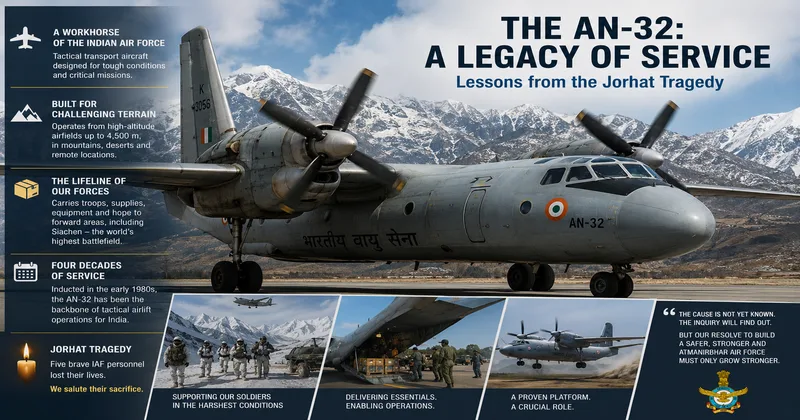
The crash of an Indian Air Force (IAF) AN-32 aircraft during a routine sortie near Jorhat in Assam, claiming the lives of five Air Warriors, including two officers, has once again brought national attention to one of the most enduring workhorses of Bharat’s military aviation fleet. As the Air Force has rightly ordered a Court of Inquiry, it is important to state at the outset that the cause of the accident remains unknown. Until the investigation is completed, assigning blame to pilots, maintenance personnel, weather conditions or the aircraft itself would be both premature and irresponsible.
Yet, while the immediate cause of the tragedy awaits investigation, the accident has revived a larger and more enduring conversation about the aircraft at the centre of the incident—the AN-32—and its place in Bharat’s defence preparedness.
The aircraft that built Bharat’s logistic backbone
Unlike fighter aircraft that dominate headlines and air shows, transport aircraft perform a quieter but equally critical role. They carry troops, ammunition, food, fuel, medicines, engineering equipment and relief supplies to some of the most inaccessible corners of the nation. In a country defined by extreme geography—from the icy heights of the Himalayas to the deserts of Rajasthan and the dense forests of the Northeast (Ishan Pradesh)—military transport aircraft are not merely machines; they are lifelines.
The AN-32 was developed specifically to meet the operational requirements of the Indian Air Force. Based on the Soviet-era AN-26 platform but equipped with more powerful engines and enhanced performance characteristics, it was designed to operate in conditions where many conventional aircraft would struggle. Its ability to fly from short and semi-prepared runways, function in hot climates and operate at high-altitude airfields made it uniquely suited to Bharat’s strategic environment.
For decades, the AN-32 has been one of the principal logistical arteries connecting remote military outposts with the rest of the country. Nowhere is this more evident than in Siachen, world’s highest battlefield. At such altitudes, logistics is not merely a matter of convenience—it is a matter of survival. Every kilogram of food, fuel, medical supplies, winter clothing and ammunition must be transported through a complex chain of air and ground operations. The AN-32 has played an indispensable role in sustaining these deployments.
In many ways, it has been the Indian Air Force’s equivalent of a working-class soldier: reliable, rugged and often unnoticed despite carrying some of the heaviest burdens.
A legacy marked by service—and concern
However, the AN-32’s story is not one of service alone. It is also a story marked by recurring safety concerns and a history of accidents that have periodically raised questions about the fleet’s future.
Over its decades of operation, the aircraft has been involved in several major accidents. Some occurred in difficult terrain, others during adverse weather conditions and still others under circumstances that varied considerably. Each accident had its own causes and operational context. Nevertheless, the cumulative effect of these incidents has ensured that every subsequent AN-32 accident attracts significant public attention.
Among the most notable tragedies were the 1986 crash in Jammu and Kashmir, the 1999 accident near Delhi, the 2009 crash in Arunachal Pradesh, the disappearance of an aircraft over the Bay of Bengal in 2016, and the 2019 loss of another AN-32 shortly after take-off from Jorhat. These incidents collectively contributed to a growing debate about fleet ageing and aviation safety. The latest tragedy has inevitably reopened these discussions.
Military necessity versus fleet ageing
The central question facing Bharat today is not whether the AN-32 has served the nation well. Its record in sustaining military operations across difficult terrain answers that question decisively. The real issue is how long an aircraft originally inducted decades ago can continue meeting modern operational and safety expectations.
This is not a challenge unique to Bharat. Armed forces around the world routinely grapple with the dilemma of balancing operational necessity against ageing equipment. Replacing an aircraft fleet is neither simple nor inexpensive. New platforms require procurement, infrastructure development, pilot conversion, maintenance ecosystems, spare-part chains and years of operational integration.
Recognising these realities, Bharat did not ignore concerns surrounding the AN-32 fleet. Following a series of accidents, particularly after 2009, the government approved a comprehensive modernisation programme. More than one hundred aircraft underwent upgrades involving avionics, navigation systems, communications equipment, engines and structural improvements. Emergency locator transmitters were also added to improve post-crash search and rescue capabilities.
These measures reflected a recognition that while the aircraft remained operationally valuable, safety and survivability had to be enhanced. However, modernisation can extend the life of an aircraft; it cannot make it immortal.
The search for a successor
The challenge facing policymakers and military planners today is therefore larger than a single accident investigation. Bharat’s expanding strategic responsibilities demand a transport fleet that is both reliable and capable of operating in diverse environments.
An important part of this transition is already underway. The Airbus C-295 transport aircraft, being manufactured in Vadodara, Gujarat, through the Tata-Airbus partnership, represents a significant step in Bharat’s defence modernisation and self-reliance journey.
While the C-295 is not a direct one-for-one replacement for every mission currently performed by the AN-32, it offers modern avionics, improved maintainability and a long-term production ecosystem within the country. More importantly, the programme is helping create an indigenous aerospace manufacturing base capable of supporting future military aviation requirements. In strategic terms, the significance of the C-295 lies not only in replacing ageing aircraft but also in strengthening Bharat’s ability to build, maintain and sustain critical defence platforms at home.
The Indian Air Force has already begun modernising parts of its transport inventory through aircraft such as the C-130J Super Hercules and the C-17 Globemaster III. However, these platforms occupy different operational niches and cannot simply replace the AN-32 on a one-for-one basis.
What Bharat ultimately requires is a comprehensive transition plan that ensures continuity of tactical airlift capability while gradually reducing dependence on ageing fleets. Such a transition must be driven not by emotional reactions to individual accidents, but by long-term strategic planning, industrial capability, operational requirements and financial realities. The objective should be neither to prematurely discard a useful platform nor to indefinitely postpone difficult modernisation decisions.
Beyond the headlines
The Jorhat crash is first and foremost a human tragedy. Five Air Warriors lost their lives in the service of the nation. Their sacrifice deserves remembrance, respect, and gratitude. But beyond the tragedy lies a larger story—one that reflects the complexities of military logistics, the challenges of operating across some of the world’s most difficult terrain and the difficult choices that every armed force must make regarding ageing equipment.
Until the Court of Inquiry completes its work, speculation serves no purpose. Facts, not assumptions, must guide public discussion. Yet one conclusion is already clear: the AN-32 occupies a unique place in Bharat’s military history. For decades it has connected remote outposts, sustained troops in hostile environments and quietly enabled countless missions that rarely make headlines. The aircraft’s legacy is therefore neither one of failure nor of perfection. It is a legacy of service.
The real question raised by the Jorhat tragedy is not simply why one aircraft crashed. It is how Bharat can continue to preserve the operational advantages that the AN-32 provides while ensuring that the men and women who fly these missions are equipped with the safest and most capable platforms possible.