When Dynasty is Above Democracy: From Sheikh-Nehru to Omar-Rahul on Jammu-Kashmir & 370
August 5, 2026
  • Read Ecopy
  • Circulation
  • Advertise
  • Careers
  • About Us
  • Contact Us
Android AppiPhone AppArattai
Organiser
  • ‌
  • Bharat
    • Assam
    • Bihar
    • Chhattisgarh
    • Jharkhand
    • Maharashtra
    • View All States
  • World
    • Asia
    • Europe
    • North America
    • South America
    • Africa
    • Australia
  • Editorial
  • International
  • Opinion
  • RSS @ 100
  • More
    • Op Sindoor
    • Analysis
    • Sports
    • Defence
    • Politics
    • Business
    • Economy
    • Culture
    • Special Report
    • Sci & Tech
    • Entertainment
    • G20
    • Azadi Ka Amrit Mahotsav
    • Vocal4Local
    • Web Stories
    • Education
    • Employment
    • Books
    • Interviews
    • Travel
    • Law
    • Health
    • Obituary
  • Subscribe
    • Subscribe Print Edition
    • Subscribe Ecopy
    • Read Ecopy
  • ‌
  • Bharat
    • Assam
    • Bihar
    • Chhattisgarh
    • Jharkhand
    • Maharashtra
    • View All States
  • World
    • Asia
    • Europe
    • North America
    • South America
    • Africa
    • Australia
  • Editorial
  • International
  • Opinion
  • RSS @ 100
  • More
    • Op Sindoor
    • Analysis
    • Sports
    • Defence
    • Politics
    • Business
    • Economy
    • Culture
    • Special Report
    • Sci & Tech
    • Entertainment
    • G20
    • Azadi Ka Amrit Mahotsav
    • Vocal4Local
    • Web Stories
    • Education
    • Employment
    • Books
    • Interviews
    • Travel
    • Law
    • Health
    • Obituary
  • Subscribe
    • Subscribe Print Edition
    • Subscribe Ecopy
    • Read Ecopy
Organiser
  • Home
  • Bharat
  • World
  • Operation Sindoor
  • Editorial
  • Analysis
  • Opinion
  • Culture
  • Defence
  • International Edition
  • RSS @ 100
  • Magazine
  • Read Ecopy
Home Politics

When Dynasty is Above Democracy: From Sheikh-Nehru to Omar-Rahul on Jammu-Kashmir & 370

The history of Jammu & Kashmir under the Nehru-Sheikh Abdullah alliance highlights the dangers of prioritising personal relationships over national interests. With the new partnership between Rahul Gandhi and Omar Abdullah, terrorism, corruption, and dynastic politics that emerged from the earlier alliance now threatens to derail the good work done by the Modi Government

Yatharth SikkaYatharth Sikka
Sep 2, 2024, 08:00 pm IST
inPolitics, Bharat, Special Report, Jammu and Kashmir
Follow on Google News
Facebook
Twitter
WhatsAppTelegramEmail

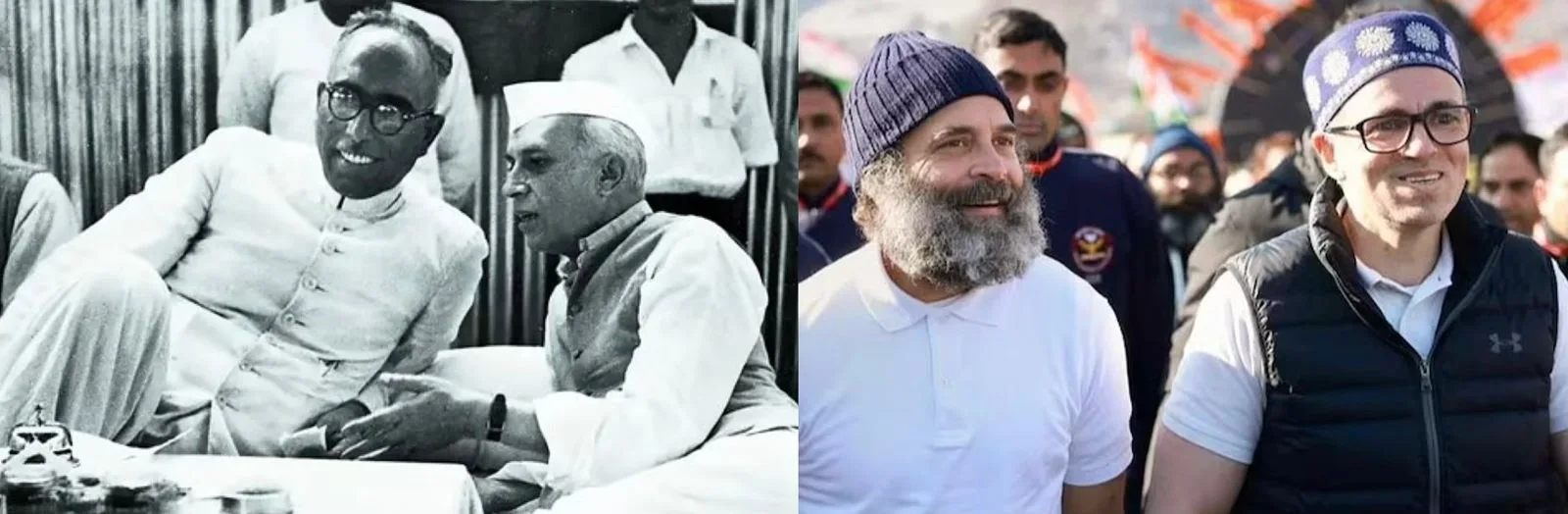
If one looks at the past, the history of Jammu & Kashmir deeply revolves around the friendship of Jawaharlal Nehru and Sheikh Abdullah. Their personal friendship and political alliance, which shaped the early years of the State are often cited as the reason why Kashmir fell into a spiral of terrorism, corruption, and dynastic politics. From the controversial decision to implement Article 370 and Article 35A to the enduring political influence of the Abdullah and Nehru families, the seeds sown by them continue to give bitter fruit in Kashmir. The brand new alliance between Rahul Gandhi’s Congress and Omar Abdullah’s National Conference (NC), is more problematic for the national integrity as NC has promised to restore Article 370 and 35A, if it returns to power. This will take back Kashmir to the troubled State it was in during the regime of Nehru and Sheikh Abdullah.

Friendship dangerous for Bharat

Nehru, who saw a spirit of secularism and socialism in Sheikh Abdullah, supported him to rose to power in Kashmir, side-lining the legitimate ruler Maharaja Hari Singh. The Instrument of Accession signed by Maharaja Hari Singh in 1947, was meant to integrate Kashmir into Bharat while allowing its autonomy in certain areas. However, Nehru’s insistence on Article 370, which granted special status to Jammu and Kashmir, created a legal barrier between Kashmir and the rest of the country. Sheikh Abdullah, who became the Prime Minister of Kashmir, used Article 370 and Article 35A as tools to maintain his political dominance, ensuring that Kashmir remained under his control rather than a fully integrated part of Bharat.

The autonomy granted under Article 370 allowed corruption and nepotism in Kashmir’s political system. Abdullah’s NC turned Governance into a family affair. This laid the foundation for dynastic politics that continue to plague Kashmir, where political power is passed like an inheritance property rather than in a democratic way.

The seeds of discontent with Nehru-Abdullah’s Kashmir policy were evident in the early 1950s with the rise of the Praja Parishad movement. The Praja Parishad, a political party in J&K opposed Article 370 and demanded the full integration of the State with India. The movement gained momentum as it became clear that Article 370 was being used not to protect the unique identity of Kashmir but to shield Sheikh Abdullah’s autocratic rule.

The Nehru-Abdullah friendship laid the foundation for the dynastic politics that continue to plague Kashmir, where political power is passed like an inheritance property

Kashmiris soon realised that Article 370 had nothing to do with the federal Constitution. Sheikh Abdullah initially brainwashed Nehru into believing that it was at his behest that the Muslims of the State had embraced India instead of the Islamic country of Pakistan. Nehru began to accept his baseless assumption and continued to maintain their friendship.

Rather than engaging with the legitimate concerns of the Praja Parishad, Nehru sided with Abdullah, even rejecting the nomination papers of 13 of its candidates in the 1951 elections. This decision further reinforced the perception that Nehru prioritised his friendship with Abdullah over the interests of the State.

Article 370 and 35A: Tools of Division and Corruption

Implementation of Article 370 and 35A not only created a constitutional barrier between Kashmir and the rest of India, but also resulted in corruption and unaccountability in the State’s administration. These articles allowed Jammu and Kashmir to have its own Constitution and flag, fostering a political environment dominated by the Abdullah and Nehru families. This set-up prioritised the interests of these two families over the development of the State. Instead of fostering progress, the special status facilitated nepotism, political favouritism and inequality, worsening the condition of the State. The meaning of the development was to preserve the power and privileges of separatists rather than addressing the needs of the general public.

The Article 35A, which gave the State the right to determine who is a permanent resident of the State, was not inserted into the Constitution by an amendment passed by the Parliament. It was inserted by the President following the advice of Jawaharlal Nehru in the Constitution on May 14, 1954, by issuing a similar order, using the powers granted to the President by Article 370 of the Constitution. This deprived the people of Jammu and Kashmir of the full benefits offered by the Constitution of Bharat, including representation and reservations for Scheduled Castes (SC) and Scheduled Tribes (ST). Notably, Congress these days is fighting elections across the country, alleging that BJP will finish the reservation. In contrast, it is in alliance with the National Conference, which had said in its manifesto to restore 35A, which will take away all the benefits from SCs and STs granted under the Constitution of Bharat.

Breeding ground for terrorists

The rise of terrorism in Kashmir was the result of the policies of Nehru and Abdullah. Political instability and a lack of economic opportunities in the State, with the inclusion of corruption and dynastic rule made Kashmir a breeding ground for Islamists. The insurgency that erupted in the 1990s was not only fueled by external factors like Pakistan but also by decades of misgovernance under the Nehru-Abdullah regime. The insurgency, which has claimed thousands of Hindu lives is a tragic reminder of the long-term consequences of this alliance. The failure to fully integrate Kashmir into Bharat coupled with the misuse of Articles 370 and 35A further nurtured separatist elements.

A New Dawn for Kashmir

The abrogation of Article 370 and 35A by the Narendra Modi Government on August 5, 2019, marked a significant turning point in Kashmir’s history. The decision, which brought Jammu and Kashmir fully under the purview of the Indian Constitution, was seen by many as the fulfillment of a long-standing demand. The abrogation of Article 370 and 35A has also opened up new opportunities for the region. With the removal of the special status, the Union Government has been able to push forward with much-needed reforms in the State, including the implementation of anti-corruption measures, reservation policy, infrastructure development, etc. The return of normalcy to the region, with a reduction in terror activities and an increase in tourism, is a testament to the positive impact of these changes.

Congress-NC Alliance: Threat of a Return to Old Order

The alliance between the Rahul Gandhi, great-grandson of Pt. Nehru, and Omar Abdullah, grandson of Sheikh Abdullah, has raised concerns among those who fear that these parties, if they come to power, will undo the progress made in recent years. The National Conference has made it clear in its manifesto that it intends to restore Article 370, a move that would effectively reverse the gains made since its abrogation. It has also promised the release of political prisoners (separatists). This alliance between the new generation dynasts of Congress and National Conference is viewed by many as an attempt only to regain power rather than to offer a vision for Kashmir’s future.

The new partnership between the Nehru-Abdullah families could lead to a resurgence of corruption and anarchy that have plagued Kashmir for decades, as well as a potential revival of separatist sentiments and terrorism. As Jammu and Kashmir stand at a crossroads with the potential for a new era of peace and development, it is crucial that the lessons of the past are not forgotten in the upcoming elections.


Topics: Article 370Jammu & Kashmir370 and 35AJawaharlal Nehru Sheikh AbdullahOmar Abdullah- Rahul GandhiPakistan
Yatharth Sikka
Yatharth Sikka
Yatharth Sikka is a PhD Research Scholar and a dynamic media professional, working as an Anchor, Writer, Researcher, and Voice-Over Artist. He has also served as a Research Assistant for two books and has produced one documentary, adding depth and scholarly rigour to his journalistic work. As one of the emerging young voices in Indian media, Yatharth extensively covers political and socio-cultural issues with a strong focus on North India — Punjab, Jammu & Kashmir, Haryana, Delhi, and Himachal Pradesh. His storytelling reflects a keen interest in the intersections of politics, sports, society, and everyday life, decoding how policy and power shape public experiences. He has conducted interviews with prominent political leaders, sportspersons, film figures, and cultural commentators, bringing authentic ground-level perspectives to his audience. Yatharth has participated in several national and international conferences and seminars, further strengthening his academic engagement and research capabilities. Combining research-backed analysis with sharp on-ground reporting, Yatharth continues to contribute to contemporary Indian journalism and Research Field. [Read more]
Share
Tweet
SendShareSend
✮ Subscribe Organiser YouTube Channel. ✮
✮ Join Organiser's WhatsApp channel for Nationalist views beyond the news. ✮
Previous News

Andhra Pradesh: Archaeologists unearth 139,000-year-old tools that draw parallels to modern craftsmanship

Next News

Haryana Assembly Elections: Heading for new equations

Related News

Pakistan Tightens Media Censorship: Foreign Journalists Need NOC to Report Beyond Major Cities (This image is generated by AI)

Pakistan moves to silence global media after PoJK crackdown: NOCs mandatory for foreign journalists

Police in J&K’s Ramban detained 21 suspected Bangladeshi nationals during a verification drive

J&K: 21 suspected Bangladeshi nationals detained in Ramban during verification drive, six more held in Delhi

August 5 Milestones: Article 370 revocation and Ram Mandir Bhoomi Pujan

Kashmir Unbound: A New Dawn After Article 370

Representative Image

Pakistan’s UNSC push on Indus Waters Treaty faces legal dead end as India stands firm on bilateral framework

Pakistan PM Shahbaz Sharif (Right)

Pakistan reportedly blocks Al Jazeera after PoJK election coverage, accuses network of “yellow journalism”

Load More

Latest News

Zuckerberg Apologises Over PM Modi Video, Meta Faces Fresh Scrutiny

Meta under fire over content manipulation: Mark Zuckerberg apologises over PM Modi video row, CSAM & deepfake lapses

The Amritsar arrests expose a troubling new face of proxy warfare, low-cost, digitally recruited and built around vulnerable young recruits (AI generated image)

Amritsar Arrests Expose the New Face of Proxy War: Petrol bombs, online handlers & vulnerable teen recruits

CPM cadre convicted by Court

Keralam: CPM cadres get 16-year jail term for bid to murder RSS karyakartas in 2018 Panoor case

Tamil Nadu Finance Minister N. Marie Wilson presented the first Budget of the TVK government in Assembly on August 5, 2026

Tamil Nadu: TVK’s first Budget projects Rs 16,000 crore additional revenue, announces welfare push

India’s global crackdown on fugitives has intensified, with 274 offenders brought back from 36 countries since 2019 (AI generated image)

From Vijay Mallya to Tahawwur Rana: India’s global pursuit of fugitives brings 274 offenders back from 36 countries

SDPI National General Secretary Riyaz Parangipete

Karnataka Hate Speech Case: SDPI’s Riyaz Parangipete convicted in 11-year-old case, PFI links back in focus

Press breifing by Adilabad SP Akhil Mahajan, IPS

Telangana: Bangladeshi nationals arrested in Adilabad; police expose cross-border burglary network active since 2015

India’s laws allow police to use proportionate force against unlawful assemblies, subject to legal safeguards

Use of Force by Police: Understanding the law beyond the controversy

I.I.M.U.N. founder Rishabh Shah (Left), RSS Sarsanghchalak Dr Mohan Bhagwat (Right)

‘Not the first time’: RSS Sarsanghchalak Dr Bhagwat returns to I.I.M.U.N. to engage with Gen Z & Gen Alpha in Mumbai

Varanasi is set to welcome a spectacular cricket stadium blending modern sports infrastructure with Kashi’s timeless spiritual identity (AI generated image)

Varanasi: Bhagwan Shiva-inspired cricket stadium set to blend Kashi’s spiritual heritage with modern sporting grandeur

Load More
  • Privacy
  • Terms
  • Cookie Policy
  • Refund and Cancellation
  • Delivery and Shipping

© Bharat Prakashan (Delhi) Limited.
Tech-enabled by Ananthapuri Technologies

  • Home
  • Search Organiser
  • Bharat
    • Assam
    • Bihar
    • Chhattisgarh
    • Jharkhand
    • Maharashtra
    • View All States
  • World
    • Asia
    • Africa
    • North America
    • South America
    • Europe
    • Australia
  • Editorial
  • Operation Sindoor
  • Opinion
  • Analysis
  • Defence
  • Culture
  • Sports
  • Business
  • RSS @ 100
  • Entertainment
  • More ..
    • Sci & Tech
    • Vocal4Local
    • Special Report
    • Education
    • Employment
    • Books
    • Interviews
    • Travel
    • Health
    • Politics
    • Law
    • Economy
    • Obituary
  • Subscribe Magazine
  • Read Ecopy
  • Advertise
  • Circulation
  • Careers
  • About Us
  • Contact Us
  • Policies & Terms
    • Privacy Policy
    • Cookie Policy
    • Refund and Cancellation
    • Terms of Use

© Bharat Prakashan (Delhi) Limited.
Tech-enabled by Ananthapuri Technologies