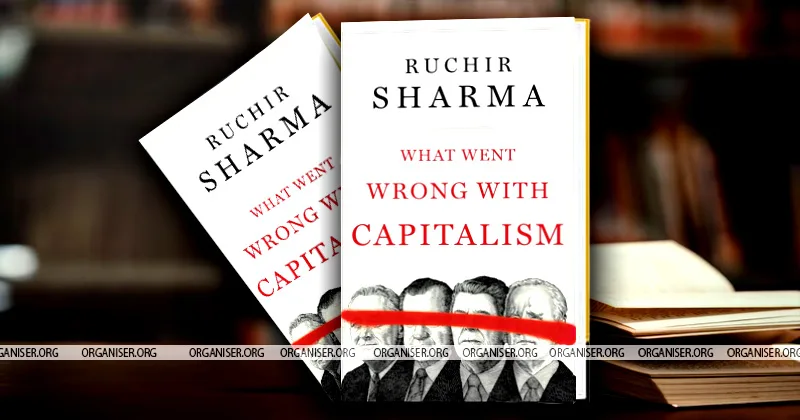
The pre-eminent problem facing nearly all Western liberal democracies in the 21st century—this is one way to put it, is that their political leaders have become pathologically obsessed with mitigating risk. Risk means that something could go wrong and that somebody gets the blame when things do go wrong. The problem, as we learned during the recent pandemic, is that risk mitigation can bring about more damage than the thing you wanted to avoid.
What went wrong with Capitalism? Ruchir Sharma’s explanation is unlike any you have heard before. Progressives are partly right when they mock modern Capitalism as “socialism for the rich.” Still, in recent decades, Governments in developed nations expanded in just about every measurable dimension, from spending and regulation to the sheer scale of its rescues each time the economy wobbled. The result, Sharma says, is “socialised risk,” expensive government guarantees for everyone―welfare for the poor, entitlements for the middle class, and bailouts for the rich.
Voters say they are disillusioned with Capitalism, but a system distorted by government interventions is a dysfunctional version of free market ideals. As a result, productivity and economic growth have slowed sharply, shrinking the pie for everyone and stoking popular anger. Since these flaws developed as the government expanded, building an even bigger state will only double down on what’s gone wrong. The answer Sharma offers is a series of seven fixes to restore the balance between state support and free markets and lay the path to a more prosperous and happier future.
Sharma’s answer to the question posed in the title of his engaging book is beguilingly simple: easy money. In the US, low interest rates made money cheap, and from this followed all the ills of Capitalism. Low interest rates became the solution to every problem. Governments found it cheap to borrow. Except for a brief period under Bill Clinton, no government retrenched spending. So, debt became a problem. The political choices in the US are tax cuts and increased spending (Republicans) or tax and increased spending (Democrats). The Keynesian intuition that government spending should be counter-cyclical was replaced by a ‘permanent stimulus’ philosophy.
In his farewell address, Ronald Reagan described America as the “shining city on a hill”, open to “anyone with the will and heart to get here”. I was inspired to try, and today, the dynamic mix of academics and entrepreneurs who energise the world’s technology leader still strikes me as a marvel. Of the top 100 US companies, 10 now have chief executives born in India, a breakthrough that could have happened only in a capitalist meritocracy.
Nonetheless, I worry about where the US is leading the world now. Faith in American Capitalism, built on limited government that leaves room for individual freedom and initiative, has plummeted. Most Americans don’t expect to be “better off in five years” — a record low since the Edelman Trust Barometer first asked this question more than two decades ago.
Sharma makes a good beginning by narrating the sob story of the Indian middle class, how he grew up in the maximum security prison of socialism of pre-1991 India, and how he escaped the welfare state gulag and escaped to the free market Singapore and then to the capitalist paradise, the United States. This book is a guided tour of the back alleys of Capitalism, especially in the financial sector, a far cry from the poor, from the inequality debate et al.
In India, as there were once fanatical socialist evangelists, there are now cringing market fundamentalists who cannot see the Titanic of Capitalism moving towards the iceberg. They refuse to see the iceberg. And what is the iceberg? The expanded role of the state in the market economies, as well as the bailout packages that central banks work out to save the private companies caught in a market storm, Sharma sums it up all in non-threatening prose. He writes towards the end: “It makes intuitive and moral sense that when a nation’s government accounts for more than half of all spending in the economy or takes more than half of an individual’s income in taxes, that nation is getting less free.”
This is the state of affairs not so much in the developing and emerging market economies but in advanced economies like the United States, the European Union and Japan. The startling, and perhaps not so startling, news is the existence of “zombie” companies, which do not produce anything useful and do not earn profits because of the easy loans provided by banks and the bailout packages that follow to save those companies. They were first detected in Japan, and then it was found that they also exist in Europe and America.
Sharma finds the role of governments intervening to save private sector companies to protect national economies counterproductive, and along with greater state spending on welfare programmes, harmful. The critics of Capitalism would point to the evil of welfare measures, and the critics will point an accusing finger at the bailout packages. Sharma shows the expanded role of the state and the dependence of the people and private companies on the state to be the canker in the system of Capitalism.
Capital became ill-disciplined and grossly misallocated. The price of keeping zombie firms alive dropped. Reality-distorting valuations of unicorns became the norm. Cheap money created asset bubbles, which fuelled deep inequality and capital concentration. Prices were distorted. Finance began to dominate the economy. Finance also distorted the moral compass: the best and brightest were now manipulating complex spreadsheets instead of figuring out productivity-enhancing innovations.
Meanwhile, all these were being done in the name of the poor. Raising interest rates, they intoned, would hurt the poor. Never mind that those without good credit scores still faced usury-like conditions on borrowing. Low inflation and price stability are generally a good thing. However, no consideration was given to how asset bubbles adversely affected the poor. Low interest rates became a civic religion; with a few exceptions, both the Right and the Left jumped on the bandwagon of easy money.
Sharma provides a panoramic view of how the markets have been working in the West and how the benevolent role of the states in the market system has weakened the ligaments of the people. He refers to the “revolution of pain management” which the Western states have mastered through bailout packages instead of letting the people and the companies feel the pain of the boom-bust natural cycle. He says that young people today do not believe in the government’s false promise of endless economic growth and are aware of the natural limits.
The book mentions but underplays the effect of lobbying, as the vast political science literature has demonstrated. The jeremiad against socialising risks is well-taken. But just as monetary policy became a blunt catch-all instrument, so has the critique of the welfare state.
A more honest appraisal of the permanent growth of the state would look at not just an aggregate size but a deep dive into different forms of welfare. Or, take the three areas where the American economy produces distorted outcomes: housing, health and education, which account for close to 40 per cent of GDP. Some of the distortions in this area have to do with easy money but a lot with the political economy of interest groups. The one abiding lesson of the last three decades is that well-run Capitalism needs immense nuance, not intellectual fads. The easy money thesis may also risk going from analytical insight to a fad, an easy explanation.
Capitalism is meant to go through cycles — creative destruction and downturns that weed out the inefficient. However, the promise of recession-proof economies meant that the Darwinian process of natural selection was stopped. We became infantile, insuring against every risk. And when you insure against every risk, an even worse horror follows — an overbearing regulatory state that has sapped American productivity. The successive chairs of the Federal Reserve that have ruled the world economy for the last 30 years, Alan Greenspan, Ben Bernanke, Janet Yellen and Jerome Powell, are not knights in shining armour. They are, instead, like the doctors who make us dependent on opioids — unable to cure the underlying disease, the addiction to easy money is wasting away the economy.
Sharma’s accessible and engaging book is now joining a growing chorus. Edward Chancellor’s The Price of Time: The Real Story of Interest (2022) made this case with immense depth and historical sophistication; Christopher Leonard’s The Lords of Easy Money (2022) told this story through the drama of central bankers.
Sharma’s critique of the over-bureaucratised state rings true, and the risks of Bidenomics are well worth attending to. The lessons-to-be-drawn list is a bit odd: holding up Switzerland, Taiwan and Vietnam as economies to be emulated. There is a hint of a radical idea in the book that the US should get used to permanently slower growth instead of pump-priming growth.
Sharma paints a vivid picture of the story of market crises, especially the 2008-09 financial markets meltdown — which the blinkered Indian market economists refuse to acknowledge — and the saga of bailout packages in America from the 1970s onwards — and how the so-called neoliberal Reagan revolution of rolling back the state only managed to increase budget deficit! The lesson: Something wrong with Capitalism. The answer, of course, is not socialism.