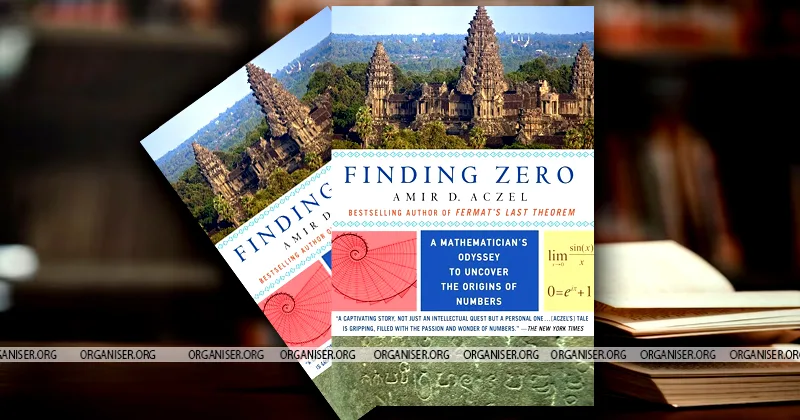
I recently read Finding Zero: A Mathematician’s Odyssey to Uncover the Origins of Numbers by Amir D. Aczel. The book immediately attracted my attention because zero is not just an ordinary number. It is one of the most important ideas in the history of mathematics and its development completely changed the way humans perform calculations and understand numbers. Before reading this book, I was already interested in the history of Indian mathematics, particularly the development of zero, so I expected the book to give me a detailed historical and mathematical explanation of how zero originated.
However, after reading it, I found that Amir D. Aczel presents the subject in a somewhat different way. His book is not simply a mathematical history of zero; it is a combination of mathematics, archaeology, travel, culture, philosophy, and the author’s own personal experiences.
One of the most interesting features of Finding Zero is the way Aczel presents his investigation as a personal journey. Instead of simply discussing ancient manuscripts and mathematical texts from a distance, he travels to different countries and historical locations in search of evidence related to the earliest use of zero. A considerable part of the book describes his journeys through Cambodia, Thailand, Myanmar, India and other parts of Southeast Asia.
He describes temples, monuments, landscapes, local people, monks, historical inscriptions and archaeological sites. I found these descriptions interesting because they helped me imagine the historical environment in which ancient numerical ideas developed. At the same time, I sometimes felt that these travel descriptions became so extensive that they moved the focus away from the mathematical history of zero.
For me, this is one of the main characteristics of Aczel’s writing. He writes more like an explorer searching for an ancient mystery than like a historian presenting a systematic mathematical history. The title itself, Finding Zero, reflects this approach. Aczel is not merely explaining zero; he is physically and intellectually searching for evidence of its origins. This makes the book very readable and gives it an adventurous quality. However, for a reader particularly interested in the mathematical development of zero, some parts can feel less focused.
A major theme that I noticed throughout the book is the relationship between the mathematical idea of zero and the philosophical idea of emptiness. Aczel gives considerable attention to Buddhist philosophy, especially the concept of Sunyata, or emptiness. During his discussions of Cambodia and other parts of Southeast Asia, he connects ideas of emptiness, nothingness, impermanence, and the absence of inherent existence with the development of the concept of zero. He describes Buddhist monasteries, monks, meditation, and philosophical teachings to explain the cultural background surrounding these ideas.
I found this philosophical discussion interesting because it raises an important question: can a philosophical understanding of “nothingness” be related to the mathematical concept of zero? The two ideas are certainly related at a broad conceptual level, but I felt that Aczel sometimes gives the philosophical connection more importance than the direct historical evidence supports. The mathematical zero is a specific numerical concept with a particular role in positional notation and arithmetic, whereas Buddhist Sunyata is a much broader philosophical idea. Therefore, although I found the connection intellectually interesting, I would be careful about treating Buddhist philosophy as the direct origin of mathematical zero.
Aczel also introduces the work of the great Buddhist philosopher Nagarjuna. Nagarjuna’s philosophy of emptiness is important for understanding the intellectual background of Buddhist thought, and Aczel uses it to discuss the relationship between emptiness and the idea of zero. However, while reading these sections, I sometimes felt that Nagarjuna’s inclusion was more philosophical and thematic than directly connected to the historical development of the mathematical zero. The fact that a culture has a philosophical concept of emptiness does not automatically demonstrate that it developed the mathematical symbol or numerical operation of zero from that philosophy.
Another important person in Aczel’s investigation is the French scholar Georges Coedes. Aczel follows the intellectual trail created by Coedes, particularly his study of inscriptions from Southeast Asia. This part of the book gives the narrative an archaeological character. Aczel attempts to retrace the historical evidence and understand the importance of ancient Khmer inscriptions in the development of zero. His investigation eventually brings considerable attention to the K-127 Khmer inscription, which contains an early zero symbol.
The K-127 story is one of the most exciting parts of the book. Aczel’s search for this inscription gives the book a clear sense of discovery. It shows how historical research is not always about reading books in a library; sometimes researchers have to travel, examine inscriptions, compare evidence, and reconstruct the past from incomplete information. This aspect of the book made me appreciate the difficulties involved in studying the history of mathematics.
However, this is also where I developed one of my main criticisms of the book. The dramatic importance given to the K-127 inscription and Southeast Asian evidence sometimes seems disproportionate when compared with the depth given to India’s mathematical contributions. The existence of an early zero symbol in a Khmer inscription is undoubtedly historically important, but it should be considered within the much larger history of Indian mathematics.
Aczel does acknowledge the importance of India. He discusses ancient Indian mathematical traditions and mentions important evidence such as the Bakhshali manuscript, Brahmi numerals, and the Gwalior zero. He also refers to Indian mathematicians such as Aryabhata and Brahmagupta. Nevertheless, I felt that these topics deserved much more detailed treatment.
The Gwalior inscription, for example, is extremely important because it contains zero symbols in a clear numerical context and dates from the ninth century. Similarly, the Bakhshali manuscript provides important evidence concerning the use of a dot as a placeholder and the development of numerical notation in India. Brahmagupta’s mathematical treatment of zero is even more significant because he did not merely use zero as a symbol; he gave rules for performing arithmetic operations involving zero. This represents an important stage in transforming zero from a placeholder into a number with mathematical properties.
Because of this, while reading Aczel’s book, I sometimes wished that he had spent more time explaining the mathematical development of zero in India. The history of zero is not only a story about finding the oldest physical symbol. It is also a story about how the concept evolved from a placeholder into a number that could participate in arithmetic and eventually become fundamental to the decimal positional number system.
Another aspect of the book that I found interesting was Aczel’s discussion of the ancient Harappan civilization and the early intellectual environment of the Indian subcontinent. These references are important because they remind us that mathematical ideas do not appear suddenly. They develop within broader cultural, scientific, and technological environments. However, I again felt that these discussions could have been explored in greater depth.
For me, one of the biggest lessons from the book is that searching for the “origin” of zero is more complicated than simply finding the oldest zero symbol. There are actually several different questions involved. We can ask when humans first developed the idea of absence, when a placeholder was used in a numerical system, when a symbol representing zero appeared, when zero became a number, and when mathematical rules involving zero were formally established. These are not necessarily the same historical event.
This distinction is particularly important when discussing the K-127 inscription. Finding an early zero symbol in Cambodia is historically fascinating, but it does not necessarily mean that mathematical zero originated independently in Cambodia. The development of the mathematical zero has a much broader history and the evidence for the mature mathematical concept points strongly toward the Indian subcontinent.
In my opinion, this is where Finding Zero becomes both interesting and slightly problematic. Aczel ultimately recognizes the importance of the Eastern world, particularly India, in the development of the fully developed mathematical zero. However, the structure of his narrative places such strong emphasis on Cambodia, Buddhist philosophy, and his own archaeological journey that a reader who is not already familiar with Indian mathematical history might come away with an incomplete impression of the subject.
Despite these criticisms, I enjoyed reading the book.
Aczel’s writing makes a difficult historical subject accessible to ordinary readers. His personal experiences make the story more engaging than a purely academic historical account would probably be. I especially liked the way he combined historical evidence with his own experiences of visiting ancient sites. It made me feel that I was accompanying him in his search rather than simply reading a collection of historical facts.
At the same time, I would not consider Finding Zero a complete academic history of the origin and development of zero. For someone who wants a rigorous understanding of Indian mathematics, Brahmagupta’s contribution, the Bakhshali manuscript, Brahmi numerals, positional notation, and the evolution of zero as a number, additional scholarly sources would be necessary. Aczel’s book is better understood as a personal and cultural investigation into the mystery surrounding zero.
Overall, I found Finding Zero to be an engaging and thought-provoking book. Amir D. Aczel successfully shows that the history of zero is much more than the history of a mathematical symbol. It is connected with language, philosophy, culture, archaeology, religion, travel, and the development of human thinking. His journey through Cambodia and Southeast Asia gives the book a unique character, while his discussions of Buddhist Sunyata, Nagarjuna, Georges Coedes, and the K-127 inscription add philosophical and archaeological dimensions to the story.
However, after reading the book, I personally feel that the mathematical achievements of India deserved greater attention. India was not merely one location in the story of zero; it played a central role in transforming zero into a fully developed mathematical concept. The contributions of Indian mathematicians such as Aryabhata and especially Brahmagupta, along with evidence from the Bakhshali manuscript and Gwalior inscription, are essential for understanding this transformation.
Therefore, my overall impression of Finding Zero is that it is more of an adventure-driven search for the origins of zero than a comprehensive academic history of zero. I enjoyed the cultural richness, travel experiences, archaeological investigation, and philosophical discussions, but I also felt that these elements sometimes overshadowed the mathematical core of the subject. For me, the greatest value of the book is that it encourages the reader to ask deeper questions about where mathematical ideas come from and how different civilizations contributed to their development. It also made me appreciate even more the remarkable contribution of ancient Indian mathematics to the history of numbers and, ultimately,