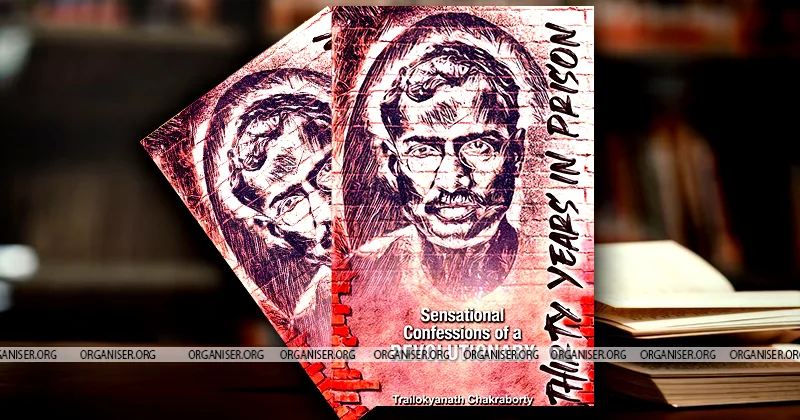
Freedom is not a concession, but it is the intrinsic nature of being and a secret pulse of every human heart. We are born with this truth and the truth we carry with us into death. The story of Hindustan’s freedom is the story of millions who bled for it, whose names we do not know—farmers, workers, teachers, students, sadhus, soldiers, satyagrahis—who offered their youth, their bodies and their breath so that this land stands free. Independence neither descended as a gift of someone’s diplomacy nor was catalysed by polished negotiators at the table of power. In fact, Independence rose from the dust in the hearts of countless men and women who bled in silence and vanished into anonymity leaving behind a free country. The book Thirty Years in Prison: Sensational Confessions of a Revolutionary by Trailokya Nath Chakraborty is that rare category of books that, as a primary source, reveals to us the true circumstances and barbarities of the British Empire back then. The book removes the mask from the British Empire’s ‘civilised’ facade and exposes the raw brutality of its rule. It brings to light an authentic account of the freedom struggle and how it was earned and not a gift as a concession by the British. The book was first written in Bengali and first published in English in 1963.
This book never lets us forget the gap between the history we are taught and the history that was lived. The history of our freedom struggle has included selected texts and contexts. But when we look at the first-hand account of revolutionaries like Trailokya Nath Chakraborty, it opens us to the veil that shrouds the history of the countless struggles.
The history we inherit has been bound around a few names, as if the nation was freed by them alone, whose few years in prison have been amplified into legend. Our generations were taught to imagine an Independence struggle arrived from those prison cells where our leaders wrote memoirs in all comforts. But missing from the script are the other cells where revolutionaries like Trailokya Nath Chakraborty and others were incarcerated in solitude for years, who were denied food concession if they ever wrote even a word, and all they had for writing was the floor or a wall, and brick powder for writing. This book also highlights the sacrifices of the few who stepped into power vis-à-vis the sacrifices of those who had no party, no machinery to amplify their contribution. Our textbooks echo the glory of the few but fail to mention the obscurity of the prisoners who never returned. The Thirty Years in Prison is the book telling the truth of our freedom struggle – the names of those who never returned, buried nameless in distant island jails, who paid the cost of freedom.
Emerges from the pages of the book is the revolutionary author Trailokya Nath Chakraborty-the chronicler of the revolutionary underground movement–a key organiser of the Dacca Anushilan Samiti who spent three full decades behind bars, from the Cellular Jail in the Andamans to Mandalay and other British prisons.
The book introduces us to the brutality of the British prison regime, the Ghani or Kolhu (the oil mill) that broke bodies, the silent cells, the calculated weaponisation of hunger, the endless roll-calls, the beatings, and even the indignity of the tiny latrine holes. It also preserves the jailhouse vocabulary of that world—File, Gile and Dail: File for the prisoners counted again and again through the day, Gile for the stream of abuses hurled by jail officers, and Dail for the thin dal that formed the staple prison food without any change. The book reveals a whole taxonomy of punishments: bar fetters or Dandaberi—heavy iron bars clamped to the legs, sometimes with cross-bars, worn day and night—neck-ring shackles, leg irons and chains, stretches of solitary confinement, the dreaded flogging stand, coarse gunny-sack uniforms that chafed the skin, and ‘diet punishment’ in the form of rotten, watery rice and slop passed off as food.
The author writes with unflinching clarity about other prisoners and he shows deep respect and admiration for the Sikh prisoners from Punjab incarcerated in Cellular Jail. He narrates with clarity their names and descriptions. During confrontations with jail authorities, Sikh prisoners were mercilessly beaten whose hunger strikes often ended in anonymous graves. Others were punished with Dandaberi (horizontal bars) cell confinement. The book discusses with clarity the rare political genius of Neta Subhash Chandra Bose who was extremely respected by the author and the author’s contribution to that movement. It opens us to rare moments of discussion with Netaji, with the author and insights regarding the geopolitical situation then. It answers how national politics pushed Netaji into the international space and then pushed the true hero Netaji into oblivion.
Chakraborty notes that Dr Keshav Baliram Hedgewar, later founder of Rashtriya Swayamsevak Sangh (RSS), had, in his student days at Calcutta National Medical College, been associated with Anushilan Samiti network, explicitly identifying him as part of the revolutionary underground. When Chakraborty meets Hedgewarji in Nagpur in 1940, both re-establish and renew this older bond from their Anushilan years. Chakraborty introduces himself by recalling his former alias, “Kalicharan Da,” the name he had used while absconding.
The author speaks candidly about underground movements involving assassinations, fake currencies, and dacoities and how they were deployed for running Anushilan Samiti successfully. He recalls an unforgettable moment with immaculate precision when he was deeply enamoured with revolutionary Bhagat Singh and the bomb in the Assembly. Bhagat Singh told him that the youth of Punjab were of such bravery and spirit that even if the British were to cut them into pieces, they would not utter a word.
The book shows the author lamenting in pain when communal riots broke out. The book also mentions one Jallianwala Bagh type massacre, which took place in Dacca Jail, where 300 Goonda Security prisoners were detained by police, who were demanding good food and Biri (tobacco leaves) but in return for demanding this, they were kept locked in one single room. When they complained to the white European Superintendent, the Superintendent got infuriated at the audacity of black prisoners and opened fire on unarmed prison inmates they were shot to death. Unfortunately, we don’t find mention of such a carnage in our textbooks.
The book strongly delineates between leaders who seek benefits for proximity to authority and those who don’t. Chakraborty challenges the dominant tendency of Indian nationalist writing, the Congress-centred narrative that treats revolutionaries as footnotes. The book mentions explicitly revolutionaries whose names rarely enter school histories who were incarcerated in Cellular Jail–Yogendra Shukla, Batukeshwar Dutt, Subodh Roy, Bhai Parmanand, Sachindra Nath Sanyal, among others. The book also highlights that revolutionaries were not led by national political platforms but were moving arms, building secret cells, and infiltrating the colonial Army.
If one reads the book alongside the usual autobiographies of freedom struggles, which often mention Congress sessions, discussions in constituent assemblies, negotiations with Viceroys, one finds that this book mirrors freedom that was dug deep out the cells of those island jails. Every page of this book is a reminder that independence was not a gift of a few great and celebrated men. The book places an obligation upon us and asks us to search for buried names and reopen the pages of our freedom struggle.