The Satnami community, predominantly located in the central Indian state of Chhattisgarh, boasts a rich cultural heritage and a pivotal role in India’s fight for independence. Emerging as a distinct religious and social group, the Satnamis have preserved their unique traditions while actively participating in significant social and political movements during the colonial era.
Origins and Religious Beliefs
The Satnami movement was founded in 1657 by a saint named Birbhan in Narnaul, a town in present-day Haryana. Birbhan’s teachings, which drew inspiration from the great saint Ravidas, laid the foundation for the Satnami sect. The term “Satnami” is derived from the Sanskrit words “Sat” (truth) and “Nam” (name), reflecting the community’s devotion to the worship of the formless and nameless God, Satnam.
The Satnamis focus on the chanting and meditation of divine names, particularly those of Rama and Krishna. This spiritual practice is believed to stabilise the mind and consciousness, making one receptive to higher intuitive knowledge of the divine. The sect primarily attracted members from the lower strata of Hindu society, including leather workers, sweepers, carpenters, and goldsmiths, but it rejected caste distinctions entirely, judging individuals solely by their actions.
Traditions and Practices
The Satnami community adheres to a set of spiritual and social practices that distinguish them from other religious groups. Central to their belief system is the worship of Satnam, the eternal truth, and the rejection of idol worship. They maintain a simple lifestyle, emphasising honesty, humility, and service to others. The Satnamis are also known for their distinctive appearance, including their saint-like attire and shaved heads, a practice that earned them the nickname “Mundiyas.” They abstain from intoxicants and animal foods, tenets that continue to be observed by many in the community today.
Rituals and ceremonies within the Satnami community are marked by simplicity and inclusivity. Key festivals include “Mahanadi Utsav,” which celebrates the teachings of their spiritual leader, and “Chhath,” a solar festival observed with reverence to the Sun God, albeit in a form that aligns with their monotheistic beliefs. Community gatherings are integral to the Satnamis, where spiritual discourses and collective prayers reinforce their communal bonds.
The Satnamis also have a rich tradition of cultural expressions, including folk songs, dances, and oral traditions that have been passed down through generations. These cultural practices not only preserve their heritage but also serve as a medium for social cohesion and resistance against external pressures.
Role in the Freedom Struggle
The great Satnami revolt occurred during the reign of Mughal Emperor Aurangzeb, a period marked by his strict Islamic policies, including the reimposition of the Jiziya tax on non-Muslims, the banning of music and art, and the destruction of Hindu temples.
The Satnami community’s contributions to India’s freedom struggle are both significant and enduring. Their resistance against oppression began long before the British colonial era, most notably during the reign of Mughal Emperor Aurangzeb. The Satnamis rose in revolt against Aurangzeb’s oppressive policies, including the reimposition of the Jiziya tax on non-Muslims and the destruction of Hindu temples.
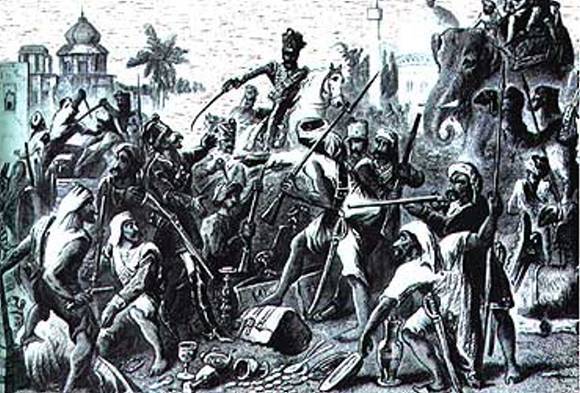
In 1672, the Satnamis, numbering about 5,000, took up arms against the Mughal forces after a Mughal soldier killed one of their own. Despite being poorly armed and resourceless, they managed to defeat Mughal troops and even established their own administration in place of the Mughal rule. Their revolt, which spread to Agra and Ajmer, was a remarkable display of resistance, especially given their lack of weaponry and funds. The rebellion was eventually suppressed by Aurangzeb, who personally led a force of 10,000 troops against them, resulting in the massacre of thousands of Satnamis. The survivors fled in different directions, disorganised and leaderless, for many years.
In the ensuing battle, approximately 2,000 Satnamis were slain on the battlefield, with many more killed in pursuit. The Mughal forces then sought to annihilate the remaining Satnamis, destroying their homes and dispersing the survivors.
Reorganisation and Continued Resistance
In the 18th century, the remnants of the Satnami community were reorganised by a Kshatriya named Jagjivandas from Uttar Pradesh. His efforts, along with those of his disciple Dulandas, revitalised the Satnami sect, demonstrating the unity between various sections of Hindu society, even during times of severe caste discrimination.
The Satnamis continued to resist oppression during the British colonial era. Their involvement in the 1857 Revolt, also known as the First War of Independence, was particularly noteworthy. The Satnamis in Chhattisgarh, along with other marginalised groups, rose in rebellion against the British, utilising their knowledge of local terrain and guerrilla tactics to challenge colonial authority.
In the early 20th century, the Satnamis actively participated in the Non-Cooperation Movement led by Mahatma Gandhi. Their commitment to non-violence and truth resonated with Gandhian principles, and they supported the boycott of British goods and institutions. Guru Balakdas, a prominent Satnami leader, played a crucial role in mobilising the community to support the freedom movement. Under his leadership, the Satnamis not only fought for political freedom but also for social equality and justice.
Post-Independence Contributions
Following India’s independence, the Satnami community continued to play an active role in social and political spheres. They have been at the forefront of the social justice movement, advocating for the rights of Dalits and other marginalised communities. The teachings of Guru Ghasidas, the spiritual leader who inspired the Satnami movement, remain a guiding force for the community, driving their efforts to fight against caste-based discrimination and to promote equality.
Today, the Satnamis are recognised as a Scheduled Caste in India, and they continue to preserve their cultural and religious heritage while striving for social and economic empowerment. Their contributions to India’s freedom struggle, rooted in a quest for both political and social liberation, remain a proud chapter in the narrative of India’s journey to independence.
The history of the Satnami community is one of resilience, spirituality, and social activism. From their origins in the teachings of Guru Ghasidas to their active participation in the fight against British colonial rule, the Satnamis have left an indelible mark on India’s history. Their legacy of resistance, both spiritual and military, continues to inspire future generations in the ongoing struggle for equality and justice.