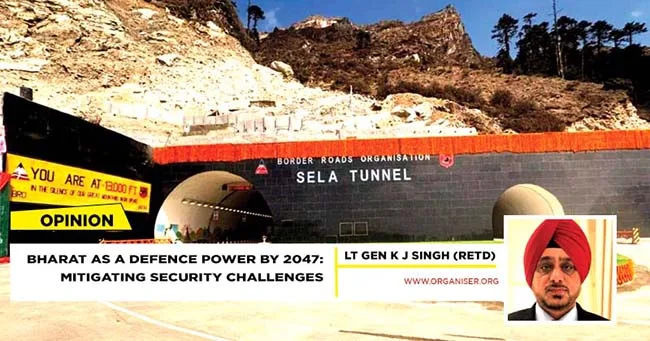
Bharat (India) is in the defining quarter, Amrit Kaal, of its hundred-year journey and will emerge as Viksit Bharat in 2047. It is logical to infer that the Viksit (developed) milestone can only be achieved in the surakshit (secure) template.
Bharat as the most populous nation with huge demographic dividend and fifth largest economy is set on an aspirational trajectory to emerge as part of the top three (USA, China and India) trinity, yet, it faces very complex security challenges. This is very much unlike the virtual honeymoon, enjoyed by China under Deng Xiaoping for decades, in the ‘hide your shine-bide your time’ regime.
Misplaced Priorities
The Chinese benefited from ‘below the horizon’ advantage, due to the flawed plan of the USA, banking on misplaced hope of using the capital economy to usher-in democracy in China. It was aimed at leveraging Dragon against Russia and above all, international failure to decipher Chinese perfidy and deception. This was aided by opacity in China but to give the devil its due, Chinese harnessed the opportunity provided rather well, to emerge as the manufacturing hub, in global supply chains.
As we accelerate for the final push, it will be appropriate to analyse potential opportunities, challenges and preparations in what is also described as SCOT (strength, challenges, opportunities and threat) analysis. Our approach cannot be blind aping of Chinese methodology but has to be a customised strategy, factoring our unique challenges. More importantly, balancing the gun versus butter dilemma as development in noisy and competitive democracy remains key, overriding objective.
Challenges Facing Bharat
Bharat’s journey has been marked by multi-pronged challenges like external aggression, unleashed by two of our adversaries, China and Pakistan. Pakistan triggered the 1947-48 war in Kashmir, followed by the 1965 aggression. Then there was the Liberation war in 1971 and the limited war in Kargil in 1999. Kutch operations in April-May, as precursor to the monsoon war in Sept 1965 and Operation Meghdoot in Siachen (1984-2003) are classified as conflicts. Face-offs like ex-Brass-Tacks, coupled with Operation Trident (1986-87), Operation Parakram in 2001 and more recently the aerial combat and ground strikes, in the aftermath of Balakot strike (2019); all these had the potential to become full blown conflicts.
Pak Continues Proxy War
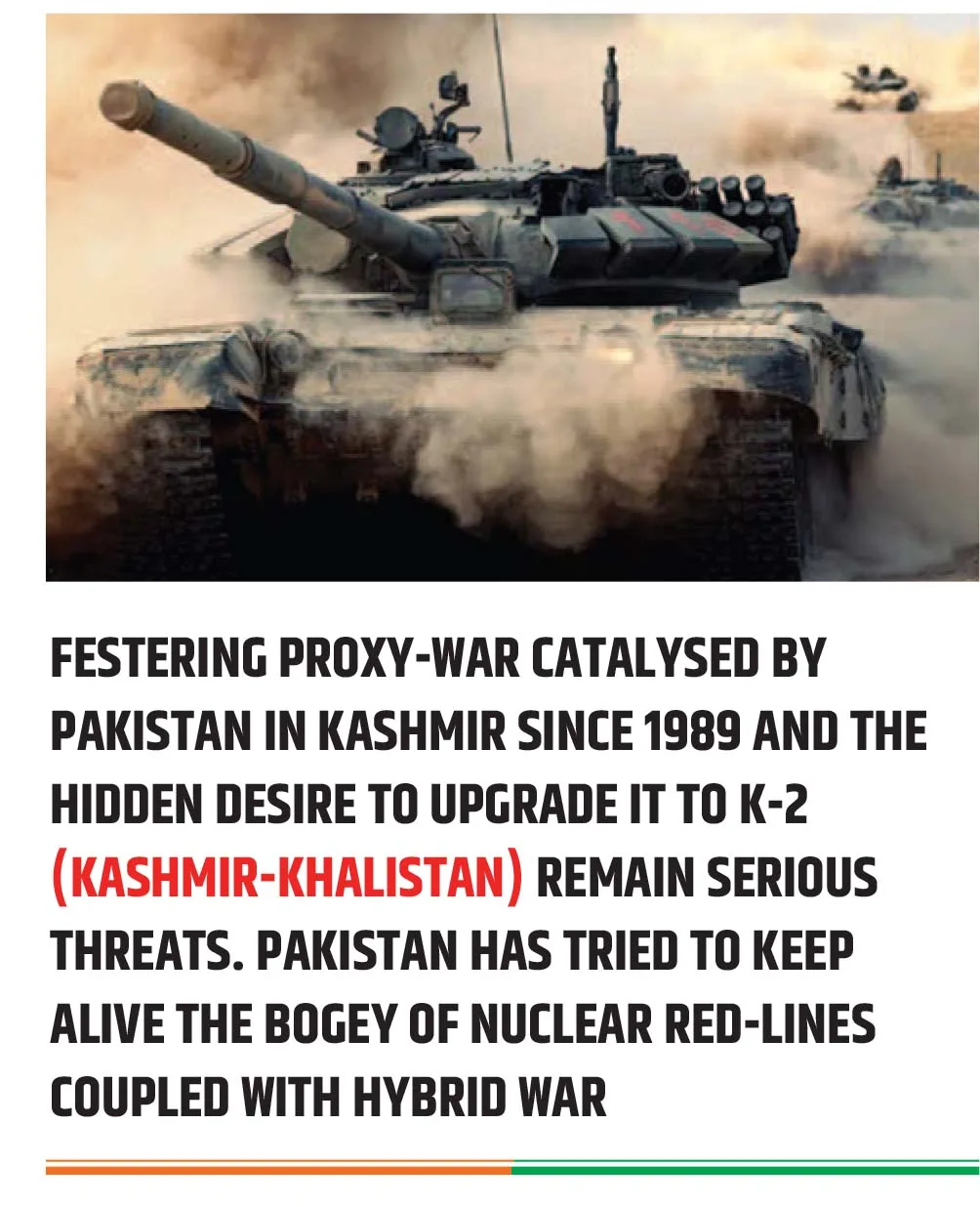
Pakistan’s raison d’etre for existence has been an anti-Indian stance propelled by political misuse of Islamist narrative. The Pak Army and deep state of milt establishment has always been driven by parity fixation and desire to outsmart India by using mostly unfair means. The festering proxy-war catalysed by Pakistan in Kashmir since 1989 and the hidden desire to upgrade it to K-2 (Kashmir Khalistan) remain serious threats. Pakistan has tried to keep alive the bogey of nuclear red-lines coupled with hybrid war to deny space for conventional response. It is to Bharat’s credit that on two occasions, during Kargil conflict and Balakot strikes, it has crafted space for non nuclear responses.
China’s Backstabbing Conflicts
China after signing Panchsheel and endorsing Hindi Chini Bhai-Bhai (Sino Indian brotherhood) bared her fangs in 1962 with war on unsuspecting India. Since then, bloody clash at Nathu-La in 1967, face off in Somdorong Chu (1986-87), Dolam (Chinese call it Doklam) in 2017, Galwan clash in 2020 and the current unresolved face-off in Ladakh have tested our security forces. This has led to enhanced deployment imposing severe financial and human resource costs. China has desired to keep India embroiled in local disputes and marginalise us to deny us our rightful place, even in our immediate extended neighbourhood. China seeks to retain unchallenged unipolar hegemony in Asia and at the same time remain as a challenger to the US, in her long term desire to become the global super-power and hegemony. Hence, for China, terms like Indo-Pacific, 21st century being India’s century are non acceptable and major irritants.
Meddling in Internal Faultlines
The seeds of Chinese and Pak complicity and collusive threat were sown in 1963, when Pakistan gifted away strategic territory of Shaksgam Valley to China, without exercising de-facto or de-jure control. There has been constant meddling in our internal faultlines like North East, Khalistan, Left wing extremism and narco-trafficking, which are extensively documented by international experts. Since then, Pakistan has degenerated into subservient, client state dependency on China. This is now being evidenced in the China-Pakistan Economic Corridor (CPEC), dubbed by American expert, Christine Fair as Colonising Pakistan to Engage China. In a collusive mode, it is ‘push-pull’ construct. China seeks to pull-up and bolster Pakistan, in multilateral fora like UNO, Shanghai Cooperation Organisation and even Nuclear Suppliers Group (NSG). The Chinese diabolic plot is to drum-up contrived parity for Pakistan. China also attempts to push-down or marginalise India in extended neighbourhood and international fora like lobbying against India getting Security Council membership and an NSG entry. In sum, China is likely to be the primary adversary, Pakistan a permanent irritant and both are likely to collude.
An unstable extended neighbourhood can create spill-over effects as was seen during the massive refugee influx from East Pakistan in 1971. Similarly, Tamil unrest in Sri Lanka resulted in India getting embroiled in a peace-keeping mission and Operation Pawan in 1985. Indian forces also intervened in Maldives in 1988 to thwart the coup. Later, Operation Khukri was launched in Sierra Leone in 2000 to bail out Indian peace-keepers. India has traditionally followed a paradigm of non alignment, now nuanced and refined as plurilateralism. In this format, our objective is to safeguard our strategic autonomy and play the role of balancer. In regional context, India has aspired to be a net provider of security, disaster relief and maritime security. This somewhat reticent approach is changing with growing expectations due to the rise in India’s power potential. India has emerged as the voice of Global South and is being invited to fora like G-7 and QUAD. Notwithstanding these developments, it will be fair to assume that alliances don’t provide fool-proof insurance for national security. The harsh truth is that nobody is likely to undertake heavy lifting and deploy ‘boots on ground’. Even in context of QUAD, we would have to remain cognisant of ‘wheels within wheels’ formulations like I-5, AUKUS and growing US security network with Japan and South Korea.
Aatmanirbhar Mission
India has also realised the criticality of reducing external dependencies by embarking on Aatmanirbhar (self-reliance) mission. While we continue to be the largest import yet, concurrently we are also emerging as a significant exporter of armaments and munitions as also diversifying our imports. There has been appreciable growth of 32.5 per cent over the last fiscal year with exports touching record Rs 21,083 crores (US $2.63 bn). It is hoped that with path breaking initiatives like promoting private manufacturing, corporatisation of Ordnance Factories, revamping Defence Research and Development Organisation (DRDO), coupled with positive lists to promote indigenisation, we would become self-sufficient with minimal dependencies. It is also presumed that we will transit to smart Aatmanirbharta, wherein as lead integrators, we will be able to develop and co-produce niche and disruptive technologies giving us technological asymmetry over our potential adversaries. Focused and determined India would have developed infrastructure in our borders along with vibrant villages to counter Chinese Xiaokangs.